The group and its six parts · chapter 1 of 16 · 7 minutes
1 What TSG RAN is, and why the radio gets a group of its own
The plenary and its six working groups, how much of 3GPP's paper they carry, and why the radio side could not be folded into the rest.
1.1 The problem that made a separate group necessary
A phone bought in one country has to work on a network in another, built by a different vendor, using a transmitter it has never seen. That only happens if both sides already agree — to the microsecond and to the decibel — on what goes out over the air.
Agreeing on that is a different kind of work from agreeing on what a core network does. It is measurable, it is contested by test equipment, and a mistake in it is a mistake in physics rather than in logic.
3GPP gives that work its own technical specification group: TSG RAN, the radio access network group. It is a plenary that decides plus six working groups that draft, and the plenary owns documents in its own right rather than only chairing RAN.
1.2 The six groups, in one line each
The working groups are RAN1, RAN2, RAN3, RAN4, RAN5 and RAN6. Five of them still meet; the group catalogue marks RAN6 as closed RAN6.
| Group | What it draws up |
|---|---|
| RAN1 | Layer 1 — what is actually sent over the air |
| RAN2 | Layer 2 and 3 — the protocols on top of it |
| RAN3 | The interfaces between the boxes |
| RAN4 | Radio performance — the measurable numbers |
| RAN5 | Device conformance testing |
| RAN6 | The old GSM radio work, closed |
Each of those has one folder of its own on the 3GPP file server; RAN1's, for instance, is the one linked from its entry in this course's register RAN1. Who does exactly what, and where the boundaries between them run, is The six working groups, and where the line between them runs.
1.3 How much paper this is
The specification catalogue on this machine counts 1059 active documents whose owner is RAN or one of its working groups [1].
The same catalogue counts 3599 active 3GPP documents altogether [2] — so 1059 of those 3599 are RAN's.
The meeting-document database is more lopsided still. It holds 811563 RAN meeting documents [3] against 1629581 for all of 3GPP [4].
And 3230 separate pieces of work were opened by a document the RAN plenary approved [5].
1.4 The plenary is a document owner, not only a chairman
It is easy to picture the plenary as a committee that approves other people's work and owns nothing. That is wrong here: 198 of the 1059 active RAN documents belong to the plenary itself [6].
Two kinds of thing end up there. The first is history. When RAN6 closed, the renumbered GSM documents did not close with it — 179 active documents from the 3G and GSM series sit with the plenary [7], among them TS 44.018 and TS 45.005.
The second is the future. The forward-looking study reports sit with the plenary too, including TR 38.913 on the requirements that became 5G and TR 38.914 on 6G.
That is the plenary's real shape: it holds what no single working group is drafting today, either because the drafting is over or because it has not started.
1.5 The document this course teaches from
RAN2 owns TS 38.300, the overall description of the 5G radio network, and it is the document five chapters of this course are built on.
Its own scope says what it is for: an overview of the NG-RAN — the radio network as a whole — with the detail left elsewhere §1.
That single sentence explains why the group is split the way it is. TS 38.300 draws the picture; the companion documents that carry the detail are drafted by different groups, each owning the part it is expert in.
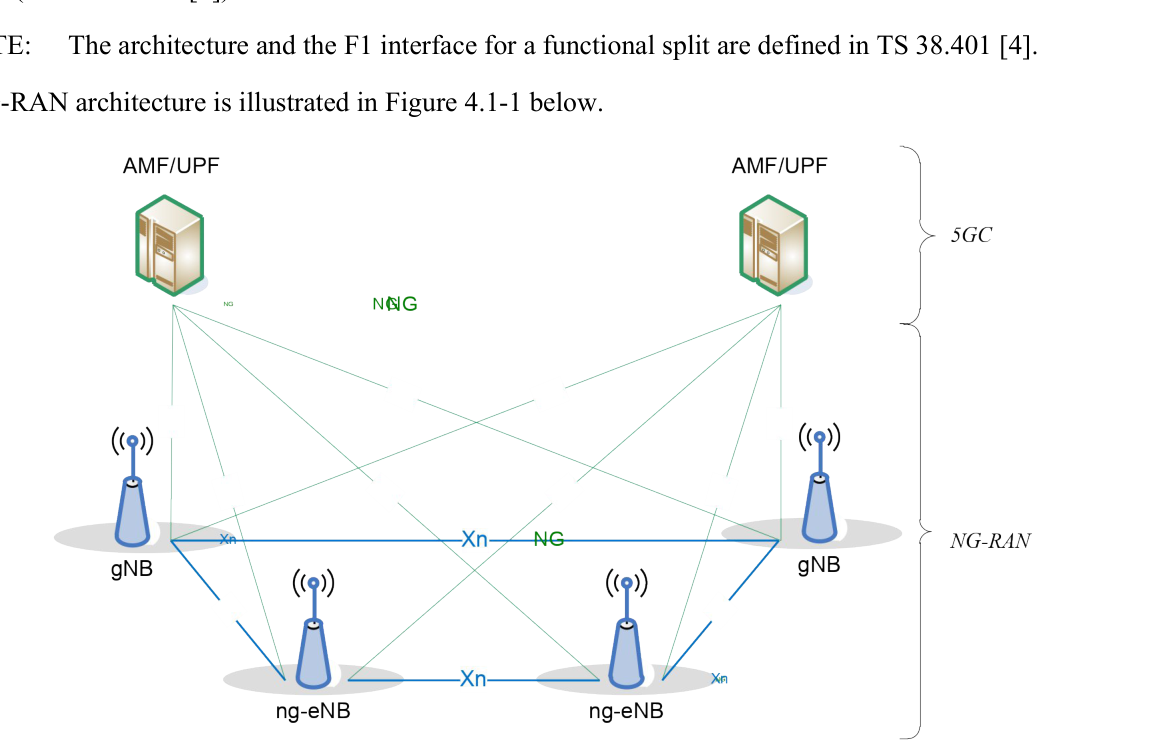
The architecture clause names the two kinds of box the whole thing is built from §4.1. An NG-RAN node is either a gNB, which terminates NR — the 5G radio — towards the device, or an ng-eNB, which terminates E-UTRA, the 4G radio, towards the device but connects to the 5G core.
They are joined to each other by the Xn interface and to the core network by the NG interface §4.1. What travels on each is Where the radio network meets the core.
1.6 Why the split of work looks the way it does
The functional split clause lists what a gNB or ng-eNB has to host §4.2. It is a long list, and reading it as one list is the fastest way to see why six groups exist rather than one.
Some of it is pure radio arithmetic: dynamic allocation of resources to devices in uplink, downlink and sidelink — that is scheduling, and it is RAN1's world at layer 1.
Some of it is protocol bookkeeping: header compression, encryption and integrity protection of data, connection setup and release, support of devices in the inactive state. That is RAN2.
Some of it is plumbing between boxes: routing user plane data towards the user plane function, routing control plane information towards the mobility function, radio access network sharing. That is RAN3.
None of it is a transmit power mask or a receiver sensitivity figure, because those are not behaviour at all — they are numbers a laboratory measures. That is RAN4, and the tests that check them are RAN5.
1.7 What this course cannot tell you about the group
The register behind this course carries a company or a role for every document — "RAN Chair (Samsung)", "ETSI MCC", "Nokia" — and never a person's name. This course therefore never names a chair, a rapporteur or a delegate, and it will not tell you who currently chairs any RAN group.
That is a question with an answer, just not here. Each group's chair history is a page of its own on 3gpp.org, addressed by the group's code [8].
The full list of what the data cannot answer — decisions and their reasons, release dates, membership, votes — is What the record does not tell you, and it is worth reading before you rely on anything in the middle of this course.
1.8 Where this meets the rest of the course
The division of labour sketched above is the spine of the whole course and is taken apart properly in The six working groups, and where the line between them runs. How big each group actually is, in documents, in paper and in people, is What the numbers say about the size and shape of each group.
The five chapters that follow those work through TS 38.300 itself, starting with What NR is — the shape of the 5G radio network.
Where the numbers in this chapter come from
- 1059 active RAN specifications rows in the pygppe specification catalogue /var/www/whatthespec.net/data/database/api/spec_catalog.sqlite where wg is one of RP, R1, R2, R3, R4, R5, R6 and active='yes', read 2026-08-04
- 3599 active 3GPP specifications in total rows in the pygppe specification catalogue /var/www/whatthespec.net/data/database/api/spec_catalog.sqlite where active='yes', read 2026-08-04
- 811563 RAN meeting documents in the local database rows in the pygppe meeting-document table /var/www/whatthespec.net/data/database/api/api.sqlite whose document number starts with one of RP-, R1-, R2-, R3-, R4-, R5-, R6-, read 2026-08-04
- 1629581 meeting documents of all of 3GPP in the local database rows in the pygppe meeting-document table /var/www/whatthespec.net/data/database/api/api.sqlite, read 2026-08-04
- 3230 work items were opened by a RAN plenary document folders under /var/www/whatthespec.net/data/data/wis whose metadata.json has a tdoc_code starting 'RP-', of 9406 work items in all, read 2026-08-04
- 198 active RAN plenary specifications rows in the pygppe specification catalogue /var/www/whatthespec.net/data/database/api/spec_catalog.sqlite where wg='RP' and active='yes', read 2026-08-04
- 179 active documents the RAN plenary holds from the 3G and GSM series rows in the pygppe specification catalogue /var/www/whatthespec.net/data/database/api/spec_catalog.sqlite where wg='RP', active='yes' and the number starts with one of 25, 43, 44, 45, 48, 49, 50, 52, read 2026-08-04
- address of one group's chair history read from /var/www/whatthespec.net/pygppe/libs/pygpp/pygpp_elections.py, 2026-08-04
Check yourself
Answers appear when you pick one, with where they come from.
Q1.1 How many working groups does TSG RAN have, and how many of them still meet?
RAN1 to RAN6 are six. The group catalogue marks RAN6 as closed and the other five as still meeting. RAN6
Q1.2 How many of the 3599 active 3GPP documents does RAN own?
1059 active RAN documents against 3599 active 3GPP documents in the same catalogue, both counted on the same day. 198 of the 1059 are the plenary's own; 3230 is the count of pieces of work RAN has opened. 1059 active RAN specifications
Q1.3 What is an NG-RAN node, according to TS 38.300?
The first line of the architecture clause gives exactly two kinds — a gNB, which terminates NR towards the device, and an ng-eNB, which terminates E-UTRA towards it. §4.1
Q1.4 Does the RAN plenary own documents itself, or only chair the working groups?
The catalogue records 198 active documents whose owning group is the plenary, including the old GSM numbers and the forward-looking studies. 198 active RAN plenary specifications
Q1.5 Where does TS 38.300 say the detail of the radio interface protocols lives?
The scope says the document is an overview and that the details are specified in companion specifications of the 38 series. §1
This chapter was written against TS 38.300 version 19.3.0, and built from a source register generated 2026-08-04. A newer version of the document may say something else.