How the work gets done · chapter 14 of 16 · 7 minutes
14 Conformance testing, and why a separate group writes the exam
What RAN5 owns, how the test documents pair with the requirement documents, why base station testing sits elsewhere, and what a device has to declare before it can be tested at all.
14.1 Why the exam is a separate document
A requirement and a test for that requirement are two different pieces of writing. "The transmitter shall not exceed X dBm" is one sentence. Proving it takes a defined signal, a defined measurement bandwidth, a defined tolerance, a defined ambient temperature and a defined pass criterion.
If both lived in one document, every clarification of the test would be a change to the requirement, and every product's certification would be tied to a document the requirement's authors keep editing.
So 3GPP separates them, and in RAN it separates the groups as well. RAN4 writes the requirement; RAN5 writes the test that proves it.
14.2 What RAN5 owns
RAN5 is mobile terminal conformance testing, with 84 active documents [1].
Its shape is unlike the other RAN groups. 72 of those 84 are specifications and only 12 are study reports [2] [3].
Everywhere else in RAN the balance runs the other way — RAN4 has 352 study reports against 75 specifications [4] — because a test case is a rule or it is nothing.
Four documents carry most of the work:
-
TS 38.508-1 — the common test environment: the settings, the reference configurations and the definitions every other test document builds on.
-
TS 38.521-1 — radio transmission and reception tests.
-
TS 38.523-1 — protocol tests.
-
TS 38.533 — radio resource management tests.
14.3 The pairs
Each of those has a requirement document behind it, and the pairing is the fastest way to understand the group's agenda.
| Test document | Owner | Requirement it proves | Owner |
|---|---|---|---|
| TS 38.521-1 | RAN5 | TS 38.101-1 | RAN4 |
| TS 38.533 | RAN5 | TS 38.133 | RAN4 |
| TS 38.523-1 | RAN5 | TS 38.331 | RAN2 |
Two of the three requirement documents are RAN4's and one is RAN2's, and RAN5 tests all three. It is worth noticing that all four groups sit in the same building in the same week — the record shows the co-location and does not say why it was arranged that way.
14.4 The exam changes almost as often as the rule
The change counts make the coupling visible. TS 38.133 has 18987 documents changing it [5] and TS 38.533, the test for it, has 6735 [6].
TS 38.331 has 11787 [7] and TS 38.523-1 has 8655 [8].
TS 38.521-1 has 5564 [9] and even the common test settings document TS 38.508-1 has 5520 [10].
Five of the ten most-changed RAN documents are RAN5's, counting the 4G test document 36.521-1 — the full ranking is The documents that attract the most change, and what that says.
14.5 Base stations are tested by somebody else
RAN5's name says mobile terminal, and it means it. Base station conformance testing is RAN4's: TS 38.141-1 for tests conducted over a cable and TS 38.141-2 for tests radiated through the air. Satellite access node conformance testing, TS 38.181, is RAN4's too.
So the same group that writes what a base station's radio must do TS 38.104 also writes the tests for it, while the device side is split between two groups.
R4-2605235 is one of those base station test changes in the flesh: a change request from Nokia, agreed at RAN4#119, adding band n115 to TS 38.141-1.
14.6 What a device has to declare first
A test regime only works if the device says what it claims to do. TS 38.300's capability clause sets out how §14.
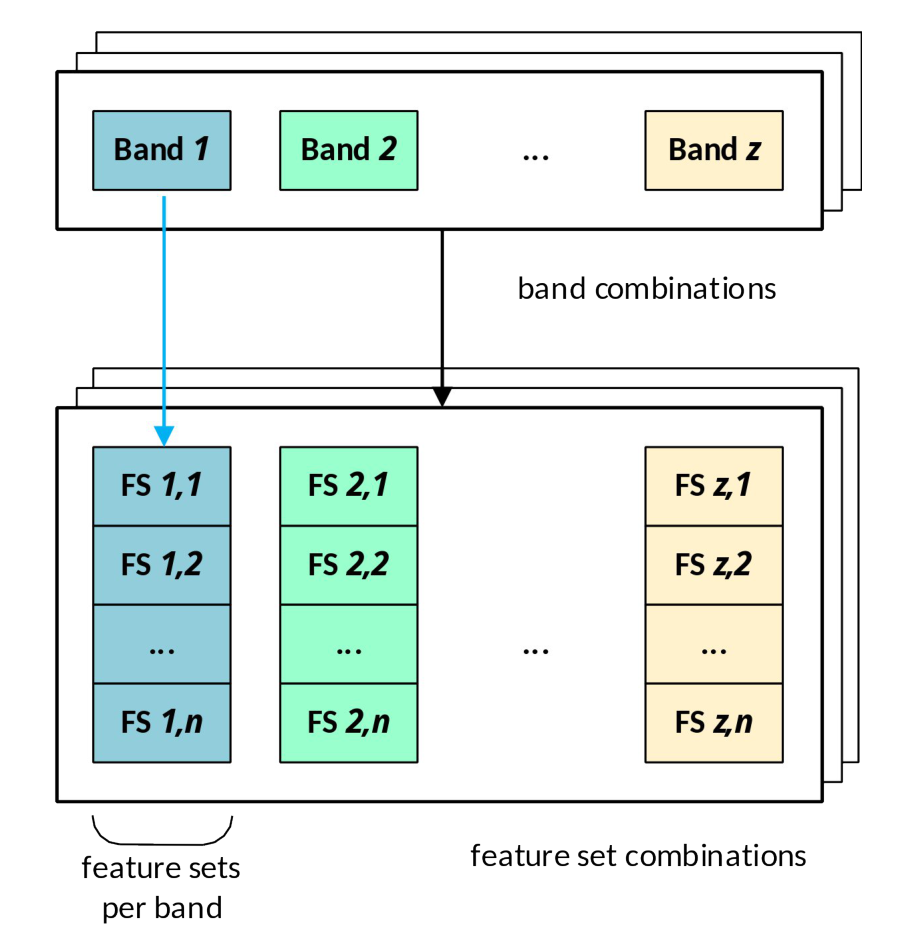
Capabilities are hierarchical: per device, per duplex mode, per frequency range, per band, per band combination §14. Some parameters are always per-device — the ones for SDAP, PDCP and RLC — and others, such as the MAC and physical layer parameters, are not.
For each block of contiguous serving cells in a band, the supported features are a feature set. A device may declare several alternatives for a band.
The matrix of feature sets across every band of a band combination is a feature set combination, and each band combination is linked to exactly one of those §14.
The clause also kills a habit carried over from earlier generations:
The peak rate is instead the sum of the peak rates of the individual carriers, each computed from the capabilities declared for that carrier in that band combination §14.
Because a full declaration would be enormous, the base station can ask for a restricted set of bands, and the device may skip some of the requested combinations under defined fallback rules §14.
A device may also present an identifier that stands for a pre-provisioned set of capabilities instead of the capabilities themselves §7.5.
The document that defines what may be declared is TS 38.306, which is RAN2's — a third group in the chain between a claim and a test.
14.7 Where the measurement requirements come from
One more crossing is worth knowing about. TS 38.300's measurement model says what the device measures and how it is filtered, and then says the performance those measurements have to meet is specified in TS 38.133 §9.2.4.
So the chain for a single mobility measurement runs: RAN2 defines the reporting, RAN4 defines how fast and how accurately, RAN5 writes the test. Three groups, one number in a report.
14.8 RAN5's own calendar
RAN5 meets in the same week as the other four groups — 9 February 2026 3GPPRAN5#110 and 18 May 2026 3GPPRAN5#111 — and does not take the extra week in April that RAN1, RAN2, RAN3 and RAN4 take. The full pattern is The meeting rhythm — plenary, working-group week and bis.
Its meetings are not small. RAN5#111 carried 1660 documents with 274 people in the room 3GPPRAN5#111, and the group has 99770 meeting documents in the local database altogether [11].
It writes its own minutes: R5-261705 is RAN5's record of its previous meeting, filed by the secretariat at the next one.
And work can be opened for it directly. RP-260923, approved at RAN#112, is a work item description whose entire subject is conformance for a gateway device function.
14.9 Where this meets the rest of the course
The requirement documents that RAN5 tests are described in The six working groups, and where the line between them runs, and the numbering that keeps them apart is The specification families, and what a number tells you.
Why the test documents sit so high in the change ranking is The documents that attract the most change, and what that says.
Where the numbers in this chapter come from
- 84 active RAN5 specifications rows in the pygppe specification catalogue /var/www/whatthespec.net/data/database/api/spec_catalog.sqlite where wg='R5' and active='yes', read 2026-08-04
- 72 active RAN5 specifications (TS) rows in the pygppe specification catalogue /var/www/whatthespec.net/data/database/api/spec_catalog.sqlite where wg='R5', active='yes' and type='TS', read 2026-08-04
- 12 active RAN5 study reports (TR) rows in the pygppe specification catalogue /var/www/whatthespec.net/data/database/api/spec_catalog.sqlite where wg='R5', active='yes' and type='TR', read 2026-08-04
- 352 active RAN4 study reports (TR) rows in the pygppe specification catalogue /var/www/whatthespec.net/data/database/api/spec_catalog.sqlite where wg='R4', active='yes' and type='TR', read 2026-08-04
- 18987 RAN documents change 38.133 rows in the pygppe meeting-document table /var/www/whatthespec.net/data/database/api/api.sqlite with a RAN document number, grouped on the crspec column after trimming spaces, read 2026-08-04
- 6735 RAN documents change 38.533 rows in the pygppe meeting-document table /var/www/whatthespec.net/data/database/api/api.sqlite with a RAN document number, grouped on the crspec column after trimming spaces, read 2026-08-04
- 11787 RAN documents change 38.331 rows in the pygppe meeting-document table /var/www/whatthespec.net/data/database/api/api.sqlite with a RAN document number, grouped on the crspec column after trimming spaces, read 2026-08-04
- 8655 RAN documents change 38.523-1 rows in the pygppe meeting-document table /var/www/whatthespec.net/data/database/api/api.sqlite with a RAN document number, grouped on the crspec column after trimming spaces, read 2026-08-04
- 5564 RAN documents change 38.521-1 rows in the pygppe meeting-document table /var/www/whatthespec.net/data/database/api/api.sqlite with a RAN document number, grouped on the crspec column after trimming spaces, read 2026-08-04
- 5520 RAN documents change 38.508-1 rows in the pygppe meeting-document table /var/www/whatthespec.net/data/database/api/api.sqlite with a RAN document number, grouped on the crspec column after trimming spaces, read 2026-08-04
- 99770 RAN5 meeting documents in the local database rows in the pygppe meeting-document table /var/www/whatthespec.net/data/database/api/api.sqlite whose document number starts 'R5-', read 2026-08-04
Check yourself
Answers appear when you pick one, with where they come from.
Q14.1 Which group writes the test cases a phone has to pass?
RAN5 is mobile terminal conformance testing, with 84 active documents, of which 72 are specifications. RAN5
Q14.2 Which document tests what 38.133 requires?
38.533 is the radio resource management conformance specification and pairs with 38.133, the radio resource management requirements. 38.523-1 tests protocol, 38.508-1 holds the common settings. TS 38.533
Q14.3 Who owns base station conformance testing?
38.141-1 and 38.141-2, the conducted and radiated base station conformance tests, are RAN4's. RAN5's name is mobile terminal conformance testing, and mobile terminal is meant literally. TS 38.141-1
Q14.4 How are a device's radio capabilities structured?
The capabilities clause gives exactly that hierarchy, and says explicitly that NR does not rely on categories. §14
Q14.5 Are NR device categories signalled to the network?
The clause says categories associated with fixed peak data rates are defined for marketing purposes and not signalled; the peak rate is computed from the capabilities of each carrier instead. §14
This chapter was written against TS 38.300 version 19.3.0, and built from a source register generated 2026-08-04. A newer version of the document may say something else.