3GPP 38.300 v19.3.0 — the document's own text
4.1 Overall Architecture
Taught in 1. What TSG RAN is, and why the radio gets a group of its own (TSG RAN — the group that specifies the radio, in depth), 4. What NR is — the shape of the 5G radio network (TSG RAN — the group that specifies the radio, in depth), 1. What TSG RAN is, and why the radio gets a group of its own (TSG RAN — the group that specifies the radio, overview), 4. What NR actually is, in the shape its own document gives it (TSG RAN — the group that specifies the radio, overview), 3. What NR is, read off the document itself (TSG RAN — the group that specifies the radio, quick start).
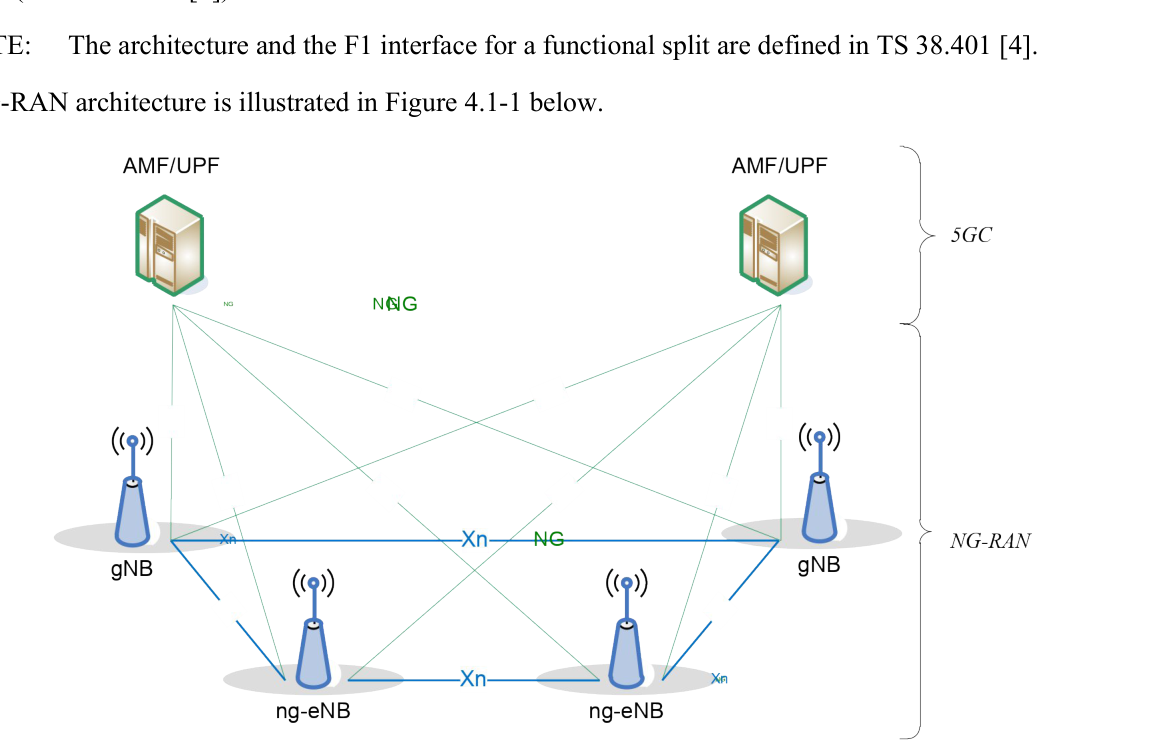
An NG-RAN node is either:
- a gNB, providing NR user plane and control plane protocol terminations towards the UE; or
- an ng-eNB, providing E-UTRA user plane and control plane protocol terminations towards the UE.
The gNBs and ng-eNBs are interconnected with each other by means of the Xn interface. The gNBs and ng-eNBs are also connected by means of the NG interfaces to the 5GC, more specifically to the AMF (Access and Mobility Management Function) by means of the NG-C interface and to the UPF (User Plane Function) by means of the NG-U interface (see TS 23.501 [3]).
NOTE: The architecture and the F1 interface for a functional split are defined in TS 38.401 [4].
The NG-RAN architecture is illustrated in Figure 4.1-1 below.