The group and its six parts · chapter 2 of 16 · 7 minutes
2 The six working groups, and where the line between them runs
Who writes the physical layer, who writes the protocols, who writes the interfaces, who writes the radio numbers, who writes the tests, and what became of RAN6.
2.1 Why the line is drawn where it is
Six groups is not an accident of history. It is a cut along the seams of the radio stack, and the seams are the places where one kind of expert stops being useful and another starts.
TS 38.300 draws the same seams without meaning to. Its control plane picture §4.4.2 stacks RRC over PDCP over RLC over MAC over the physical layer, and each of those layers has one owner.
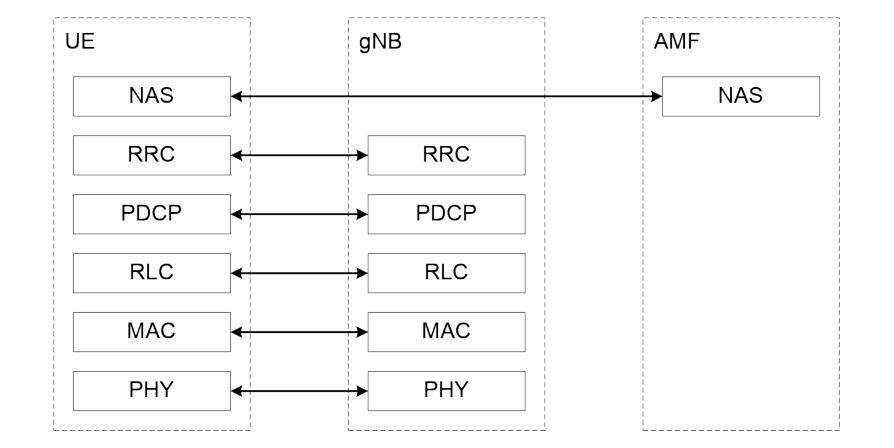
Read the stack from the bottom and you have read the working groups from RAN1 upwards. Read the document numbers on the right of that stack and you have the same list again.
2.2 RAN1 — what is actually sent
RAN1 owns layer 1: the physical radio. What is transmitted, in which shape, at which moment, with which coding. It has 66 active documents [1].
Four of them describe the 5G air interface and are the ones anybody working at this level lives in: TS 38.211 for channels and modulation, TS 38.212 for channel coding, TS 38.213 for control procedures and TS 38.214 for data procedures.
TS 38.300 gives the layer one clause of summary and then hands over.
The waveform clause says the downlink is ordinary OFDM with a cyclic prefix and the uplink is the same with an optional transform that spreads the signal §5.1 — OFDM being the scheme that splits a wide channel into many narrow sub-carriers.
The same clause is where the numerology lives: sub-carrier spacing scales as 2^µ × 15 kHz, twelve consecutive sub-carriers make a physical resource block, and up to 275 of those fit on one carrier §5.1.
What the physical layer offers upwards is a small, fixed list of transport channels §5.5: the broadcast channel, the downlink shared channel and the paging channel going down; the uplink shared channel and the random access channel coming up.
2.3 RAN2 — the protocols on top
RAN2 owns layer 2 and layer 3: what the phone and the base station say to each other once the radio works. It has 62 active documents [2].
Its central document is TS 38.331, which defines every message of the radio connection, field by field. Under it sit the three layer-2 protocols: TS 38.321 for medium access control, TS 38.322 for radio link control and TS 38.323 for packet data convergence.
RAN2 also owns the document you are reading clauses from — TS 38.300, the overall description — and TS 36.331, the same radio connection protocol for 4G.
That last pairing matters when you are tracking a change. A feature that has to work on both radios often lands as two change requests, one against 38.331 and one against 36.331, in the same group in the same week.
The layer-2 overview clause states the stack as a chain of services §6.1: the physical layer offers transport channels to MAC, MAC offers logical channels to RLC, RLC offers RLC channels to PDCP, PDCP offers radio bearers to SDAP, and SDAP offers QoS flows to the core network.
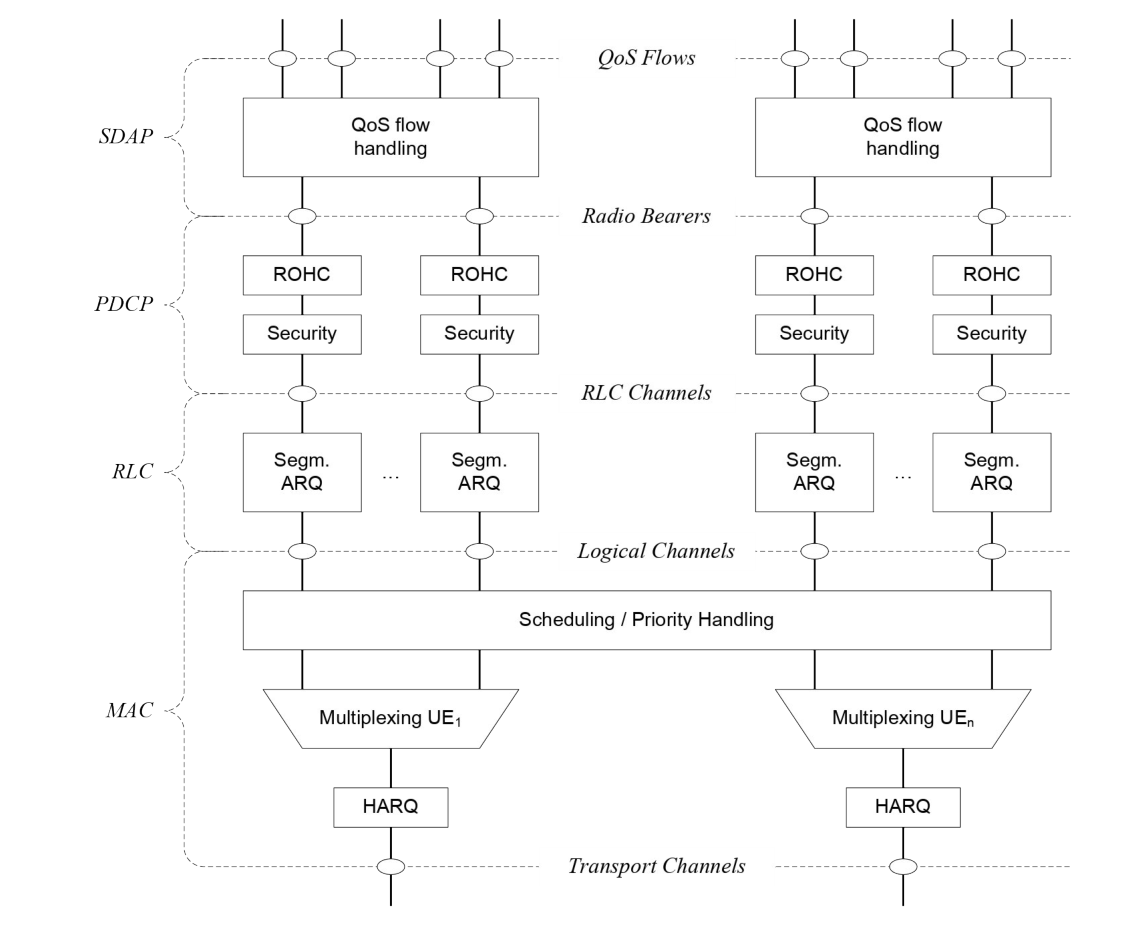
Layer 3 is RRC, and its service list §7.1 reads like a job description for the group: broadcast of system information, paging, establishment and release of the connection, security key management, mobility including handover, and carrying the core network's own messages through as sealed containers.
2.4 RAN3 — the wires between the boxes
RAN3 owns the interfaces: how one base station talks to another and to the core network. It has 168 active documents [3] — more than RAN1 and RAN2 together.
Four of them carry most of the weight. TS 38.401 is the architecture description, the document that says how a base station may be split into a central part and a distributed part.
Then three protocols: TS 38.413 towards the core, TS 38.423 between base stations, and TS 38.473 inside a split base station.
TS 38.300 names the same interfaces without specifying them. The NG control plane runs NGAP over SCTP over IP and provides interface management, device context management, mobility, transport of core-network messages, paging, session management, configuration transfer and warning messages §4.3.1.2.
The Xn control plane runs XnAP over the same transport and does three things: interface management, device mobility including context transfer and paging, and dual connectivity §4.3.2.2.
2.5 RAN4 — the numbers a laboratory can measure
RAN4 owns radio performance: transmit power, receiver sensitivity, how fast a phone must find a neighbouring cell. It has 427 active documents — more than any other group in RAN [4].
Three of them are the ones cited in arguments: TS 38.101-1, what a phone's radio must do; TS 38.104, what a base station's radio must do; and TS 38.133, the radio resource management requirements — how quickly and how accurately a device has to measure and report.
RAN4's work has no clause of its own in TS 38.300, and that absence is telling. The overall description says what has to happen; RAN4 says how well. The two never share a sentence.
2.6 RAN5 — the exam board
RAN5 owns mobile terminal conformance testing: the test cases a device has to pass. It has 84 active documents [5].
Four of them are the working set: TS 38.508-1 for the common test settings, TS 38.521-1 for the radio transmission tests, TS 38.523-1 for the protocol tests and TS 38.533 for the radio management tests.
Notice the pairing. 38.521-1 tests what 38.101-1 requires. 38.533 tests what 38.133 requires. 38.523-1 tests what 38.331 requires. The exam paper is written by a different group from the syllabus, on purpose, and why that is so is Conformance testing, and why a separate group writes the exam.
2.7 RAN6 — the group that finished
RAN6 held the GERAN radio work — the old GSM radio. It is the only RAN group the catalogue marks as closed. It still has 54 active documents against its name [6], and it last met on 26 October 2020, for a single day, by telephone 3GPPRAN6#18-Decision Teleconference.
The documents it holds are the ones nobody is changing. The GSM documents that are still touched moved to the plenary: 179 active documents from the 3G and GSM series are the plenary's [7], including TS 44.018 and TS 45.005.
RAN6 owns none of the 38 series at all [8], which is the cleanest one-number statement of what closed means: no share of the current radio.
2.8 Reading a document number back to a group
Because each group owns whole document families, the number usually tells you who wrote it — but only usually, and never on its own. 38.2xx is RAN1's territory, 38.3xx RAN2's, 38.4xx RAN3's, 38.1xx RAN4's and 38.5xx RAN5's, and the exceptions are real.
The specification families, and what a number tells you does this properly, with the counts that show where the rule breaks.
The safe move is always the same: open the specification's own information page on 3gpp.org, which is addressed by the number with its dots removed [10], and read the owning group off it.
2.9 Where this meets the rest of the course
How big each of these groups is — in documents, in meeting paper and in people in the room — is What the numbers say about the size and shape of each group. What each group does at a meeting, and how the six of them are sequenced across a quarter, is The meeting rhythm — plenary, working-group week and bis.
The stack sketched here is taken apart layer by layer in The radio protocol stack, sublayer by sublayer, and the interfaces RAN3 owns are Where the radio network meets the core.
Where the numbers in this chapter come from
- 66 active RAN1 specifications rows in the pygppe specification catalogue /var/www/whatthespec.net/data/database/api/spec_catalog.sqlite where wg='R1' and active='yes', read 2026-08-04
- 62 active RAN2 specifications rows in the pygppe specification catalogue /var/www/whatthespec.net/data/database/api/spec_catalog.sqlite where wg='R2' and active='yes', read 2026-08-04
- 168 active RAN3 specifications rows in the pygppe specification catalogue /var/www/whatthespec.net/data/database/api/spec_catalog.sqlite where wg='R3' and active='yes', read 2026-08-04
- 427 active RAN4 specifications rows in the pygppe specification catalogue /var/www/whatthespec.net/data/database/api/spec_catalog.sqlite where wg='R4' and active='yes', read 2026-08-04
- 84 active RAN5 specifications rows in the pygppe specification catalogue /var/www/whatthespec.net/data/database/api/spec_catalog.sqlite where wg='R5' and active='yes', read 2026-08-04
- 54 active RAN6 specifications rows in the pygppe specification catalogue /var/www/whatthespec.net/data/database/api/spec_catalog.sqlite where wg='R6' and active='yes', read 2026-08-04
- 179 active documents the RAN plenary holds from the 3G and GSM series rows in the pygppe specification catalogue /var/www/whatthespec.net/data/database/api/spec_catalog.sqlite where wg='RP', active='yes' and the number starts with one of 25, 43, 44, 45, 48, 49, 50, 52, read 2026-08-04
- 0 active 38-series documents owned by RAN6 rows in the pygppe specification catalogue /var/www/whatthespec.net/data/database/api/spec_catalog.sqlite where wg='R6', active='yes' and the number starts '38.', read 2026-08-04
- 1115 RAN6 meeting documents in the local database rows in the pygppe meeting-document table /var/www/whatthespec.net/data/database/api/api.sqlite whose document number starts 'R6-', read 2026-08-04
- address of one specification's information page read from /var/www/whatthespec.net/pygppe/site/3gpp/spec_details.php (info_url), 2026-08-04
Check yourself
Answers appear when you pick one, with where they come from.
Q2.1 Which group owns TS 38.331, the document that defines every message of the radio connection?
38.331 is RAN2's, along with the three layer-2 protocols 38.321, 38.322 and 38.323 and the overall description 38.300. TS 38.331
Q2.2 Which of these documents does RAN3 own?
RAN3 owns the interfaces — 38.401 the architecture description, 38.413 to the core, 38.423 between base stations and 38.473 inside a split base station. TS 38.413
Q2.3 What does RAN4 write?
RAN4 is radio performance — the measurable side. Its three best known documents are 38.101-1 for the phone, 38.104 for the base station and 38.133 for radio resource management. 427 active RAN4 specifications
Q2.4 What happened to RAN6?
The group catalogue marks it closed, and the last RAN6 meeting on record was a one-day teleconference on 26 October 2020. 3GPPRAN6#18-Decision Teleconference
Q2.5 Who holds the renumbered GSM documents such as 44.018 and 45.005 now?
179 active documents from the 3G and GSM series sit with the plenary, not with the closed working group. 179 active documents the RAN plenary holds from the 3G and GSM series
Q2.6 In TS 38.300's layer-2 picture, what does the MAC sublayer offer upwards?
The physical layer offers transport channels to MAC; MAC offers logical channels to RLC; RLC offers RLC channels to PDCP; PDCP offers radio bearers to SDAP. §6.1
This chapter was written against TS 38.300 version 19.3.0, and built from a source register generated 2026-08-04. A newer version of the document may say something else.