3GPP 38.300 v19.3.0 — the document's own text
4.2 Functional Split
Taught in 1. What TSG RAN is, and why the radio gets a group of its own (TSG RAN — the group that specifies the radio, in depth), 4. What NR is — the shape of the 5G radio network (TSG RAN — the group that specifies the radio, in depth), 8. Where the radio network meets the core (TSG RAN — the group that specifies the radio, in depth), 13. Where RAN meets the groups that write the rest of 3GPP (TSG RAN — the group that specifies the radio, in depth), 4. What NR actually is, in the shape its own document gives it (TSG RAN — the group that specifies the radio, overview), 3. What NR is, read off the document itself (TSG RAN — the group that specifies the radio, quick start).
The gNB and ng-eNB host the following functions:
- Functions for Radio Resource Management: Radio Bearer Control, Radio Admission Control, Connection Mobility Control, Dynamic allocation of resources to UEs in uplink, downlink and sidelink (scheduling);
- IP and Ethernet header compression, uplink data decompression, encryption and integrity protection of data;
- Selection of an AMF at UE attachment when no routing to an AMF can be determined from the information provided by the UE;
- Routing of User Plane data towards UPF(s);
- Routing of Control Plane information towards AMF;
- Connection setup and release;
- Scheduling and transmission of paging messages;
- Scheduling and transmission of system broadcast information (originated from the AMF or OAM);
- Measurement and measurement reporting configuration for mobility and scheduling;
- Transport level packet marking in the uplink;
- Session Management;
- Support of Network Slicing;
- QoS Flow management and mapping to data radio bearers;
- Support of UEs in RRC_INACTIVE state;
- Distribution function for NAS messages;
- Radio access network sharing;
- Dual Connectivity;
- Tight interworking between NR and E-UTRA;
- Maintain security and radio configuration for User Plane CIoT 5GS Optimisation, as defined in TS 23.501 [3] (ng-eNB only).
NOTE 1: BL UE or UE in enhanced coverage is only supported by ng-eNB, see TS 36.300 [2].
NOTE 2: NB-IoT UE is only supported by ng-eNB, see TS 36.300 [2].
The AMF hosts the following main functions (see TS 23.501 [3]):
- NAS signalling termination;
- NAS signalling security;
- AS Security control;
- Inter CN node signalling for mobility between 3GPP access networks;
- Idle mode UE Reachability (including control and execution of paging retransmission);
- Registration Area management;
- Support of intra-system and inter-system mobility;
- Access Authentication;
- Access Authorization including check of roaming rights;
- Mobility management control (subscription and policies);
- Support of Network Slicing;
- SMF selection.
- Selection of CIoT 5GS optimisations;
The UPF hosts the following main functions (see TS 23.501 [3]):
- Anchor point for Intra-/Inter-RAT mobility (when applicable);
- External PDU session point of interconnect to Data Network;
- Packet routing & forwarding;
- Packet inspection and User plane part of Policy rule enforcement;
- Traffic usage reporting;
- Uplink classifier to support routing traffic flows to a data network;
- Branching point to support multi-homed PDU session;
- QoS handling for user plane, e.g. packet filtering, gating, UL/DL rate enforcement;
- Uplink Traffic verification (SDF to QoS flow mapping);
- Downlink packet buffering and downlink data notification triggering.
The Session Management function (SMF) hosts the following main functions (see TS 23.501 [3]):
- Session Management;
- UE IP address allocation and management;
- Selection and control of UP function;
- Configures traffic steering at UPF to route traffic to proper destination;
- Control part of policy enforcement and QoS;
- Downlink Data Notification.
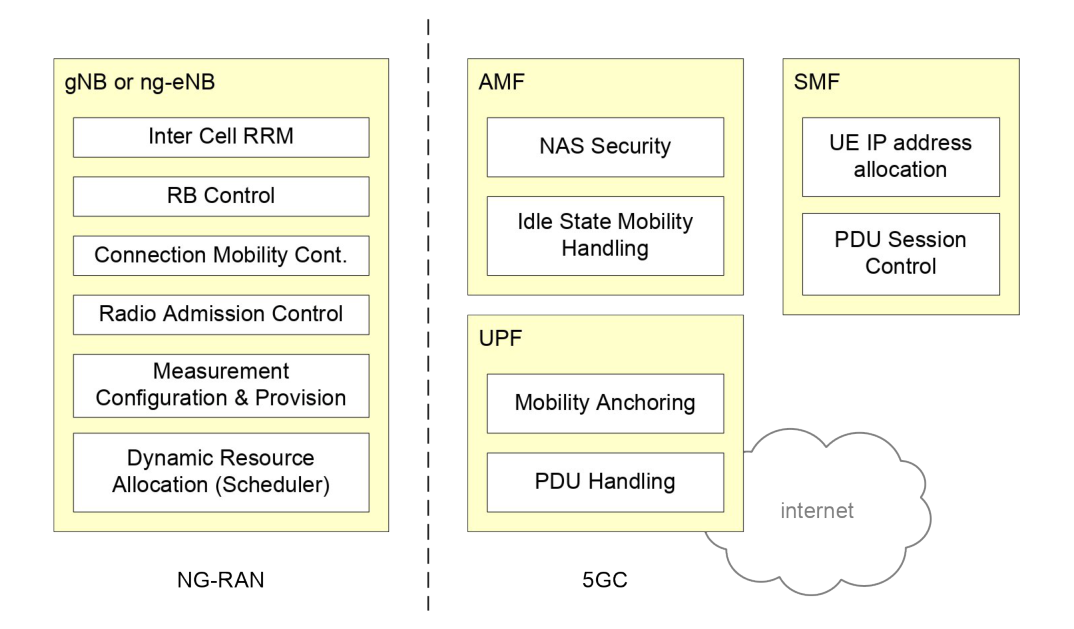
This is summarized on the figure below where yellow boxes depict the logical nodes and white boxes depict the main functions.