3GPP 38.300 v19.3.0 — the document's own text
4.3.1.2 NG Control Plane
Taught in 4. What NR is — the shape of the 5G radio network (TSG RAN — the group that specifies the radio, in depth), 8. Where the radio network meets the core (TSG RAN — the group that specifies the radio, in depth), 2. The six working groups and the line between them (TSG RAN — the group that specifies the radio, overview), 4. What NR actually is, in the shape its own document gives it (TSG RAN — the group that specifies the radio, overview), 2. The six groups, and what each one worries about (TSG RAN — the group that specifies the radio, quick start), 3. What NR is, read off the document itself (TSG RAN — the group that specifies the radio, quick start).
The NG control plane interface (NG-C) is defined between the NG-RAN node and the AMF, or between the NG-RAN node and the AIOTF. The control plane protocol stack of the NG interface is shown on Figure 4.3.1.2-1. The transport network layer is built on IP transport. For the reliable transport of signalling messages, SCTP is added on top of IP. The application layer signalling protocol is referred to as NGAP (NG Application Protocol). The SCTP layer provides guaranteed delivery of application layer messages. In the transport, IP layer point-to-point transmission is used to deliver the signalling PDUs.
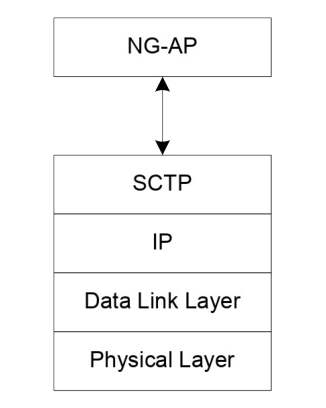
NG-C provides the following functions:
- NG interface management;
- UE context management;
- UE mobility management;
- Transport of NAS messages;
- Paging;
- PDU Session Management;
- Configuration Transfer;
- Warning Message Transmission.