3GPP 38.300 v19.3.0 — the document's own text
5.1 Waveform, numerology and frame structure
Taught in 4. What NR is — the shape of the 5G radio network (TSG RAN — the group that specifies the radio, in depth), 2. The six working groups and the line between them (TSG RAN — the group that specifies the radio, overview), 4. What NR actually is, in the shape its own document gives it (TSG RAN — the group that specifies the radio, overview), 2. The six groups, and what each one worries about (TSG RAN — the group that specifies the radio, quick start), 3. What NR is, read off the document itself (TSG RAN — the group that specifies the radio, quick start).
The downlink transmission waveform is conventional OFDM using a Cyclic Prefix. The uplink transmission waveform is conventional OFDM using a CP with a transform precoding function performing DFT spreading that can be disabled or enabled. For operation with shared spectrum channel access in FR1, the uplink transmission waveform subcarrier mapping can map to subcarriers in one or more PRB interlaces.
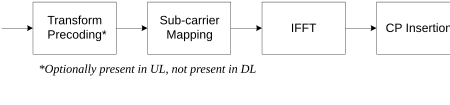
The numerology is based on exponentially scalable sub-carrier spacing f = 2µ × 15 kHz with µ={0,1,3,4,5,6} for PSS, SSS and PBCH and µ={0,1,2,3,5,6} for other channels. Normal CP is supported for all sub-carrier spacings, Extended CP is supported for µ=2. 12 consecutive sub-carriers form a Physical Resource Block (PRB). Up to 275 PRBs are supported on a carrier.
Table 5.1-1: Supported transmission numerologies.
| CP | Supported for data | Supported for synch | ||
|---|---|---|---|---|
| 0 | 15 | Normal | Yes | Yes |
| 1 | 30 | Normal | Yes | Yes |
| 2 | 60 | Normal, Extended | Yes | No |
| 3 | 120 | Normal | Yes | Yes |
| 4 | 240 | Normal | No | Yes |
| 5 | 480 | Normal | Yes | Yes |
| 6 | 960 | Normal | Yes | Yes |
The UE may be configured with one or more bandwidth parts on a given component carrier, of which only one can be active at a time, as described in clauses 7.8 and 6.10 respectively. The active bandwidth part defines the UE's operating bandwidth within the cell's operating bandwidth. For initial access, and until the UE's configuration in a cell is received, initial bandwidth part detected from system information is used.
Downlink and uplink transmissions are organized into frames with 10 ms duration, consisting of ten 1 ms subframes. Each frame is divided into two equally-sized half-frames of five subframes each. The slot duration is 14 symbols with Normal CP and 12 symbols with Extended CP, and scales in time as a function of the used sub-carrier spacing so that there is always an integer number of slots in a subframe.
Timing Advance TA is used to adjust the uplink frame timing relative to the downlink frame timing.
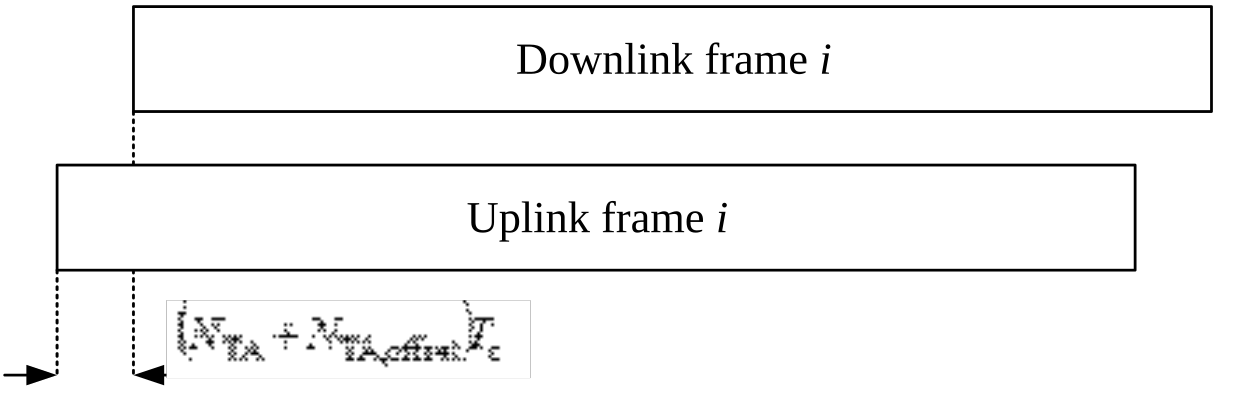
Operation on both paired and unpaired spectrum is supported.