What they wrote, and where to read it · chapter 3 of 4 · 4 minutes
3 What NR is, read off the document itself
Two kinds of base station, two interfaces, the four layers a packet falls through and the three states a device sits in — enough to picture the 5G radio.
Built from §4.1 §4.2 §4.3 §4.4 §4.5 §4.6 §5.1 §6.1 §6.10 §7.1 §7.2 §9.2.2.1 §12.1
3.1 The shape in one picture
An NG-RAN node is one of two things. A gNB gives a device the 5G radio. An ng-eNB gives it the 4G radio while still hanging off a 5G core §4.1.
They are joined to each other by the Xn interface, and to the core by the NG interfaces — a control half towards the AMF, the function that tracks where a device is, and a user half towards the UPF, the one that forwards the packets §4.1.
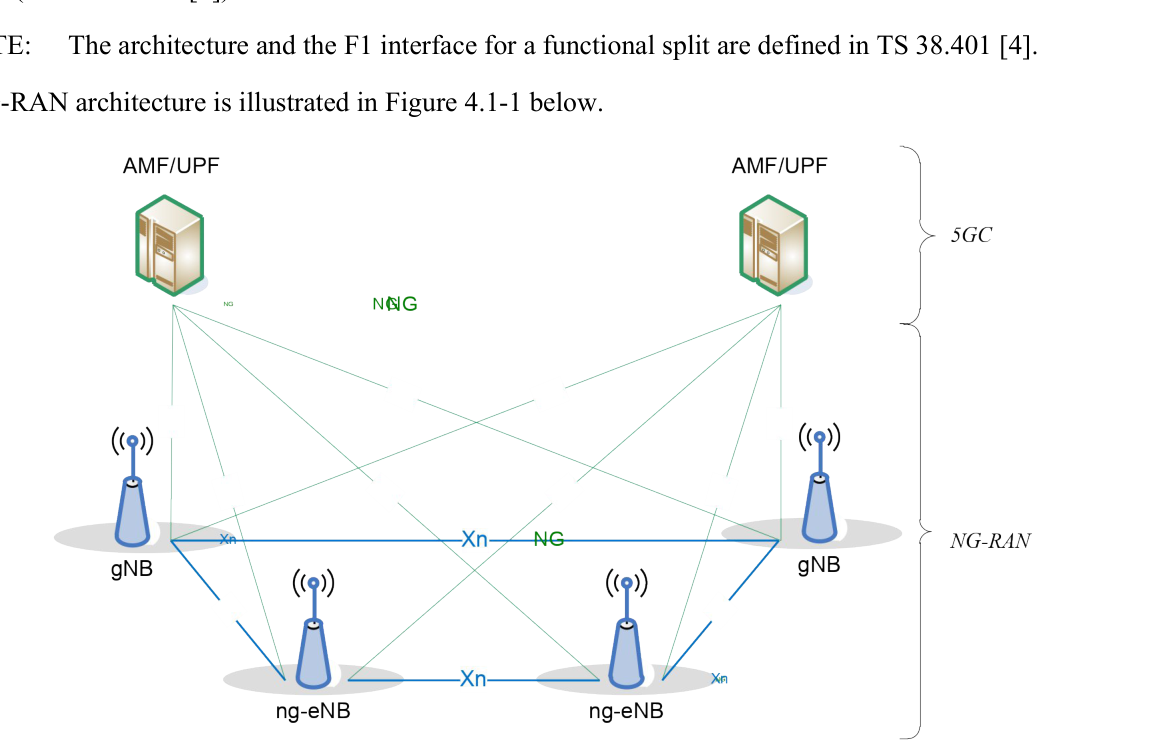
The two halves are built differently on purpose. The signalling half adds a transport that guarantees delivery §4.3.1.2; the user half explicitly gives non-guaranteed delivery §4.3.1.1.
3.2 What the base station is answerable for
The base station holds everything about the radio: deciding who transmits when, admitting and releasing connections, compressing, ciphering and integrity-protecting data, broadcasting system information, paging, configuring measurements, and mapping traffic onto radio bearers §4.2.
What it does not hold is the signalling between the device and the core that is not about radio. That passes straight through and ends at the AMF §4.4.
3.3 The layers a packet falls through
Layer 2 is four sublayers, and the clearest way to hold them is by what each one offers upwards §6.1:
- the physical layer offers transport channels to MAC;
- MAC offers logical channels to RLC;
- RLC offers RLC channels to PDCP;
- PDCP offers radio bearers to SDAP;
- SDAP offers QoS flows to the core.
In plain terms: MAC schedules and multiplexes, RLC segments and retransmits, PDCP ciphers and reorders, SDAP sorts traffic into the right bearer §6.1.
Above them sits RRC, the protocol that sets up, changes and releases the radio connection, broadcasts system information, carries paging and handles handover §7.1.
3.4 Three states
A device sits in one of three states, and the middle one is the interesting part §7.2.
| State | What it means |
|---|---|
| RRC_IDLE | no connection; the device picks cells itself and the core pages it |
| RRC_INACTIVE | no active connection, but the context is kept and the base station pages it |
| RRC_CONNECTED | connected; the network knows the cell and controls the mobility |
3.5 The signal, briefly
The air interface is regular and scalable §5.1.
Subcarrier spacing is a ladder rather than a single value: 2 to the power µ, times 15 kHz. Twelve subcarriers make a resource block, and a carrier holds up to 275 of them.
Time is fixed. A frame is 10 ms and holds ten subframes of 1 ms; a slot is 14 symbols and shrinks as the spacing grows, so a subframe always holds a whole number of slots.
A device is given one or more bandwidth parts on a carrier and only one is active at a time. The width can be ordered to change, so a wide carrier is used narrowly during a quiet period to save power §6.10.
3.6 Two more shapes worth picturing
Two schedulers at once. A connected device can be told to use radio from two different NG-RAN nodes at the same time, each with its own scheduler, joined by an ordinary backhaul link — one giving NR, the other NR or the 4G radio §4.5.
One mast, several operators. A shared cell broadcasts a tracking area code and a cell identity for each subset of networks sharing it, so a device sees the network it belongs to §4.6.
3.7 What the network promises
Quality is handled in two steps, and keeping them apart avoids most confusion §12.1.
The core sorts packets into QoS flows and marks each with a flow identifier. The radio side then maps those flows onto data radio bearers. The core never sees the second step, and the radio never sees the first.
Where to read all of this yourself is Where to look yourself, and what the record does not say.
Check yourself
Answers appear when you pick one, with where they come from.
Q3.1 What are the two kinds of node an NG-RAN is built from?
A gNB gives a device the NR radio; an ng-eNB gives it the 4G radio while still hanging off a 5G core. Both are NG-RAN nodes. §4.1
Q3.2 Which interface joins two base stations to each other, and which joins one to the core?
NG splits again into a control half towards the AMF and a user half towards the UPF. §4.1
Q3.3 Which four sublayers make up layer 2 of NR?
RRC sits above them and the physical layer below. Each sublayer offers something to the one above it. §6.1
Q3.4 What is special about RRC_INACTIVE?
The device may also move inside its notification area without telling the network, which is what makes the state cheap. §9.2.2.1
This chapter was written against TS 38.300 version 19.3.0, and built from a source register generated 2026-08-04. A newer version of the document may say something else.