3GPP 38.300 v19.3.0 — the document's own text
6.10 Bandwidth Adaptation
Taught in 5. The radio protocol stack, sublayer by sublayer (TSG RAN — the group that specifies the radio, in depth), 2. The six working groups and the line between them (TSG RAN — the group that specifies the radio, overview), 4. What NR actually is, in the shape its own document gives it (TSG RAN — the group that specifies the radio, overview), 5. The layers a packet falls through, and the three states a device sits in (TSG RAN — the group that specifies the radio, overview), 3. What NR is, read off the document itself (TSG RAN — the group that specifies the radio, quick start).
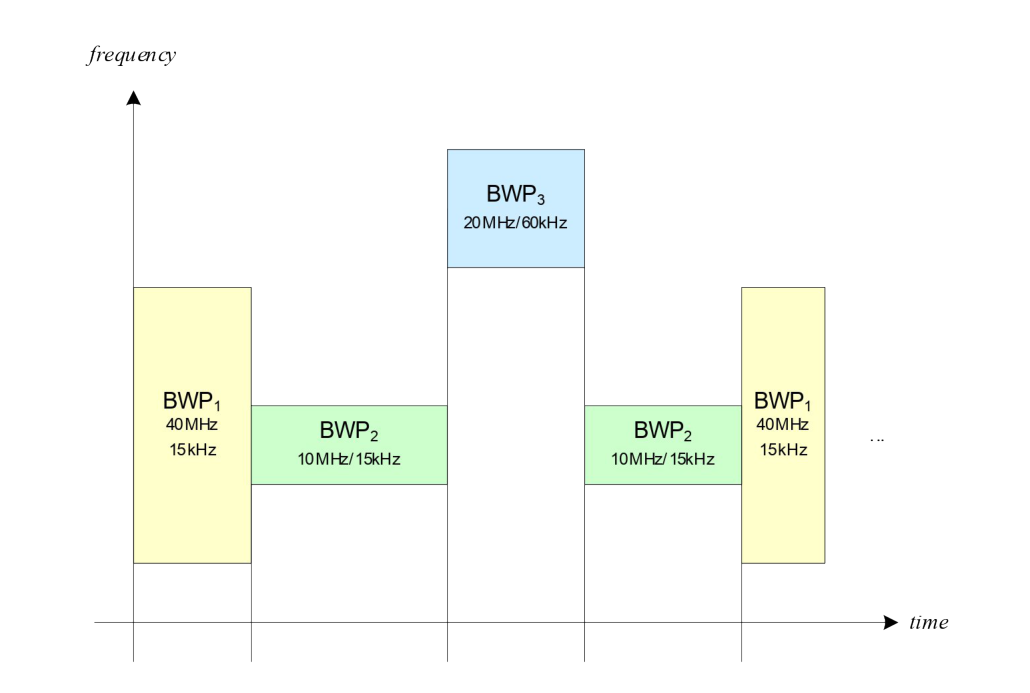
With Bandwidth Adaptation (BA), the receive and transmit bandwidth of a UE need not be as large as the bandwidth of the cell and can be adjusted: the width can be ordered to change (e.g. to shrink during period of low activity to save power); the location can move in the frequency domain (e.g. to increase scheduling flexibility); and the subcarrier spacing can be ordered to change (e.g. to allow different services). A subset of the total cell bandwidth of a cell is referred to as a Bandwidth Part (BWP) and BA is achieved by configuring the UE with BWP(s) and telling the UE which of the configured BWPs is currently the active one.
Figure 6.10-1 below describes a scenario where 3 different BWPs are configured:
- BWP1 with a width of 40 MHz and subcarrier spacing of 15 kHz;
- BWP2 with a width of 10 MHz and subcarrier spacing of 15 kHz;
- BWP3 with a width of 20 MHz and subcarrier spacing of 60 kHz.