The group and its six rooms · chapter 1 of 7 · 5 minutes
1 What TSG RAN is, and why the radio gets a group of its own
The plenary and its six working groups, what the plenary owns in its own right, and how much of 3GPP's paper the radio side accounts for.
1.1 The problem that makes a committee necessary
A phone bought in one country has to work on a mast in another, built by a different company, running software from a third.
Nothing in the phone and nothing in the mast can fix that on its own. The only thing that makes it work is a written agreement, settled before either was built, about what is sent over the air and what it means.
The radio is where the agreement bites hardest. Two boxes that disagree about a message on a wire can be patched; two boxes that disagree about the shape of a signal in the air simply do not hear each other.
It is also the part with the most kinds of question in it at once. The signal, the conversation over that signal, the links between masts, the transmitter limits and the proof that a given phone obeys all of them are five different skills, and no single room does them all well.
1.2 Three words that keep coming back
Before the group makes sense, three of its words have to.
A specification — a TS — is a rule other people have to follow. A study report — a TR — is a piece of homework a group did before deciding anything. A change request is the only way a published specification is ever altered.
Almost everything counted in this course is one of those three, or a paper arguing about one of them.
1.3 What the group is made of
TSG RAN — the technical specification group that standardises the radio side of a mobile network — is a plenary plus six working groups RAN.
The six are RAN1, RAN2, RAN3, RAN4, RAN5 and RAN6. Five of them still meet; RAN6 is the only one the group catalogue marks as closed RAN6.
Each has one job. RAN1 takes the signal itself, RAN2 the protocols spoken over that signal, RAN3 the connections between the boxes, RAN4 the measurable radio performance, RAN5 the tests a phone has to pass, and RAN6 the old GSM radio RAN1 RAN2 RAN3 RAN4 RAN5.
The next chapter, The six working groups and the line between them, takes each of them in turn.
1.4 The plenary decides, and it also writes
It is easy to read "plenary" as a rubber stamp, and here it is not one.
Two kinds of paper sit there. One is the old work: the renumbered GSM documents such as 44.018 and 45.005, 179 active documents from the 3G and GSM series in all TS 44.018 TS 45.005 [3].
The other kind is the forward-looking homework — a study report is a piece of work a group does before deciding anything. The plenary holds 38.913 on the requirements that became 5G, and 38.914 on 6G TR 38.913 TR 38.914.
1.5 How much of 3GPP this is
RAN owns 1059 active documents [2].
All of 3GPP together owns 3599 [4], and 1059 of those are RAN's.
Paper from meetings tells the same story more loudly. The local database holds 811563 RAN meeting documents [5] out of 1629581 for all of 3GPP [6].
And 3230 separate pieces of work were opened by a RAN plenary document [7].
1.6 The document this course reads
Every claim in this course about the radio itself comes from one specification: TS 38.300, the overall description of NR and the NG-RAN. NR is the 5G radio, and NG-RAN is the network of base stations that speaks it.
It belongs to RAN2, not to the plenary TS 38.300.
It says plainly what it is and what it is not:
So it is a map, not a manual. It names the boxes, the interfaces and the layers, and points at the document that carries each one in full.
The same sentence draws a second line, this one between radio technologies: the 4G radio hanging off a 5G core is covered in the 36 series, not here §1. Which document series a thing lives in is how 3GPP keeps two radios apart inside one network.
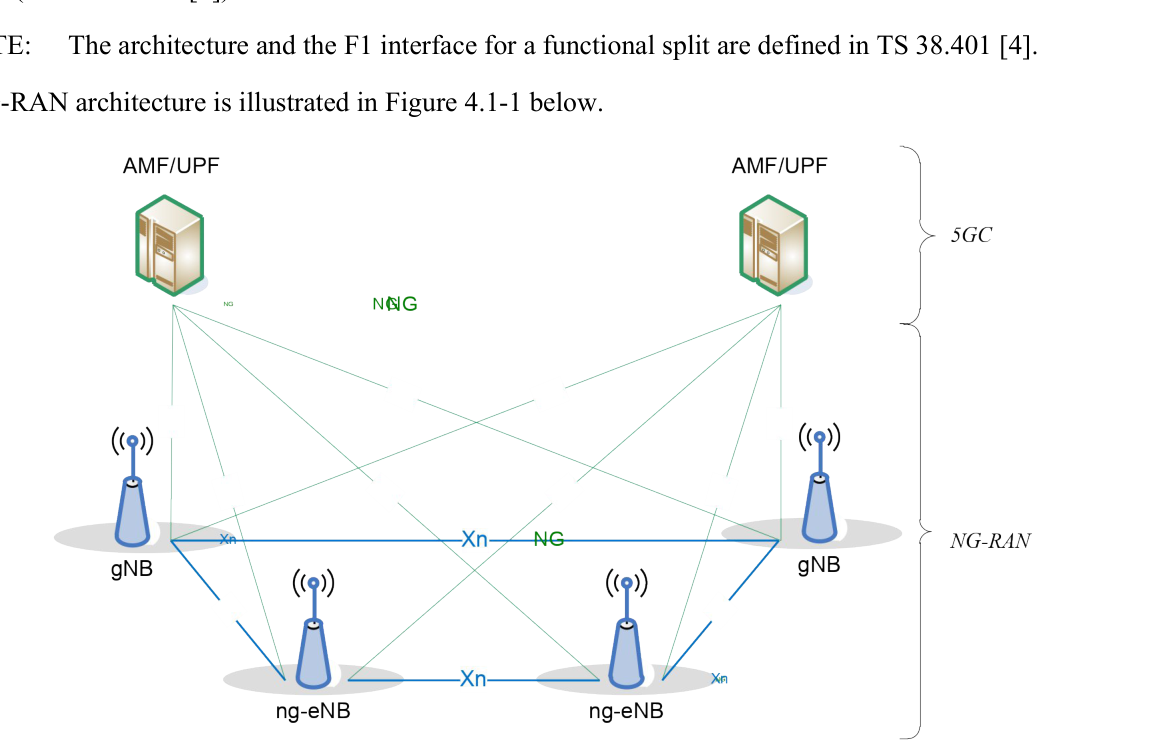
That shape shows immediately. A base station in this network is one of two things — a gNB, which speaks NR, or an ng-eNB, which speaks the 4G radio into a 5G core — and both are joined to each other and to the core the same way §4.1.
1.7 The beat the group runs on
The work is not continuous. It arrives in weeks.
The plenary meets four times a year, usually for four days, and the five open working groups meet together in their own week — same week, same place, five days 3GPPRAN#112 3GPPRAN1#125.
The plenary then sits a few weeks after that week, deciding on work the groups have just finished: the groups met on 2026-05-18, the plenary on 2026-06-08 3GPPRAN1#125 3GPPRAN#112.
That is the shape to hold on to. Groups draft, the plenary decides, and the calendar in How to follow TSG RAN yourself, and what the record will not tell you fills in the rest.
1.8 Where the numbers on this page come from
Every count on this page was read out of a database or a folder on one machine, and the register behind the course records the exact question that produced it.
That is worth saying out loud, because it also fixes the limits of the course. The counts describe what this machine holds, not what 3GPP holds. Where the difference could matter, the text says "the local record".
The last chapter, How to follow TSG RAN yourself, and what the record will not tell you, sets out what else the record cannot tell you — and there is a good deal of it.
Where the numbers in this chapter come from
- 198 active RAN plenary specifications rows in the pygppe specification catalogue /var/www/whatthespec.net/data/database/api/spec_catalog.sqlite where wg='RP' and active='yes', read 2026-08-04
- 1059 active RAN specifications rows in the pygppe specification catalogue /var/www/whatthespec.net/data/database/api/spec_catalog.sqlite where wg is one of RP, R1, R2, R3, R4, R5, R6 and active='yes', read 2026-08-04
- 179 active documents the RAN plenary holds from the 3G and GSM series rows in the pygppe specification catalogue /var/www/whatthespec.net/data/database/api/spec_catalog.sqlite where wg='RP', active='yes' and the number starts with one of 25, 43, 44, 45, 48, 49, 50, 52, read 2026-08-04
- 3599 active 3GPP specifications in total rows in the pygppe specification catalogue /var/www/whatthespec.net/data/database/api/spec_catalog.sqlite where active='yes', read 2026-08-04
- 811563 RAN meeting documents in the local database rows in the pygppe meeting-document table /var/www/whatthespec.net/data/database/api/api.sqlite whose document number starts with one of RP-, R1-, R2-, R3-, R4-, R5-, R6-, read 2026-08-04
- 1629581 meeting documents of all of 3GPP in the local database rows in the pygppe meeting-document table /var/www/whatthespec.net/data/database/api/api.sqlite, read 2026-08-04
- 3230 work items were opened by a RAN plenary document folders under /var/www/whatthespec.net/data/data/wis whose metadata.json has a tdoc_code starting 'RP-', of 9406 work items in all, read 2026-08-04
Check yourself
Answers appear when you pick one, with where they come from.
Q1.1 How many working groups sit under the RAN plenary, and how many of them still meet?
The group catalogue lists RAN1 to RAN6. RAN6 is the only one it marks as closed, so five are still running. RAN6
Q1.2 What does the RAN plenary do besides chairing the working groups?
The plenary is a document owner in its own right. The local catalogue puts 198 of RAN's 1059 active documents in the plenary's own hands. 198 active RAN plenary specifications
Q1.3 How many of the 3599 active 3GPP documents does RAN own?
RAN owns 1059 active documents out of 3599 for all of 3GPP. 198 of those 1059 are the plenary's own; 3230 is the number of pieces of work a RAN plenary document has opened. 3599 active 3GPP specifications in total
Q1.4 What does TS 38.300 say it covers?
The scope says it is an overview and overall description, and that the details of the radio interface protocols live in companion specifications of the 38 series. §1
Q1.5 A colleague says "RAN has never written anything about GSM." Is that right?
The renumbered GSM documents sit with the plenary, not with the closed RAN6, and there are 179 of them from the 3G and GSM series. 179 active documents the RAN plenary holds from the 3G and GSM series
This chapter was written against TS 38.300 version 19.3.0, and built from a source register generated 2026-08-04. A newer version of the document may say something else.