3GPP 23.501 v20.2.0 — the document's own text
5.33.2.1 Dual Connectivity based end to end Redundant User Plane Paths
Taught in 23. Very fast, very reliable, very picky (The 5G system architecture, in depth).
In order to support highly reliable URLLC services, a UE may set up two redundant PDU Sessions over the 5G network, such that the 5GS sets up the user plane paths of the two redundant PDU Sessions to be disjoint. The user's subscription indicates if user is allowed to have redundant PDU Sessions and this indication is provided to SMF from UDM.
NOTE 1: It is out of scope of 3GPP how to make use of the duplicate paths for redundant traffic delivery end-to-end. It is possible to rely on upper layer protocols, such as the IEEE 802.1 TSN (Time Sensitive Networking) FRER (Frame Replication and Elimination for Reliability) [83], to manage the replication and elimination of redundant packets/frames over the duplicate paths which can span both the 3GPP segments and possibly fixed network segments as well.
NOTE 2: The following redundant network deployment aspects are within the responsibility of the operator and are not subject to 3GPP standardization:
- RAN supports dual connectivity and there is sufficient RAN coverage for dual connectivity in the target area.
- UEs support dual connectivity.
- The core network UPF deployment is aligned with RAN deployment and supports redundant user plane paths.
- The underlying transport topology is aligned with the RAN and UPF deployment and supports redundant user plane paths.
- The physical network topology and geographical distribution of functions also supports the redundant user plane paths to the extent deemed necessary by the operator.
- The operation of the redundant user plane paths is made sufficiently independent, to the extent deemed necessary by the operator, e.g. independent power supplies.
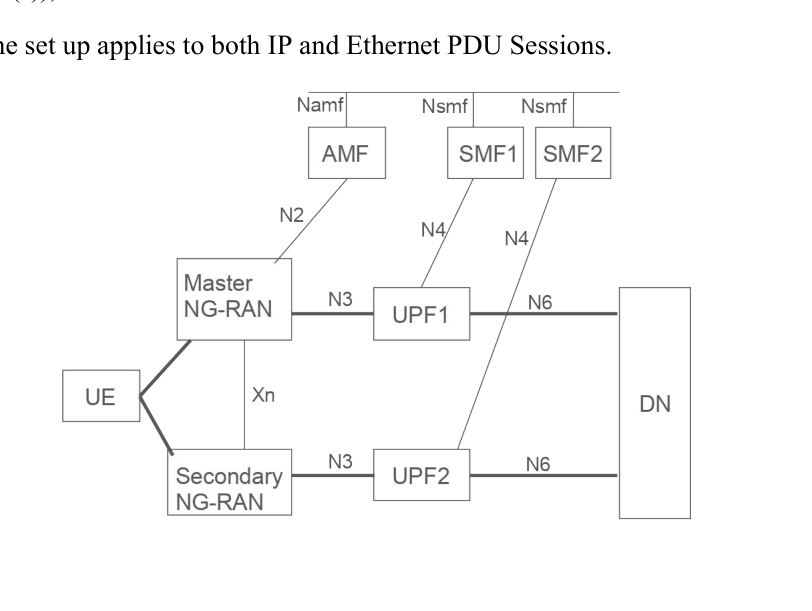
Figure 5.33.2.1-1 illustrates an example user plane resource configuration of dual PDU Sessions when redundancy is applied. One PDU Session spans from the UE via Master RAN node to UPF1 acting as the PDU Session Anchor and the other PDU Session spans from the UE via Secondary RAN node to UPF2 acting as the PDU Session Anchor. As described in TS 37.340 [31], NG-RAN may realize redundant user plane resources for the two PDU Sessions with two NG-RAN nodes (i.e. Master RAN node and Secondary RAN node as shown in Figure 5.33.2.1-1) or a single NG-RAN node. In both cases, there is a single N1 interface towards AMF.
Based on these two PDU Sessions, two independent user plane paths are set up. UPF1 and UPF2 connect to the same Data Network (DN), even though the traffic via UPF1 and UPF2 may be routed via different user plane nodes within the DN.
In order to establish two redundant PDU Sessions and associate the duplicated traffic coming from the same application to these PDU Sessions, URSP as specified in TS 23.503 [45] may be used, or alternatively the UE may perform this task independently from URSP.
When URSP is used to establish two redundant PDU Sessions, duplicated traffic from the application, associated to the redundant PDU Sessions, is differentiated by two distinct traffic descriptors, each in a distinct URSP rule. These traffic descriptors need to have different DNNs, IP descriptors or non-IP descriptors (e.g. MAC address, VLAN ID), so that the two redundant PDU Sessions are matched to the Route Selection Descriptors of distinct URSP rules. These Route Selection Descriptors of distinct URSP rules may include corresponding RSNs and PDU Session Pair IDs. The Route Selection Descriptors share same PDU Session Pair ID, if included, to denote the two traffic are redundant with each other. How does UE determines the PDU Session Pair ID and/or RSN from the matched URSP rules is described in clause 6.6.2 of TS 23.503 [45].
When the UE performs the establishment of two redundant PDU Sessions and the duplication of traffic independently from URSP, the UE may establish two redundant PDU Sessions even when the application does not duplicate the traffic and the application does not provide two distinct traffic descriptors. In this case the UE may set the RSN and PDU Session Pair ID in the PDU Session Establishment Request message based on UE implementation.
NOTE 3: As an example, the UE may use the implementation of FRER (Frame Replication and Elimination for Reliability), IEEE Std 802.1CB-2017 [83], in the UE's operating system.
If the operator decides to allow UE to use its own mechanisms to determine PDU Session Pair ID and RSN (where such UE capability is known based on local PCF configuration based on e.g. deployment, terminal implementation or policies per group of UE(s)), then the PCF shall not include PDU Session Pair ID and RSN in URSP rule.
The redundant user plane set up applies to both IP and Ethernet PDU Sessions.
Support of redundant PDU Sessions include:
- UE initiates two redundant PDU Sessions and may provide PDU Session Pair ID (optional) and the RSN (optional). Different combinations of RSN, DNN and S-NSSAI are used for each PDU Session within a given pair of redundant PDU Sessions. Different combinations of PDU Session Pair ID, DNN and S-NSSAI are used between the different pairs of redundant PDU Session.
- The UE may include a PDU Session Pair ID and/or RSN in each of the PDU Session establishment Request when it establishes redundant PDU Sessions. UE determines the PDU Session Pair ID and/or RSN based on UE local mechanism or the matched URSP rules.
- The SMF determines whether the PDU Session is to be handled redundantly. The determination is based on the presence of the PDU Session Pair ID and/or RSN in the PDU Session Establishment Request or the determination is based on an indication that redundant PDU Session is required provided by PCF for the PDU Session, if dynamic PCC applies for the PDU Session or the combination of the S-NSSAI, DNN, user subscription and local policy configuration in the SMF if dynamic PCC is not used for the PDU Session. If the PDU session is to be handled redundantly and the PDU Session Pair ID was not included in the PDU Session Establishment request, the SMF uses S-NSSAI, DNN and local configuration to determine the PDU Session Pair ID. If the PDU session is to be handled redundantly and RSN was not included in the PDU Session Establishment request, the SMF uses S-NSSAI, DNN to determine the RSN value. The RSN differentiates the PDU Sessions that are handled redundantly and indicates redundant user plane requirements for the PDU Sessions in NG-RAN.
- The SMF shall provide the RSN and PDU Session Pair ID to the NG-RAN for a redundant PDU Session.
- Operator configuration of UPF selection ensures the appropriate UPF selection for disjoint paths.
- At establishment of the PDU Sessions or at transitions to CM-CONNECTED state, the RSN parameter indicates to NG-RAN that redundant user plane resources shall be provided for the given PDU Sessions by means of dual connectivity. The PDU Session Pair ID identifies the two redundant PDU Sessions that belong together. The value of the RSN parameter and the PDU Session Pair ID indicates redundant user plane requirements for the PDU Sessions. This request for redundant handling is made by indicating the RSN to the NG-RAN node on a per PDU Session granularity. PDU Sessions associated with different RSN values shall be realized by different, redundant UP resources. Based on the RSN, the PDU Session Pair ID and RAN configuration, the NG-RAN sets up dual connectivity as defined in TS 37.340 [31] so that the sessions have end to end redundant paths. When there are multiple PDU Sessions with the RSN parameter set, of different values of RSN and the same PDU Session Pair ID, this indicates to NG-RAN that CN is requesting dual connectivity to be set up and the user plane shall be handled as indicated by the RSN parameter, the PDU Session Pair ID and the associated RAN configuration. If the RSN value and PDU Session Pair ID are provided to the NG-RAN, NG-RAN shall consider the RSN value and PDU Session Pair ID when it associates the PDU Sessions with NG-RAN UP.
NOTE 4: The decision to set up dual connectivity remains in NG-RAN as defined today. NG-RAN takes into account the additional request for the dual connectivity setup provided by the CN.
- Using NG-RAN local configuration, NG-RAN determines whether the request to establish RAN resources for a PDU Session is fulfilled or not considering user plane requirements indicated by the RSN parameter and the PDU Session Pair ID by means of dual connectivity. If the request to establish RAN resources for PDU Session can be fulfilled by the RAN, the PDU Session is established even if the user plane requirements indicated by RSN cannot be satisfied. The decision for each PDU Session is taken independently (i.e. rejection of a PDU Session request shall not release the previously established PDU Session). The RAN shall determine whether to notify the SMF if the RAN resources indicated by the RSN parameter and the PDU Session Pair ID can no longer be maintained and SMF can use that to determine if the PDU Session should be released.
- In the case of Ethernet PDU Sessions, the SMF has the possibility to change the UPF (acting as the PSA) and select a new UPF based on the identity of the Secondary RAN node for the second PDU Session if the Secondary RAN node is modified (or added/released), using the Ethernet PDU Session Anchor Relocation procedure described in clause 4.3.5.8 of TS 23.502 [3].
- The SMF's charging record may reflect the RSN information.
- The RSN parameter and the PDU Session Pair ID, if available, is transferred from Source NG-RAN to Target NG-RAN in the case of handover.