3GPP 38.300 v19.3.0 — the document's own text
4.9.1 Architecture
Taught in 4. What NR is — the shape of the 5G radio network (TSG RAN — the group that specifies the radio, in depth), 4. What NR actually is, in the shape its own document gives it (TSG RAN — the group that specifies the radio, overview).
A Network-Controlled Repeater node, referred to as NCR-node, is an RF repeater that enables wireless amplifying-and-forwarding functionality in NG-RAN. The NCR-node is capable of receiving and applying side control information from a gNB with additional functionality to support Network-Controlled Repeater.
The NCR-node comprises an NCR-MT and an NCR-Fwd. The NCR-MT is an entity supporting a subset of the UE functionality that communicates with the gNB to receive side control information via a control link based on the NR Uu interface. The NCR-Fwd is the function performing amplifying-and-forwarding of signals between gNB and UE via the NCR-Fwd backhaul link and NCR-Fwd access link, respectively. The NCR-Fwd can support multiple beams towards the UE. The NCR-Fwd can support multiple beams in the backhaul link, and those may be different from the beams in the control link. The behaviour of the NCR-Fwd is controlled according to the side control information received from the gNB. The NCR-node is modelled as depicted in Figure 4.9.1-1.
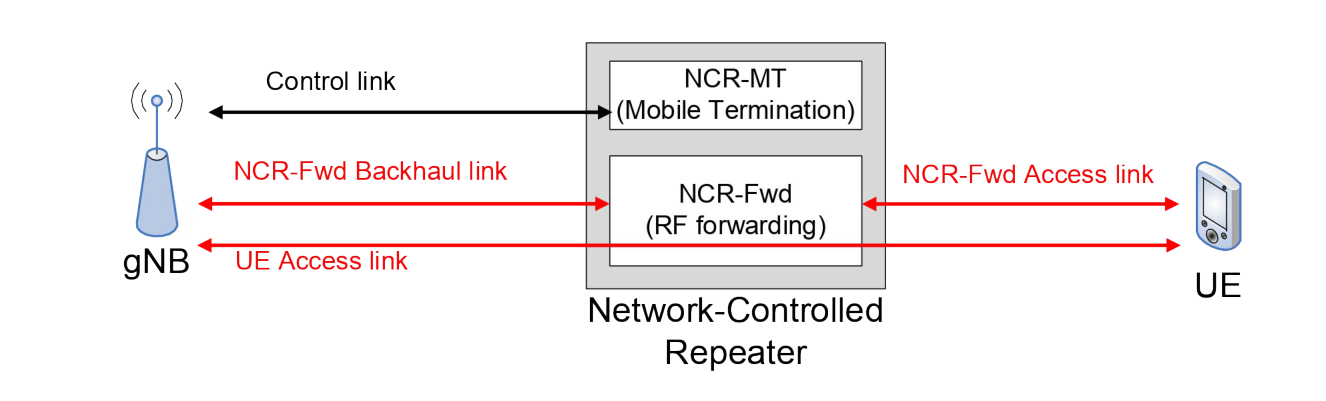
An NCR-MT establishes SRBs and, optionally, DRB(s) with a gNB. The establishment of DRB(s) can be used to transport OAM traffic.
The signal that NCR-Fwd forwards is associated to the cell that the NCR-MT is connected to via the control link. Whether the NCR-Fwd can forward other signals is up to implementation.