3GPP 38.300 v19.3.0 — the document's own text
11 UE Power Saving
Taught in 6. The three states a device sits in (TSG RAN — the group that specifies the radio, in depth), 5. The layers a packet falls through, and the three states a device sits in (TSG RAN — the group that specifies the radio, overview).
The PDCCH monitoring activity of the UE in RRC connected mode is governed by DRX, BA, DCP, cell DTX (see clause 15.4.2.3) and LP-WUS.
When DRX is configured, the UE does not have to continuously monitor PDCCH. DRX is characterized by the following:
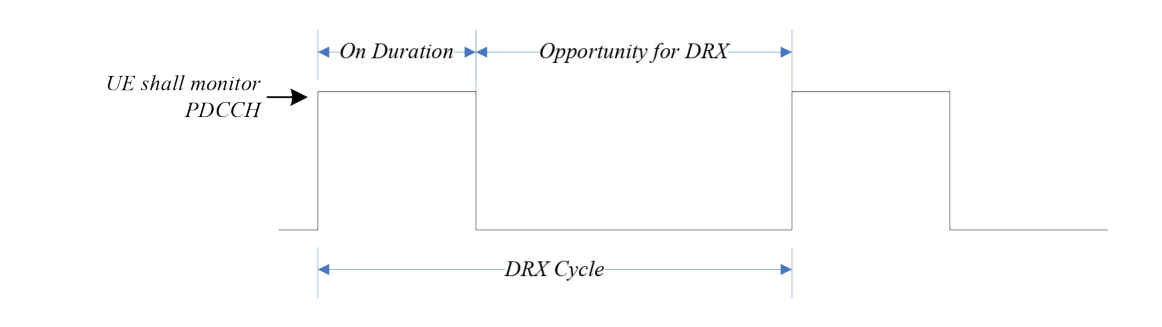
- on-duration: duration that the UE waits for, after waking up, to receive PDCCHs. If the UE successfully decodes a PDCCH, the UE stays awake and starts the inactivity timer;
- inactivity-timer: duration that the UE waits to successfully decode a PDCCH, from the last successful decoding of a PDCCH, failing which it can go back to sleep. The UE shall restart the inactivity timer following a single successful decoding of a PDCCH for a first transmission only (i.e. not for retransmissions);
- LP-WUS PDCCH monitoring timer: duration that the UE waits for, after woken up by LP-WUS, to receive PDCCH. In case this timer is configured the UE does not start the on-duration timer. If the UE successfully decodes a PDCCH, the UE stays awake and starts the inactivity timer;
- retransmission-timer: duration until a retransmission can be expected;
- cycle: specifies the periodic repetition of the on-duration followed by a possible period of inactivity (see figure 11-1 below);
- active-time: total duration that the UE monitors PDCCH. This includes the "on-duration" of the DRX cycle, the time UE is performing continuous reception while the inactivity timer has not expired, the time when the UE is performing continuous reception while waiting for a retransmission opportunity and the time UE is performing continuous reception while the LP-WUS PDCCH monitoring timer has not expired.
UE can be configured with LP-WUS for power saving in all RRC states. A LP-WUS is transmitted based on OOK and overlaid OFDM sequence(s) over OOK ON symbols and can carry up to 5 information bits and one codepoint out of up to 32 codepoints. A UE supports detection of LP-WUS information carried by OOK and/or overlaid OFDM sequences. In RRC_IDLE and RRC_INACTIVE, the same information is delivered by OOK and overlaid OFDM sequences. For LP-WUS, the number of OOK symbols within an OFDM symbol can be configured as 1, 2 or 4. For RRC_IDLE and RRC_INACTIVE, a UE monitors two codepoints for LP-WUS. In RRC_CONNECTED, a UE can be configured to monitor up to 8 codepoints for LP-WUS.
A SL UE can be configured with DRX, in which case, PDCCH providing SL grants can be send to the UE only during its active time.
When BA is configured, the UE only has to monitor PDCCH on the one active BWP i.e. it does not have to monitor PDCCH on the entire DL frequency of the cell. A BWP inactivity timer (independent from the DRX inactivity-timer described above) is used to switch the active BWP to the default one: the timer is restarted upon successful PDCCH decoding and the switch to the default BWP takes place when it expires.
In addition, the UE may be indicated, when configured accordingly, whether it is required to monitor or not the PDCCH during the next occurrence of the on-duration by a DCP monitored on the active BWP. If the UE does not detect a DCP on the active BWP, it does not monitor the PDCCH during the next occurrence of the on-duration, unless it is explicitly configured to do so in that case.
A UE can only be configured to monitor DCP when connected mode DRX is configured, and at occasion(s) at a configured offset before the on-duration. If short DRX cycle is configured, DCP is not applicable when short DRX cycle is used. More than one monitoring occasion can be configured before the on-duration. The UE does not monitor DCP on occasions occurring during active-time, measurement gaps, MUSIM gaps, BWP switching, or when it monitors response for a CFRA preamble transmission for beam failure recovery (see clause 9.2.6), in which case it monitors the PDCCH during the next on-duration. If no DCP is configured in the active BWP, UE follows normal DRX operation.
When CA is configured, DCP or LP-WUS is only configured on the PCell and/or PSCell.
One DCP can be configured to control PDCCH monitoring during on-duration for one or more UEs independently.
A UE configured with DRX in RRC_CONNECTED can be configured with LP-WUS. The UE does not monitor LP-WUS during active-time, measurement gaps, MUSIM gaps, BWP switching, or when it monitors response for a CFRA preamble transmission for beam failure recovery (see clause 9.2.6). If LP-WUS is detected, the UE shall start the on-duration timer or LP-WUS PDCCH monitoring timer to start PDCCH monitoring and enter active-time:
- If the UE is configured to start on-duration timer after LP-WUS reception, the UE monitors LP-WUS at occasion(s) at a configured offset before the on-duration, and the UE does not monitor LP-WUS when short DRX cycle is used. If the UE is unable to monitor the LP-WUS occasion, it shall start the on-duration timer.
- If the UE is configured to start LP-WUS PDCCH monitoring timer after LP-WUS reception, the UE monitors LP-WUS at occasion(s) according to the configured periodicity and offset which can be same or different from the periodicity and offset configured for C-DRX cycle, and the UE monitors LP-WUS regardless of which DRX cycle is used. If the UE is unable to monitor the LP-WUS occasion(s), the LP-WUS PDCCH monitoring timer is not started.
Three candidate values for minimum time gap are supported for UE in RRC_CONNECTED to report via capability signalling, where the minimum time gap is between the LP-WUS reception and MR to start PDCCH monitoring. gNB configures the time offset between LP-WUS monitoring and the corresponding PDCCH monitoring.
When LP-WUS is configured, the next available uplink resources determined by the MAC entity (e.g. PUCCH resource for SR, PRACH occasion, and CG resource) occur when MR is activated.
Power saving in RRC_IDLE and RRC_INACTIVE can also be achieved by UE relaxing neighbour cells RRM measurements when it meets the criteria determining it is in low mobility and/or not at cell edge. When UE is configured with both high speed measurements and RRM measurement relaxation as specified in TS 38.331 [12], it is up to UE implementation whether to apply the FR1 high speed RRM requirements or the relaxed RRM requirements when the low mobility related criterion is configured and fulfilled as specified in TS 38.133 [13].
Power saving in RRC_IDLE and RRC_INACTIVE can also be achieved by allowing UEs supporting LP-WUS to relax serving cell measurements on MR, further relax neighbour cell measurements on MR and/or offload serving cell measurements from MR to LR. Conditions to further relax neighbour and relax serving cell measurements are based on MR, optionally LR measurements and optionally on low mobility criterion for LP-WUS as specified in TS 38.304 [10]. To limit the impact on the power saving gains there is an additional threshold configured when low mobility is configured as specified in TS 38.304 [10]. Entry condition for offloading serving cell measurements from MR to LR is based on MR and optionally LR measurements as specified in TS 38.304 [10]. Exit conditions for offloading serving cell measurements from MR to LR are based on LR measurements as specified in TS 38.304 [10].
For UE in RRC_IDLE and RRC_INACTIVE configured with LP-WUS, LP-SS is supported for UE LR to maintain synchronization and perform serving cell RRM measurements. LP-SS transmission is based on OOK with or without overlaid OFDM sequence. For UE capable of detecting overlaid OFDM sequence by LR, PSS/SSS can be used for UE LR to maintain synchronization and perform serving cell RRM measurements. For LP-SS, the number of OOK symbols within an OFDM symbol can be configured as 1, 2 or 4 and the number can be same or larger than LP-WUS. LP-SS is not supported in RRC_CONNECTED.
For UE in RRC_IDLE and RRC_INACTIVE configured with LP-WUS, the frequency resource of LP-WUS and LP-SS can be configured within or outside the initial DL BWP in the carrier where the UE monitors paging. For UE in RRC_CONNECTED, the frequency resource of LP-WUS can be configured within or outside the UE active DL BWP, where the support of LP-WUS monitoring outside active DL BWP is optional.
For UE in RRC_IDLE and RRC_INACTIVE configured with LP-WUS, three candidate values for wake-up delay are supported for UE to report via capability signalling, where wake-up delay is defined as the minimum time gap between the LP-WUS reception and MR to start PDCCH monitoring. gNB can configure one or two time offset values between the reference PF of the PO and the associated LP-WUS monitoring occasions. If at least one of the configured time offset values are no smaller than the wake-up delay that UE reports, the UE monitors LP-WUS monitoring occasions corresponding to the smallest time offset value that is no smaller than its reported wake-up delay, otherwise, the UE does not monitor LP-WUS and monitors the following PEI or paging in its PO.
UE is not required to support simultaneous reception using LR and MR, where LR is used for LP-WUS monitoring and MR is used for transmission and/or reception of all other NR signals/channels in RRC_CONNECTED within the same cell group.
NOTE: It is up to UE implementation to implement LR in the same or different physical receiver as MR.
UE power saving may be enabled by adapting the DL maximum number of MIMO layers by BWP switching.
Power saving is also enabled during active-time via cross-slot scheduling, which facilitates UE to achieve power saving with the assumption that it won't be scheduled to receive PDSCH, triggered to receive A-CSI or transmit a PUSCH scheduled by the PDCCH until the minimum scheduling offsets K0 and K2. Dynamic adaptation of the minimum scheduling offsets K0 and K2 is controlled by PDCCH.
Serving Cells of a MAC entity may be configured by RRC in two DRX groups with separate DRX parameters. When RRC does not configure a secondary DRX group, there is only one DRX group and all Serving Cells belong to that one DRX group. When two DRX groups are configured, each Serving Cell is uniquely assigned to either of the two groups. The DRX parameters that are separately configured for each DRX group are on-duration and inactivity-timer.
A UE supporting LP-WUS can be configured with two DRX groups where the UE can be configured to start either on-duration timer or the LP-WUS PDCCH monitoring timer after detecting LP-WUS to enter active-time. After LP-WUS detection the corresponding timer is started in both of the DRX groups. In addition to on-duration and inactivity-timer, the LP-WUS PDCCH monitoring timer is separately configured for each DRX group. The UE monitors LP-WUS only when both DRX groups are outside active-time.
UE power saving in RRC_IDLE/RRC_INACTIVE may be achieved by providing the configuration for TRS with CSI-RS for tracking in TRS occasions. The TRS in TRS occasions may allow UEs in RRC_IDLE/RRC_INACTIVE to sleep longer before waking-up for its paging occasion. The TRS occasions configuration is provided in either SIB17 or SIB17bis. The availability of TRS in the TRS occasions is indicated by L1 availability indication. These TRSs may also be used by the UEs configured with eDRX.
UE power saving may be achieved by UE relaxing measurements for RLM/BFD. When configured, UE determines whether it is in low mobility state and/or whether its serving cell radio link quality is better than a threshold. The configuration for low mobility and good serving cell quality criterion is provided through dedicated RRC signalling.
RLM and BFD relaxation may be enabled/disabled separately through RRC Configuration. Additionally, RLM relaxation may be enabled/disabled on per Cell Group basis while BFD relaxation may be enabled/disabled on per serving cell basis.
The UE is only allowed to perform RLM and/or BFD relaxation when relaxed measurement criterion for low mobility and/or for good serving cell quality is met. If configured to do so, the UE shall trigger reporting of its RLM and/or BFD relaxation status through UE assistance information if the UE changes its respective RLM and/or BFD relaxation status while meeting the UE minimum requirements specified in TS 38.133 [13].
UE power saving may also be achieved through PDCCH monitoring adaptation mechanisms when configured by the network, including skipping of PDCCH monitoring and Search space set group (SSSG) switching. In this case UE does not monitor PDCCH during the PDCCH skipping duration except for the cases as specified in TS 38.213 [38], or monitors PDCCH according to the search space sets applied in SSSG.