Serving one device · chapter 5 of 7 · 6 minutes
5 The connection, and what is promised on it
What a PDU session is and what it fixes for life, how the packets are forwarded, and how quality is split into flows.
5.1 Why a connection needs a name and a promise
A phone does not simply "have internet". It has one or more connections, each to a named data network, each with its own address, its own rules about what happens when you move, and its own set of promises about delay and bit rate.
The 5G core calls that a PDU session, and the service it provides is the PDU Connectivity Service: exchanging packets between a device and a data network identified by a DNN, a Data Network Name §5.6.1.
Sessions are established at the device's request, and changed or released by either side, over the session half of the signalling that runs between the device and the SMF — the function that sets up and tears down connections §5.6.1.
5.2 What is fixed for life, and what is not
When a device asks for a session it supplies a session id unique to itself, plus the type, the slice, the data network name and the continuity mode §5.6.1. Most of those are then fixed:
| Attribute | May change later |
|---|---|
| Data Network Name | No |
| PDU Session Type | No |
| SSC mode | No |
| PDU Session Id | No |
| S-NSSAI of the serving network | Yes |
There are five session types — IPv4, IPv6, IPv4v6, Ethernet and Unstructured — and a session carries exactly one of them §5.6.1.
The SMF checks the request against the subscription it fetches from the UDM, which says per data network and per slice which types and continuity modes are allowed, which are the defaults, and what the subscribed rate limit and default quality settings are §5.6.1.
A device may hold several sessions at once, to the same data network or to different ones, over 3GPP and non-3GPP access at the same time, and they may be served by different SMFs and take completely separate paths §5.6.1. Which slice each one belongs to is One network behaving like several.
5.3 What happens to your address when you move
Session and Service Continuity mode is the promise about the address, and it is chosen once, at establishment §5.6.9.1:
-
SSC mode 1 — the connection is preserved. For an IP session the address is preserved too. Nothing the device sees changes.
-
SSC mode 2 — the network may release the session, and with it the address. The device notices and re-establishes.
-
SSC mode 3 — the change is visible, but the new path is set up before the old one goes away, so connectivity is never lost. The address does not survive the move.
Mode 3 is the interesting one, and it is what makes moving an anchor closer to a user possible without dropping anything.
5.4 Where the packets actually go
The UPF is the function that forwards. One session may be served by one UPF or several, and how many is not limited by the specification; the SMF picks them §5.8.1.
The UPF at the far end, the one facing the data network over N6, is the anchor.
A session may have more than one anchor, with an uplink classifier or an IPv6 multi-homing branch splitting the traffic. That is how part of a session reaches a local server while the rest goes to the central one §5.6.4.1.
Everything the UPF does is programmed by the SMF over N4, and the unit of that programming is the packet detection rule: what to match, and how to treat what matched — where to send it, what rate to hold it to, what to report §5.8.1.
The detection information combines tunnel information, network instance, QFI and a packet filter set, and it may name an application rather than an address §5.8.2.4.2.
5.5 The unit of quality
Quality is not given to a session as a whole. It is given to a QoS Flow inside it.
The QFI travels in the tunnel header on N3 and N9, so the end-to-end packet is never altered §5.7.1.1. Every session has one flow that exists for its whole life, the one carrying the default rule, and it should be a non-guaranteed flow.
A flow is described three times over, to three different readers §5.7.1.5:
-
A QoS profile to the radio network, so it knows what to schedule for.
-
QoS rules to the device, so it knows which packets go on which flow going up.
-
Packet detection rules to the UPF, so it knows which packets go on which flow coming down.
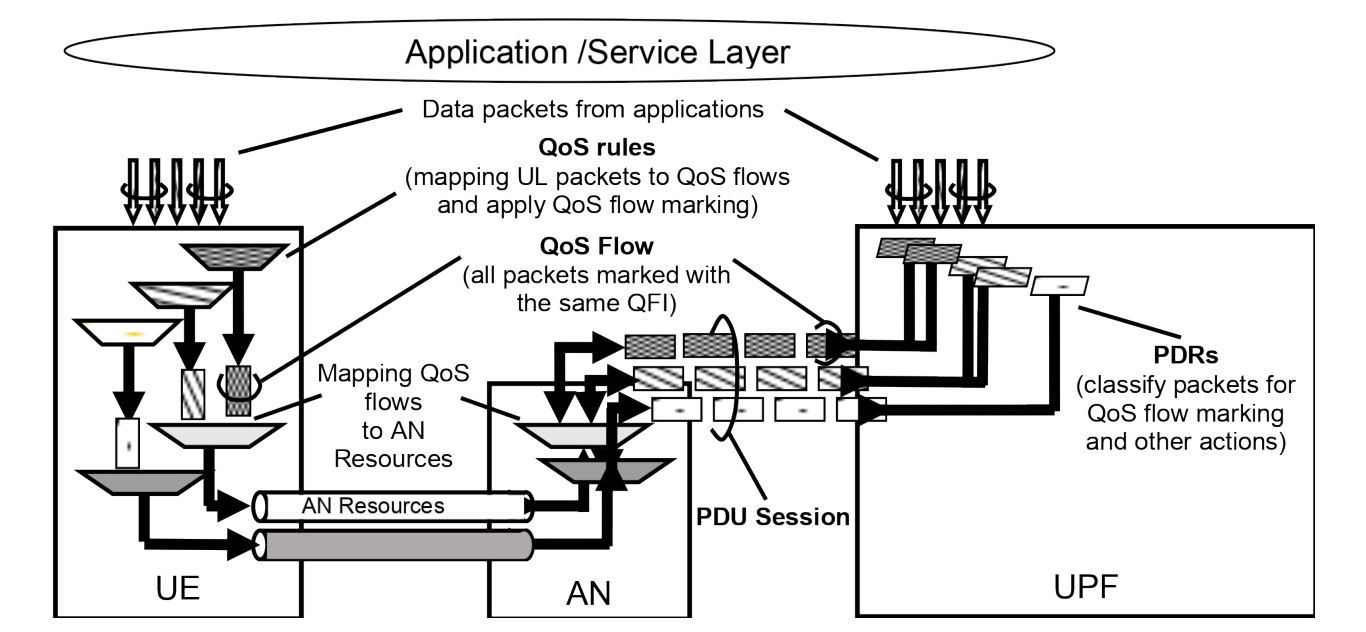
Downlink, the UPF matches packets against its rules in order of precedence and marks them with the QFI; if nothing matches, it discards the packet. Uplink, the device does the same against its own rules, and discards what matches nothing §5.7.1.5.
The profile itself is short. Every flow carries a 5QI and an ARP — the allocation and retention priority, which decides who gets bumped when there is not enough to go round.
A guaranteed flow adds a guaranteed and a maximum bit rate in each direction; a non-guaranteed flow may carry a reflective QoS attribute instead §5.7.1.2.
On top of the per-flow numbers sit aggregate limits: a Session-AMBR across all non-guaranteed flows of one session, and a UE-AMBR across all non-guaranteed flows of one device. Neither applies to guaranteed flows §5.7.2.6.
5.6 Where to look next
Session management, including continuity modes, local data networks and the uplink classifier, is §5.6. The whole QoS model, including the table of standardised 5QI values, is §5.7 — and §5.7.4 is the table itself. User plane management and the rules the SMF sends over N4 are §5.8.
The in-depth course of this track spends a chapter on sessions, a chapter on the user plane and a chapter on QoS, at the level of individual parameters.
Check yourself
Answers appear when you pick one, with where they come from.
Q5.1 What is the finest thing a 5G network can give a separate quality treatment to?
Every packet marked with the same QFI inside a session gets the same forwarding treatment, so the flow is the unit — not the session and not the packet. §5.7.1.1
Q5.2 Which of these can be changed after a PDU session has been established?
The table of session attributes marks the serving network's S-NSSAI as modifiable, because the device may move to a different network. DNN, type, SSC mode and session id are fixed. §5.6.1
Q5.3 A session is set to SSC mode 3. What does the device experience when the anchor changes?
SSC mode 3 makes the user plane change visible, but sets up the new anchor before releasing the old one so connectivity is not lost. The address does not survive the change. §5.6.9.1
Q5.4 What is a 5QI?
The 5QI is a scalar that references the 5G QoS characteristics. The identifier of a flow inside a session is the QFI. §5.7.2.1
Q5.5 An uplink packet matches no QoS rule in the device. What happens to it?
The device evaluates uplink packets against the rules in order of precedence, and if no rule matches it discards the packet. §5.7.1.5
Q5.6 Who tells the UPF how to detect, forward, police and report traffic?
The SMF selects and controls the user plane function. It gives the UPF packet detection rules and the treatment that goes with each of them. §5.8.1
This chapter was written against TS 23.501 version 20.2.0, verified 2026-08-04. A newer version of the document may say something else.