3GPP 24.501 v20.0.0 — the document's own text
D.2.1.2 Network-requested UE policy management procedure initiation
Taught in 5. Finding your way around TS 24.501 (CT1 — the group that writes what your phone says, in depth), 4. Inside TS 24.501, the document at the centre (CT1 — the group that writes what your phone says, overview).
In order to initiate the network-requested UE policy management procedure, the PCF shall:
- if the network-requested UE policy management procedure is triggered by the UE-requested V2X policy provisioning procedure as specified in 3GPP TS 24.587 [19B], the UE-requested ProSe policy provisioning procedure as specified in 3GPP TS 24.554 [19E], the UE-requested A2X policy provisioning procedure as specified in 3GPP TS 24.577 [60], or the UE-requested RSLPP provisioning procedure as specified in 3GPP TS 24.514 [62], then set the PTI IE to the PTI value of the received UE POLICY PROVISIONING REQUEST message of the UE-requested V2X policy provisioning procedure, the UE-requested ProSe policy provisioning procedure, the UE-requested A2X policy provisioning procedure, or the UE-requested RSLPP provisioning procedure, otherwise allocate a PTI value currently not used and set the PTI IE to the allocated PTI value;
- encode the information about the UE policy sections to be added, modified or deleted in a UE policy section management list IE as specified in clause D.6.2 and include it in a MANAGE UE POLICY COMMAND message;
- if the PCF is a PCF of the HPLMN or the subscribed SNPN, optionally include the UE policy network classmark IE in a MANAGE UE POLICY COMMAND message and set the non-subscribed SNPN signalled URSP handling indication of the UE policy network classmark IE to "UE is not allowed to accept URSP signalled by non-subscribed SNPNs", or "UE is allowed to accept URSP signalled by non-subscribed SNPNs";
c1) if the UE supports VPS URSP, optionally encode the information about entries of VPS URSP configuration to be added, modified or deleted in the VPS URSP configuration IE as specified in clause D.6.8 and include it in a MANAGE UE POLICY COMMAND message;
- send the MANAGE UE POLICY COMMAND message to the UE via the AMF as specified in 3GPP TS 23.502 [9]; and
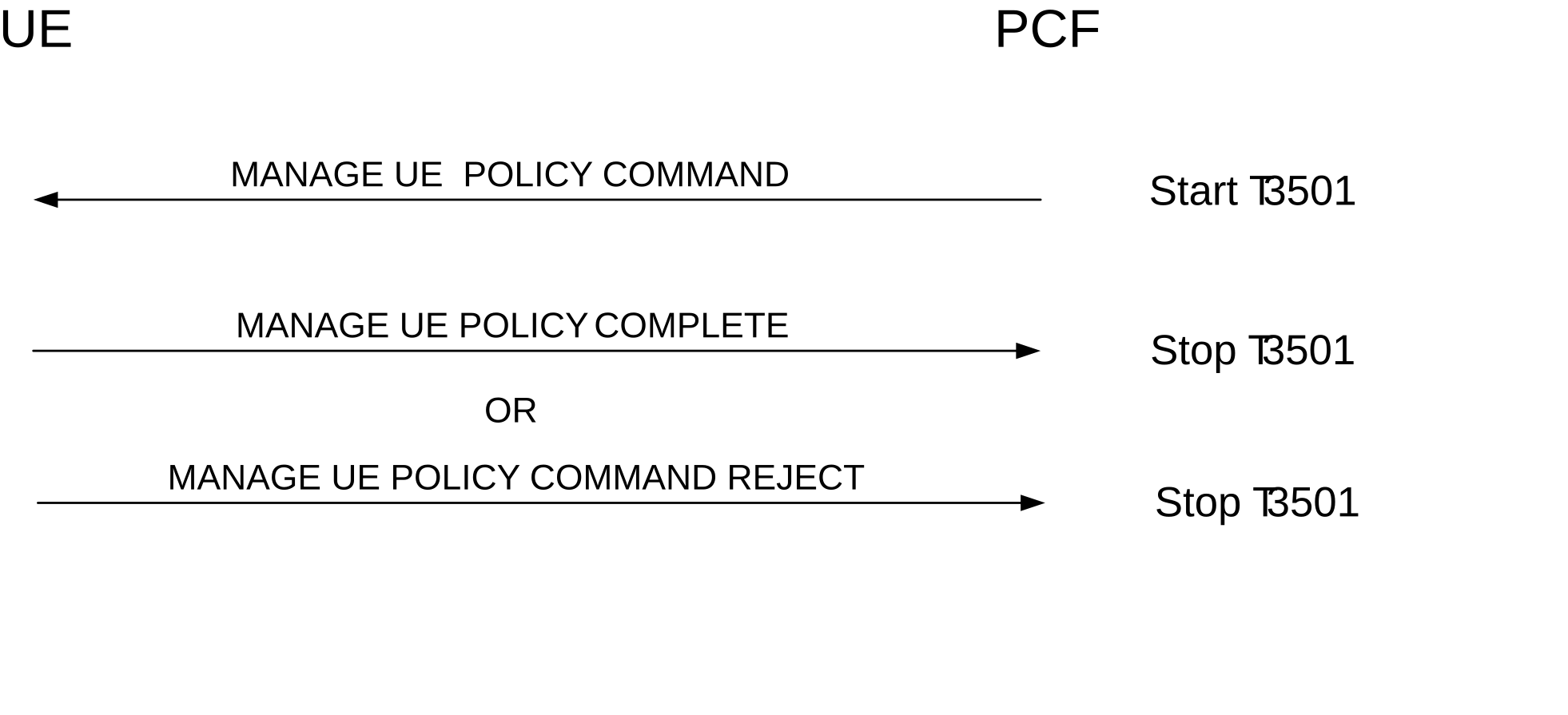
- start timer T3501 (see example in figure D.2.1.2.1).
NOTE: The PCF starts a different timer T3501 for each PTI value.
Upon receipt of the MANAGE UE POLICY COMMAND message with a PTI value currently not used by a network-requested UE policy management procedure, for each instruction included in the UE policy section management list IE, the UE shall:
- store the received UE policy section of the instruction, if the UE has no stored UE policy section associated with the same UPSI as the UPSI associated with the instruction;
- replace the stored UE policy section with the received UE policy section of the instruction, if the UE has a stored UE policy section associated with the same UPSI as the UPSI associated with the instruction; or
- delete the stored UE policy section, if the UE has a stored UE policy section associated with the same UPSI as the UPSI associated with the instruction and the UE policy section of the instruction is empty;
additionally, if the UE policy network classmark IE is included in the MANAGE UE POLICY COMMAND message, and
- the UE has an empty EHPLMN list or the EHPLMN list is not present, and the UE's RPLMN is the HPLMN;
- the UE has a non-empty EHPLMN list, and the UE's RPLMN is an EHPLMN; or
- the UE's RSNPN is the subscribed SNPN,
the UE shall delete the non-subscribed SNPN signalled URSP handling indication stored for the selected entry of "list of subscriber data" or the selected PLMN subscription, if any, and store the non-subscribed SNPN signalled URSP handling indication received in the UE policy network classmark IE, for the selected entry of "list of subscriber data" or the selected PLMN subscription.
If the UE supports the VPS URSP, and the VPS URSP configuration is included in the MANAGE UE POLICY COMMAND message:
- if the replacement type field of the received VPS URSP configuration indicates "full list of tuples", the UE shall delete the stored VPS URSP configuration, if any; and
- if the received VPS URSP configuration contains one or more tuples:
- if the UE does not have the stored VPS URSP configuration, the UE shall store the received VPS URSP configuration except zero or more tuples with no UPSCs; or
- otherwise:
- for each tuple with a tuple ID in the stored VPS URSP configuration:
A) if a tuple with the tuple ID is in the received VPS URSP configuration and contains:
- no UPSCs, the UE shall delete the tuple with the tuple ID from the stored VPS URSP configuration; or
- one or more UPSCs, the UE shall replace the tuple with the tuple ID in the stored VPS URSP configuration with the tuple with the tuple ID from the received VPS URSP configuration; or
B) if no tuple with the tuple ID is in the received VPS URSP configuration, the UE shall keep the tuple with the tuple ID in the stored VPS URSP configuration; and
- for each tuple with a tuple ID in the received VPS URSP configuration, if no tuple with the tuple ID is in the stored VPS URSP configuration and:
A) the tuple with the tuple ID in the received VPS URSP configuration contains no UPSCs, the UE shall ignore the tuple with the tuple ID in the received VPS URSP configuration; or
B) the tuple with the tuple ID in the received VPS URSP configuration contains one or more UPSCs, the UE shall add the tuple with the tuple ID from the received VPS URSP configuration to the stored VPS URSP configuration.
The UE may continue storing a received UE policy section for a PLMN or SNPN when the UE registers in another PLMN or SNPN. If necessary, the UE may delete UE policy sections stored for a PLMN other than the RPLMN and the HPLMN or for an SNPN other than the registered SNPN and the subscribed SNPN, before storing the new received UE policy sections.
When storing a UE policy section received from an SNPN, the UE shall associate the NID of that SNPN with the UPSI of the stored UE policy section.
NOTE: The maximum number of UE policy sections for PLMNs or SNPNs other than the HPLMN and the RPLMN or the registered SNPN and the subscribed SNPN that the UE can store and how the UE selects the UE policy sections to be deleted are up to the UE implementation.