3GPP 23.501 v20.2.0 — the document's own text
5.32.6.1 General
Taught in 11. Using two accesses at once (The 5G system architecture, in depth).
The functionality in an ATSSS-capable UE that can steer, switch and split the MA PDU Session traffic across 3GPP access and non-3GPP access, is called a "steering functionality". An ATSSS-capable UE may support one or more of the following types of steering functionalities:
- Steering functionalities based on multi-path protocols:
- Steering functionality that applies the MPTCP protocol (IETF RFC 8684 [81]) and is called "MPTCP functionality" (see clause 5.32.6.2.1). This steering functionality can be applied to steer, switch and split the TCP traffic flows identified in the ATSSS/N4 rules. The MPTCP functionality in the UE may communicate with an associated MPTCP Proxy functionality in the UPF, by using the MPTCP protocol over the 3GPP and/or the non-3GPP user plane.
- Steering functionalities based on MPQUIC that apply the QUIC protocol (IETF RFC 9000 [166], IETF RFC 9001 [167], IETF RFC 9002 [168]) and its multipath extensions (draft-ietf-quic-multipath [174]). The MPQUIC functionality in the UE may communicate with an associated MPQUIC Proxy functionality in the UPF, by using the QUIC protocol and its multipath extensions over the 3GPP and/or the non-3GPP user plane. The following MPQUIC functionalities are supported:
- "MPQUIC-UDP" functionality that can be applied to steer, switch and split UDP traffic flows identified in the ATSSS/N4 rules.
- "MPQUIC-IP" functionality that can be applied to steer, switch and split IP traffic identified in the ATSSS/N4 rules.
- "MPQUIC-E" functionality that can be applied to steer, switch and split Ethernet traffic identified in the ATSSS/N4 rules.
- Steering functionalities based on data switching:
- A steering functionality called "ATSSS Low-Layer functionality", or ATSSS-LL functionality (see clause 5.32.6.3.1): This steering functionality can be applied to steer, switch and split all types of traffic, including TCP traffic, UDP traffic, Ethernet traffic, etc.
NOTE: Filters used in ATSSS rules related with a MA PDU Session of type Ethernet can refer to IP level parameters such as IP addresses and TCP/UDP ports.
The UE indicates to the network its supported steering functionalities and steering modes by including in the UE ATSSS Capability one or more of the following capabilities:
- The "ATSSS-LL functionality with any steering mode allowed for ATSSS-LL supported" capability.
In this case, the UE indicates that it is capable to steer, switch and split all traffic of the MA PDU Session by using the ATSSS-LL functionality with any steering mode allowed for ATSSS-LL, as specified in clause 5.32.8.
- The "MPTCP functionality with any steering mode supported" capability and the "ATSSS-LL functionality with only Active-Standby steering mode supported" capability. The MPTCP functionality shall be used only when the type of the MA PDU Session is IPv4, IPv6, or IPv4v6.
In this case, the UE indicates that:
- it is capable to steer, switch and split the TCP traffic of the MA PDU Session by using the MPTCP functionality with any steering mode, as specified in clause 5.32.8; and
- it is capable to steer and switch all other traffic (i.e. the non-MPTCP traffic) of the MA PDU Session by using the ATSSS-LL functionality with the Active-Standby steering mode, as specified in clause 5.32.8.
- The "MPQUIC-UDP functionality with any steering mode supported" capability and the "ATSSS-LL functionality with only Active-Standby steering mode supported" capability. The MPQUIC-UDP functionality shall be used only when the type of the MA PDU Session is IPv4, IPv6, or IPv4v6.
In this case, the UE indicates that:
- it is capable to steer, switch and split the UDP traffic of the MA PDU Session by using the MPQUIC-UDP functionality with any steering mode, as specified in clause 5.32.8; and
- it is capable to steer and switch all other traffic (i.e. the non-MPQUIC traffic) of the MA PDU Session by using the ATSSS-LL functionality with the Active-Standby steering mode, as specified in clause 5.32.8.
- The "MPQUIC-IP functionality with any steering mode supported" capability and the "ATSSS-LL functionality with only Active-Standby steering mode supported" capability. The MPQUIC-IP functionality shall be used only when the type of the MA PDU Session is IPv4, IPv6, or IPv4v6.
In this case, the UE indicates that:
- it is capable to steer, switch and split all traffic of the MA PDU Session, by using the MPQUIC-IP functionality with any steering mode, as specified in clause 5.32.8. and
- it is capable to steer and switch all traffic of the MA PDU Session by using the ATSSS-LL functionality with the Active-Standby steering mode, as specified in clause 5.32.8.
- The "MPQUIC-E functionality with any steering mode supported" capability and the "ATSSS-LL functionality with only Active-Standby steering mode supported" capability. MPQUIC-E functionality shall be used only when the type of the MA PDU Session is Ethernet.
In this case, the UE indicates that:
- it is capable to steer, switch and split all traffic of the MA PDU Session of type Ethernet, by using the MPQUIC-E functionality with any steering mode, as specified in clause 5.32.8. and
- it is capable to steer and switch all traffic of the MA PDU Session by using the ATSSS-LL functionality with the Active-Standby steering mode, as specified in clause 5.32.8.
- The "MPQUIC-IP functionality with any steering mode supported" capability. The MPQUIC-IP functionality shall be used only when the type of the MA PDU Session is IPv4, IPv6, or IPv4v6. This capability shall be provided when the UE supports only MPQUIC-IP functionality.
In this case, the UE indicates that it is capable to steer, switch and split all traffic of the MA PDU Session by using the MPQUIC-IP functionality with any steering mode, as specified in clause 5.32.8.
The above steering functionalities are schematically illustrated in the Figure 5.32.6.1-1, which shows an example model for an ATSSS-capable UE supporting the MPTCP functionality, the MPQUIC functionality(ies) and the ATSSS-LL functionality. The MPTCP flows and the MPQUIC flows in this figure represent the traffic of the applications for which MPTCP protocol can be applied and for which MPQUIC protocol can be applied respectively. The five different IP addresses illustrated in the UE are further described in clause 5.32.6.2.1 and in clause 5.32.6.2.2. When the MPTCP functionality and the MPQUIC functionality(ies) are both applied, the addresses (IP@1, IP@2) used for MPTCP functionality may be the same as the addresses (IP@4, IP@5) used for MPQUIC functionality(ies).
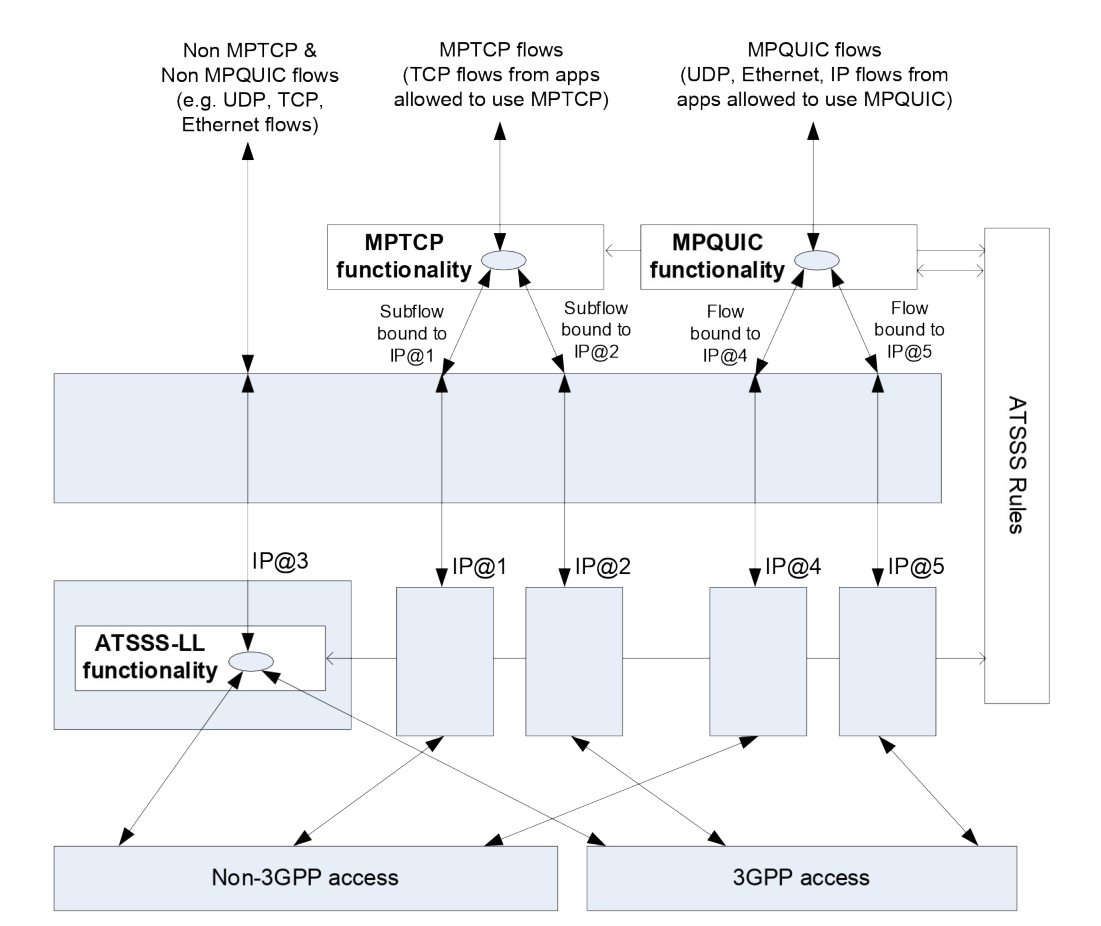
Within the same IP type MA PDU Session, it is possible to simultaneously steer different packet flows by different steering functionalities. For the same packet flow, only one steering functionality shall be used. For the same Ethernet type MA PDU Session, either ATSSS-LL functionality or MPQUIC-E functionality is enabled.
All steering functionalities in the UE shall take ATSSS decisions (i.e. decide how to steer, switch and split the traffic) by using the same set of ATSSS rules. Similarly, all ATSSS decisions in the UPF shall be taken by applying the same set of N4 rules, which support ATSSS. The ATSSS rules and the N4 rules supporting ATSSS are provisioned in the UE and in the UPF respectively, when the MA PDU Session is established.
If the UE supports multiple steering functionalities, it shall use the provisioned ATSSS rules (see TS 23.503 [45]) to decide which steering functionality to apply for a specific packet flow.