3GPP 23.501 v20.2.0 — the document's own text
4.4.8.4 Architecture to support IETF Deterministic Networking
Taught in 21. Emergency calls, messages, voice and location (The 5G system architecture, in depth).
The 5G System is integrated with the Deterministic Network as defined in IETF RFC 8655 [150] as a logical DetNet transit router, see Figure 4.4.8.4-1. The TSCTSF performs mapping in the control plane between the 5GS internal functions and the DetNet controller. 5G System specific procedures in 5GC and RAN remain hidden from the DetNet controller.
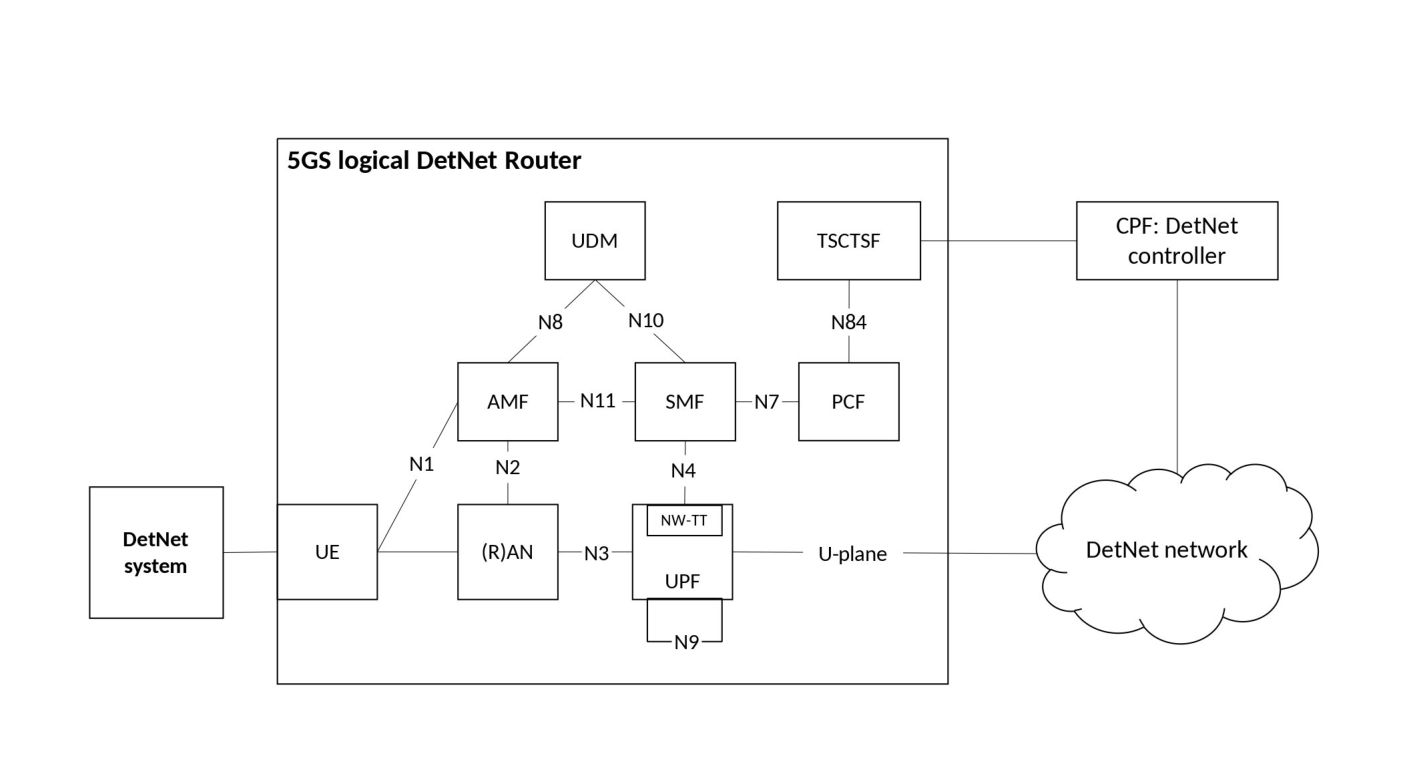
On the device side, the UE is connected with a DetNet system, which may be a DetNet End System or a DetNet Node.
The architecture does not require the DS-TT functionality to be supported in the device nor require the user plane NW-TT functionality to be supported in the UPF, however, it can co-exist with such functions. For the reporting of information of the network side ports, NW-TT control plane function is used. The architecture can be combined with architecture in clause 4.4.8.3 to support time synchronization and TSC.
DetNet may be used in combination with time synchronization mechanisms as defined in clause 5.27, but it does not require usage of these mechanisms.
5GS acts as a DetNet router in the DetNet domain. Use cases where the 5GS acts as a sub-network (see clause 4.1.2 of IETF RFC 8655 [150]) are also possible but do not require any additional 3GPP standardization. A special case where the 5GS can act as a sub-network is when the 5GS acts as a TSN network, which is supported by the 3GPP specifications based on the architecture in clause 4.4.8.2.
NOTE: For DetNet interworking, it is assumed that there is a business agreement to support the use of the DetNet controller so that it can be regarded trusted for the operator. Depending on the needs of a given deployment, functions such as the authentication, authorization and potential throttling of signalling from the DetNet controller can be achieved by including such functionalities in the TSCTSF.
The routing of the downlink packets is achieved using the existing 3GPP functions.