3GPP 23.501 v20.2.0 — the document's own text
4.4.8.3 Architecture for AF requested support of Time Sensitive Communication and Time Synchronization
Taught in 21. Emergency calls, messages, voice and location (The 5G system architecture, in depth).
This clause describes the architecture to enable Time Sensitive Communication AF requested time sensitive communication and time synchronization services. The Time Sensitive Communication and Time Synchronization related features that are supported based on AF request are described in clauses 5.27.1 and 5.27.2, respectively. Figure 4.4.8.3-1 shows the architecture to support Time Sensitive Communication and Time Synchronization services.
As shown in Figure 4.4.8.3-1, to support Time Synchronization service based on IEEE Std 802.1AS [104] or IEEE Std 1588 [126] for Ethernet or IP type PDU Sessions, the DS-TT, NW-TT and Time Sensitive Communication and Time Synchronization Function (TSCTSF) are required in order to support the features in IEEE Std 802.1AS [104] or IEEE Std 1588 [126] as described in clause 5.27. The NEF exposes 5GS capability to support Time Synchronization service as described in clause 5.27.1.8. TSCTSF controls the DS-TT(s) and NW-TT for the (g)PTP based time synchronization service. In addition, TSCTSF supports TSC assistance container related functionalities.
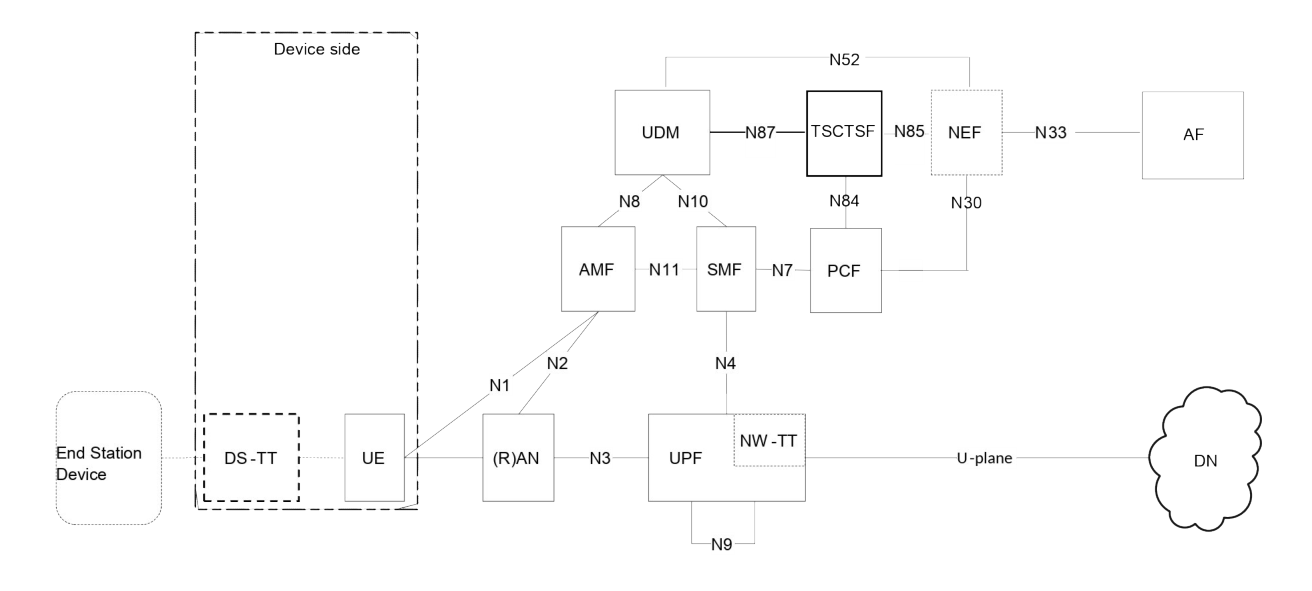
NOTE 1: If the AF is considered to be trusted by the operator, the AF could interact directly with TSCTSF, the connection between AF and TSCTSF is not depicted in the architecture diagram for brevity.
UPF/NW-TT distributes the (g)PTP messages as described in clause 5.27.1.
When the UPF supports one or more NW-TT(s), there is one-to-one association between an NW-TT and the network instance or between an NW-TT and network instance together with DNN/S-NSSAI in the UPF. When there are multiple network instances within a UPF, each network instance is considered logically separate. The network instance for the N6 interface (clause 5.6.12) may be indicated by the SMF to the UPF for a given PDU Session during PDU Session establishment procedure. UPF allocates resources based on the Network Instance and S-NSSAI and it is supported according to TS 29.244 [65]. DNN/S-NSSAI may be indicated by the SMF together with the network instance to the UPF for a given PDU Session during PDU Session establishment procedure.
NOTE 2: The same NW-TT is used for all PDU Sessions in the UPF for the given DNN/S-NSSAI; the NW-TT is unique per DNN/S-NSSAI. This ensures that the UPF selects an N4 session associated with the correct TSCTSF when the NW-TT initiates an UMIC or PMIC. At any given time, the NW-TT is associated with a single TSCTSF.