3GPP 23.501 v20.2.0 — the document's own text
4.2.10 Architecture Reference Model for ATSSS Support
Taught in 3. The shape of the 5G core (The 5G system architecture, in depth), 11. Using two accesses at once (The 5G system architecture, in depth).
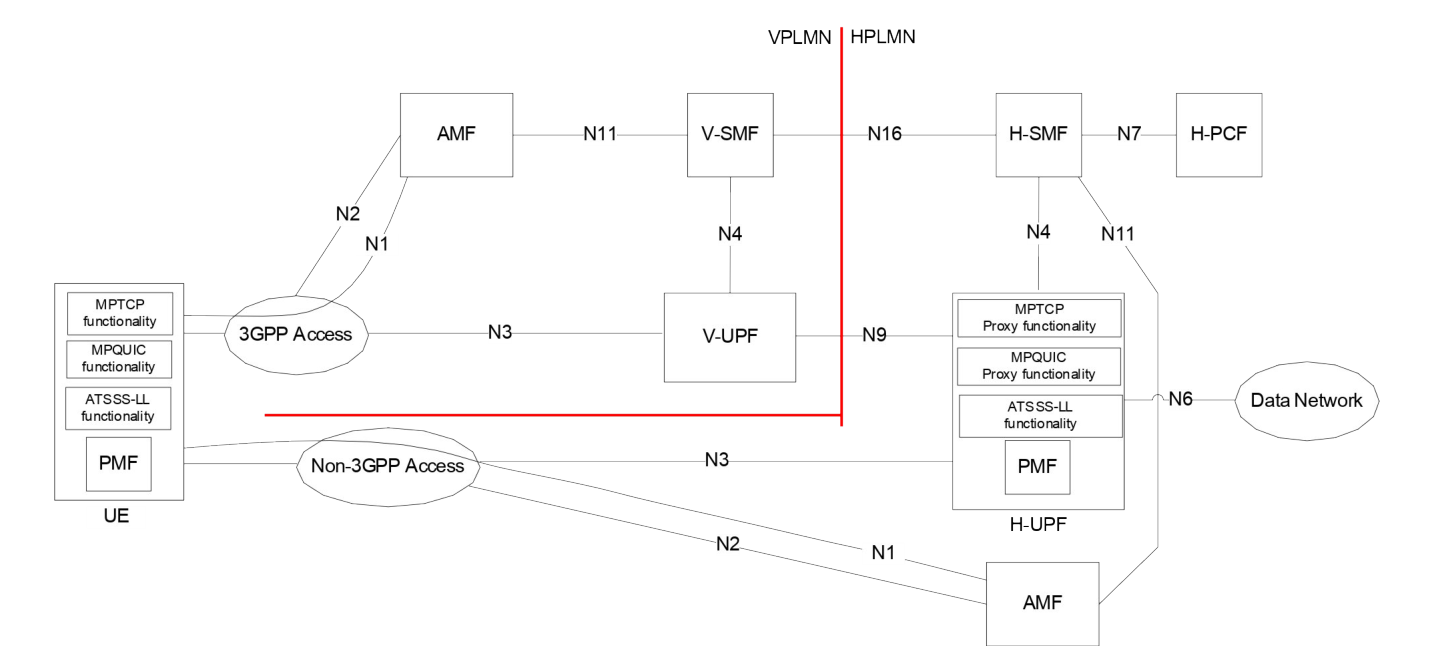
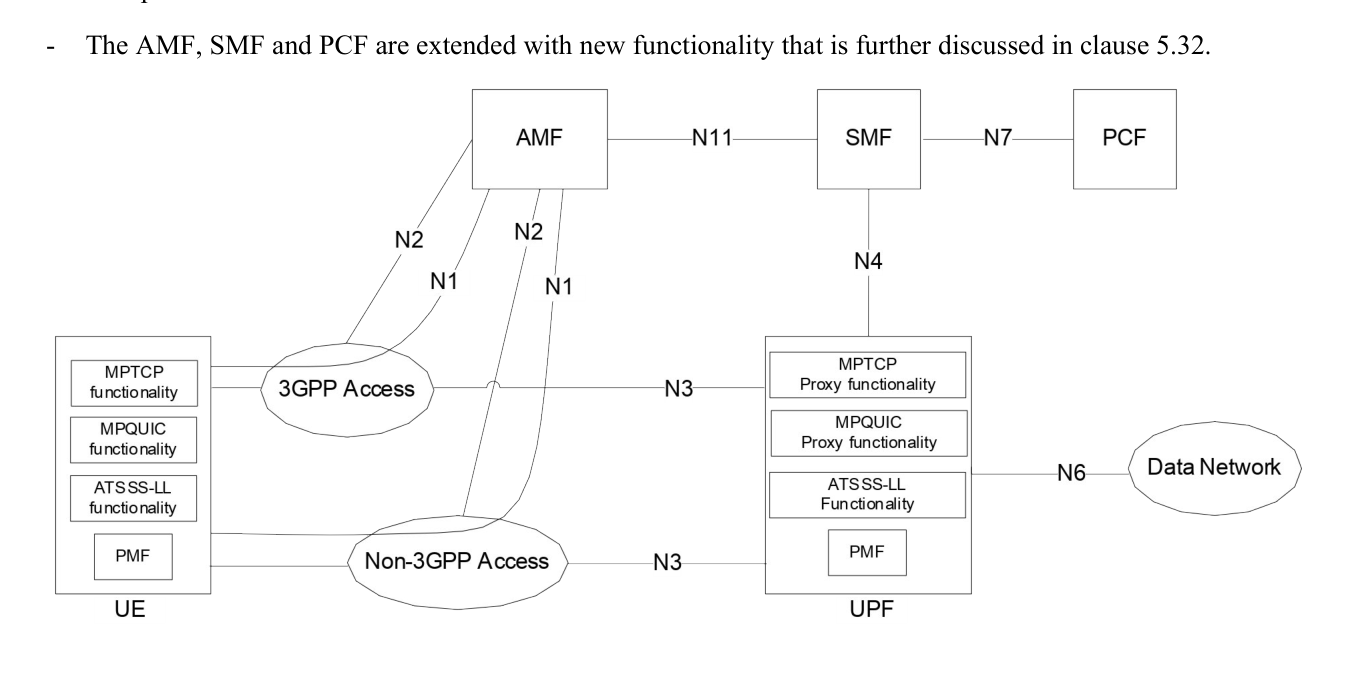
In order to support the ATSSS feature, the 5G System Architecture is extended as shown in Figure 4.2.10-1, Figure 4.2.10-2 and Figure 4.2.10-3. The additional functionality that is supported by the UE and the network functions shown in these figures is specified in clause 5.32 below. In summary:
- The UE supports one or more of the steering functionalities specified in clause 5.32.6. Each steering functionality in the UE enables traffic steering, switching and splitting across 3GPP access and non-3GPP access, in accordance with the ATSSS rules provided by the network.
NOTE 1: The "MPQUIC-UDP functionality" is referred to as "MPQUIC functionality" in previous releases of this specification that do not support the MPQUIC-IP functionality and the MPQUIC-E functionality.
- The UPF may support the MPTCP Proxy functionality, which communicates with the MPTCP functionality in the UE by using the MPTCP protocol (IETF RFC 8684 [81]), as defined in clause 5.32.6.2.1.
- The UPF may support one or more of the MPQUIC Proxy functionalities (i.e. the MPQUIC-UDP, MPQUIC-IP, MPQUIC-E Proxy functionalities), which communicate with the respective MPQUIC-UDP functionality, the MPQUIC-IP functionality, or the MPQUIC-E functionality in the UE by using the QUIC protocol (RFC 9000 [166], RFC 9001 [167], RFC 9002 [168]) and its multipath extensions (draft-ietf-quic-multipath [174]), as defined in clause 5.32.6.2.2.
- The UPF shall support at least ATSSS-LL functionality with Active-Standby steering mode and may support ATSSS-LL functionality with other steering modes. There is no user plane protocol defined between the ATSSS-LL functionality in the UE and the ATSSS-LL functionality in the UPF.
NOTE 2: Either ATSSS-LL or MPQUIC-E functionality is enabled in the 5GC for MA PDU Session of type Ethernet.
- In addition, the UPF supports Performance Measurement Functionality (PMF), which may be used by the UE to obtain access performance measurements (see clause 5.32.5) over the user-plane of 3GPP access and/or over the user-plane of non-3GPP access.
- The AMF, SMF and PCF are extended with new functionality that is further discussed in clause 5.32.
NOTE 2: The interactions between the UE and PCF that may be required for ATSSS control are specified in TS 23.503 [45].
NOTE 3: The UPF shown in Figure 4.2.10-1 can be connected via an N9 reference point, instead of the N3 reference point.
Figure 4.2.10-2 shows the 5G System Architecture for ATSSS support in a roaming case with home-routed traffic and when the UE is registered to the same VPLMN over 3GPP and non-3GPP accesses. In this case, the MPTCP Proxy functionality, the MPQUIC Proxy functionality(ies), the ATSSS-LL functionality and the PMF are located in the H-UPF.
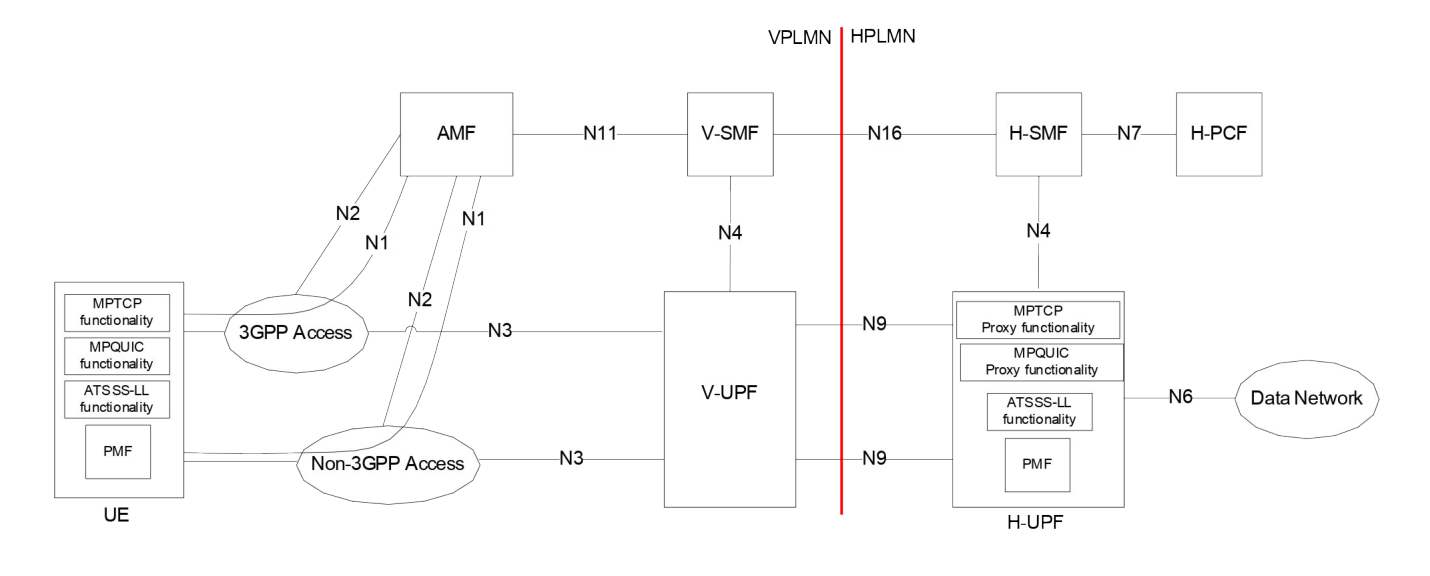
Figure 4.2.10-3 shows the 5G System Architecture for ATSSS support in a roaming case with home-routed traffic and when the UE is registered to a VPLMN over 3GPP access and to HPLMN over non-3GPP access (i.e. the UE is registered to different PLMNs). In this case, the MPTCP Proxy functionality, the MPQUIC Proxy functionality(ies), the ATSSS-LL functionality and the PMF are located in the H-UPF.