3GPP 38.300 v19.3.0 — the document's own text
9.2.5 Paging
Taught in 6. The three states a device sits in (TSG RAN — the group that specifies the radio, in depth).
Paging allows the network to reach UEs in RRC_IDLE and in RRC_INACTIVE state through Paging messages, and to notify UEs in RRC_IDLE, RRC_INACTIVE and RRC_CONNECTED state of system information change (see clause 7.3.3) and ETWS/CMAS indications (see clause 16.4) through Short Messages. Both Paging messages and Short Messages are addressed with P-RNTI on PDCCH, but while the former is sent on PCCH, the latter is sent over PDCCH directly (see clause 6.5 of TS 38.331 [12]).
While in RRC_IDLE the UE monitors the paging channels for CN-initiated paging. While in RRC_INACTIVE with no ongoing SDT procedure (see clause 18.0) the UE monitors paging channels for RAN-initiated paging and CN-initiated paging. A UE need not monitor paging channels continuously though; Paging DRX is defined where the UE in RRC_IDLE or RRC_INACTIVE is only required to monitor paging channels during one Paging Occasion (PO) per DRX cycle (see TS 38.304 [10]). The Paging DRX cycles are configured by the network:
- For CN-initiated paging, a default cycle is broadcast in system information;
- For CN-initiated paging, a UE specific cycle can be configured via NAS signalling;
- For RAN-initiated paging, a UE-specific cycle is configured via RRC signalling;
- The UE uses the shortest of the DRX cycles applicable i.e. a UE in RRC_IDLE uses the shortest of the first two cycles above, while a UE in RRC_INACTIVE uses the shortest of the three.
The POs of a UE for CN-initiated and RAN-initiated paging are based on the same UE ID, resulting in overlapping POs for both. The number of different POs in a DRX cycle is configurable via system information and a network may distribute UEs to those POs based on their IDs.
While in RRC_CONNECTED and while in RRC_INACTIVE with ongoing SDT procedure, the UE monitors the paging channels in any PO signalled in system information for SI change indication and PWS notification. In case of BA, a UE in RRC_CONNECTED only monitors paging channels on the active BWP with common search space configured.
For operation with shared spectrum channel access, a UE can be configured for an additional number of PDCCH monitoring occasions in its PO to monitor for paging. However, when the UE detects a PDCCH transmission within the UE's PO addressed with P-RNTI, the UE is not required to monitor the subsequent PDCCH monitoring occasions within this PO.
If Paging Cause is included in the Paging message, a UE in RRC_IDLE or RRC_INACTIVE state may use the Paging Cause as per TS 23.501[3].
To reduce the probability of potential paging loss due to incomplete UE Radio Capability for Paging, the gNB may update the UE Radio Capability for Paging towards the AMF during the initial context setup procedure as specified in TS 38.413 [26].
Paging optimization for UEs in CM_IDLE: at UE context release, the NG-RAN node may provide the AMF with a list of recommended cells and NG-RAN nodes as assistance info for subsequent paging. The AMF may also provide Paging Attempt Information consisting of a Paging Attempt Count and the Intended Number of Paging Attempts and may include the Next Paging Area Scope. If Paging Attempt Information is included in the Paging message, each paged NG-RAN node receives the same information during a paging attempt. The Paging Attempt Count shall be increased by one at each new paging attempt. The Next Paging Area Scope, when present, indicates whether the AMF plans to modify the paging area currently selected at next paging attempt. If the UE has changed its state to CM CONNECTED the Paging Attempt Count is reset.
Paging optimization for UEs in RRC_INACTIVE: at RAN Paging, the serving NG-RAN node provides RAN Paging area information. The serving NG-RAN node may also provide RAN Paging attempt information. Each paged NG-RAN node receives the same RAN Paging attempt information during a paging attempt with the following content: Paging Attempt Count, the intended number of paging attempts and the Next Paging Area Scope. The Paging Attempt Count shall be increased by one at each new paging attempt. The Next Paging Area Scope, when present, indicates whether the serving NG_RAN node plans to modify the RAN Paging Area currently selected at next paging attempt. If the UE leaves RRC_INACTIVE state the Paging Attempt Count is reset.
UE power saving for paging monitoring: in order to reduce UE power consumption due to false paging alarms, the group of UEs monitoring the same PO can be further divided into multiple subgroups. With subgrouping, a UE shall monitor PDCCH in its PO for paging if the subgroup to which the UE belongs is paged as indicated via associated PEI and/or LP-WUS. UE configured with LP-WUS also monitors a common codepoint associated with all subgroups in a PO. If a UE’s subgroup ID is not indicated in the received PEI, then the UE is not required to monitor its PO. If neither a UE’s subgroup ID nor the common codepoint associated with all subgroups is indicated in the received LP-WUS, then the UE is not required to monitor the following PEI nor its PO. If a UE’s subgroup ID is not supported in a cell or if the UE is unable to monitor the associated PEI and/or LP-WUS occasion corresponding to its PO, it shall monitor the paging in its PO. If the UE is configured with both LP-WUS and PEI, and the UE’s subgroup ID for LP-WUS is not supported in a cell or if the UE is unable to monitor the LP-WUS it monitors the following PEI or paging in its PO.
The gNB configures entry and exit conditions to monitor LP-WUS in system information. The UE may start monitoring LP-WUS when measurements using the MR are above the configured entry threshold(s), and the measurements using the LR are above the entry threshold(s), if configured. Exit conditions for LP-WUS monitoring are based on LR as specified in TS 38.304 [10]. LP-WUS monitoring can be disabled in the UE via NAS signalling. If LP-WUS disable indication via NAS signalling is absent LP-WUS monitoring is enabled, as described in TS 23.501 [3].
These subgroups have the following characteristics:
- They are formed based on either CN controlled subgrouping or UE ID based subgrouping;
- If CN controlled subgroup ID is not provided from AMF, UE ID based subgrouping is used if supported by the UE and network;
- The RRC state (RRC_IDLE or RRC_INACTIVE state) does not impact which subgroup the UE belongs to;
- Subgrouping support for a cell is broadcast in the system information as one of the following: Only CN controlled subgrouping supported, only UE ID based subgrouping supported, or both CN controlled subgrouping and UE ID based subgrouping supported;
- Total number of subgroups allowed in a cell is up to 8 for PEI and up to 31 for LP-WUS and represents the sum of CN controlled and UE ID based subgrouping configured by the network;
- A UE configured with CN controlled subgroup ID applies CN controlled subgroup ID if the cell supports CN controlled subgrouping; otherwise, it derives UE ID based subgroup ID if the cell supports only UE ID based subgrouping.
PEI or LP-WUS associated with subgroups has the following characteristics:
- If the PEI or LP-WUS monitoring is supported by the UE, it shall at least support UE ID based subgrouping method;
- PEI monitoring can be limited via system information to the last used cell (i.e., the cell in which the UE most recently received RRCRelease without indicating that the last used cell for PEI shall not be updated);
- A PEI-capable UE shall store its last used cell information;
- gNBs supporting the PEI monitoring to the last used cell function provide the UE's last used cell information to the AMF in the NG-AP UE Context Release Complete message for PEI capable UEs, as described in TS 38.413 [26];
- UE that expects MBS group notification shall ignore the PEI and LP-WUS and the UE shall monitor paging in its PO.
For LP-WUS, the maximum number of subgroups per PO is dependent on the number of PO(s) associated with one LO as specified in TS 38.331 [12]. The network shall support all PO-to-LO associations as specified in TS 38.213 [38] and TS 38.331 [12].
The typical area in which the PO-to-LO association is the same is up to network configuration.
CN controlled subgrouping: For CN controlled subgrouping, AMF is responsible for assigning subgroup ID to the UE. The total number of subgroups for CN controlled subgrouping which can be configured, e.g. by OAM is up to 8 for PEI and up to 31 for LP-WUS. It is assumed that the same number of CN controlled subgroups is used at least within the registration area or the entire PLMN. It is assumed that CN controlled subgrouping support is homogeneous within a TA.
The following figure describes the procedure for CN controlled subgrouping for PEI and LP-WUS:
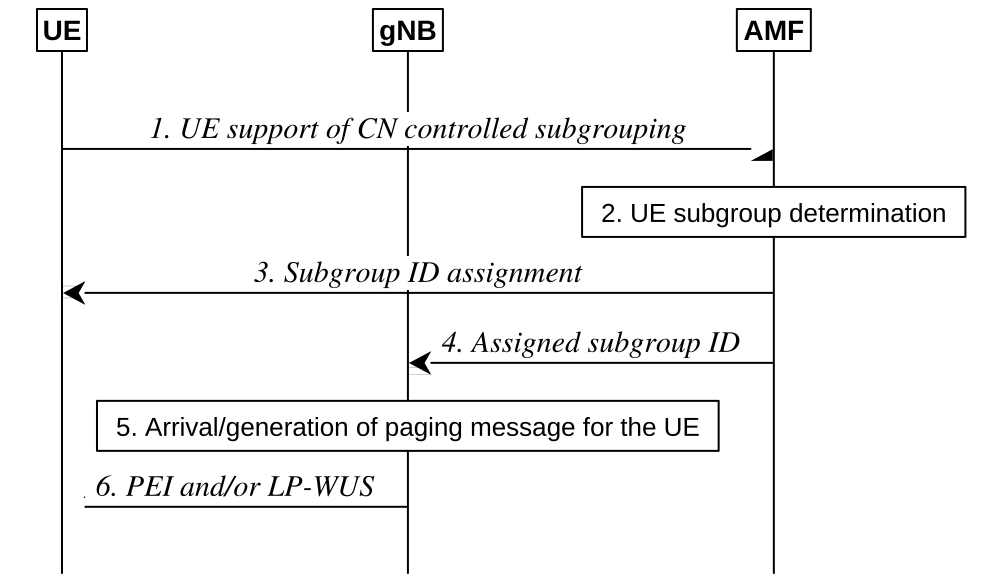
1. The UE indicates its support of CN controlled subgrouping via NAS signalling.
2. If the UE supports CN controlled subgrouping, the AMF determines the subgroup ID assignment for the UE.
3. The AMF sends subgroup ID to the UE via NAS signalling.
4. The AMF informs the gNB about the CN assigned subgroup ID for paging the UE in RRC_IDLE/ RRC_INACTIVE state.
5. When the paging message for the UE is received from the CN or is generated by the gNB, the gNB determines the PO and the associated PEI and/or LP-WUS occasion for the UE.
6. Before the UE is paged in the PO, the gNB transmits the associated PEI and/or LP-WUS and indicates the corresponding CN controlled subgroup of the UE that is to be paged using PEI and/or LP-WUS.
UE ID based subgrouping: For UE ID based subgrouping, the gNB and UE can determine the subgroup ID based on the UE ID and the total number of subgroups for UE ID based subgrouping in the cell. The total number of subgroups for UE ID based subgrouping is decided by the gNB for each cell and can be different in different cells. Up to 31 subgroups are supported for LP-WUS. The following figure describes the procedure for UE ID based subgrouping:
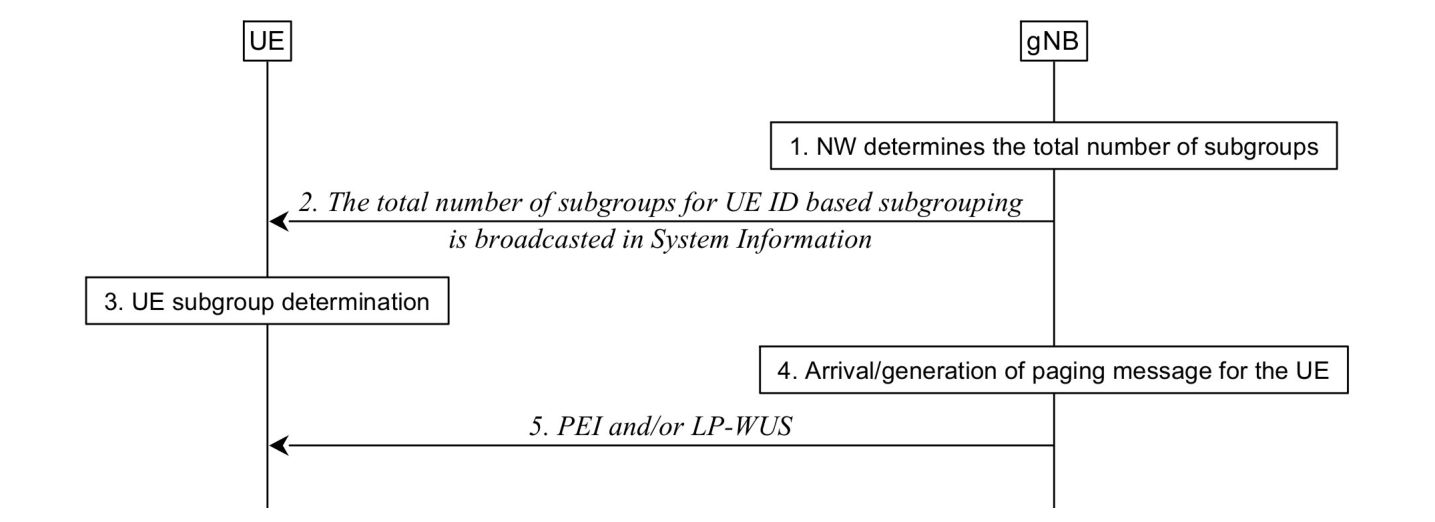
1. The gNB determines the total number of subgroups for UE ID based subgrouping in a cell.
2. The gNB broadcasts the total number of subgroups for UE ID based subgrouping in a cell.
3. UE determines its subgroup in a cell.
4. When paging message for the PEI and/or LP-WUS capable UE is received from the CN at the gNB or is generated by the gNB, the gNB determines the PO and the associated PEI and/or LP-WUS occasion for the UE.
5. Before the UE is paged in the PO, the gNB transmits the associated PEI and/or LP-WUS and indicates the corresponding subgroup derived based on UE ID of the UE that is paged using PEI and/or LP-WUS.
Paging adaptation for network energy saving for UEs in RRC_IDLE and RRC_INACTIVE: in order to increase gNB sleeping time, the value of N and Ns are extended to increase the number of POs per PF with sparser PFs. The UE supporting paging adaptation shall monitor PDCCH in POs separately signalled for paging adaptation, if configured. The UE supporting paging adaptation and PEI and/or LP-WUS can monitor PEIs and/or LP-WUS separately signalled for paging adaptation, if configured.