3GPP 38.300 v19.3.0 — the document's own text
18.3 SDT without UE context relocation
The overall procedure for SDT procedure over RACH without UE context relocation is illustrated in the figure 18.3-1.
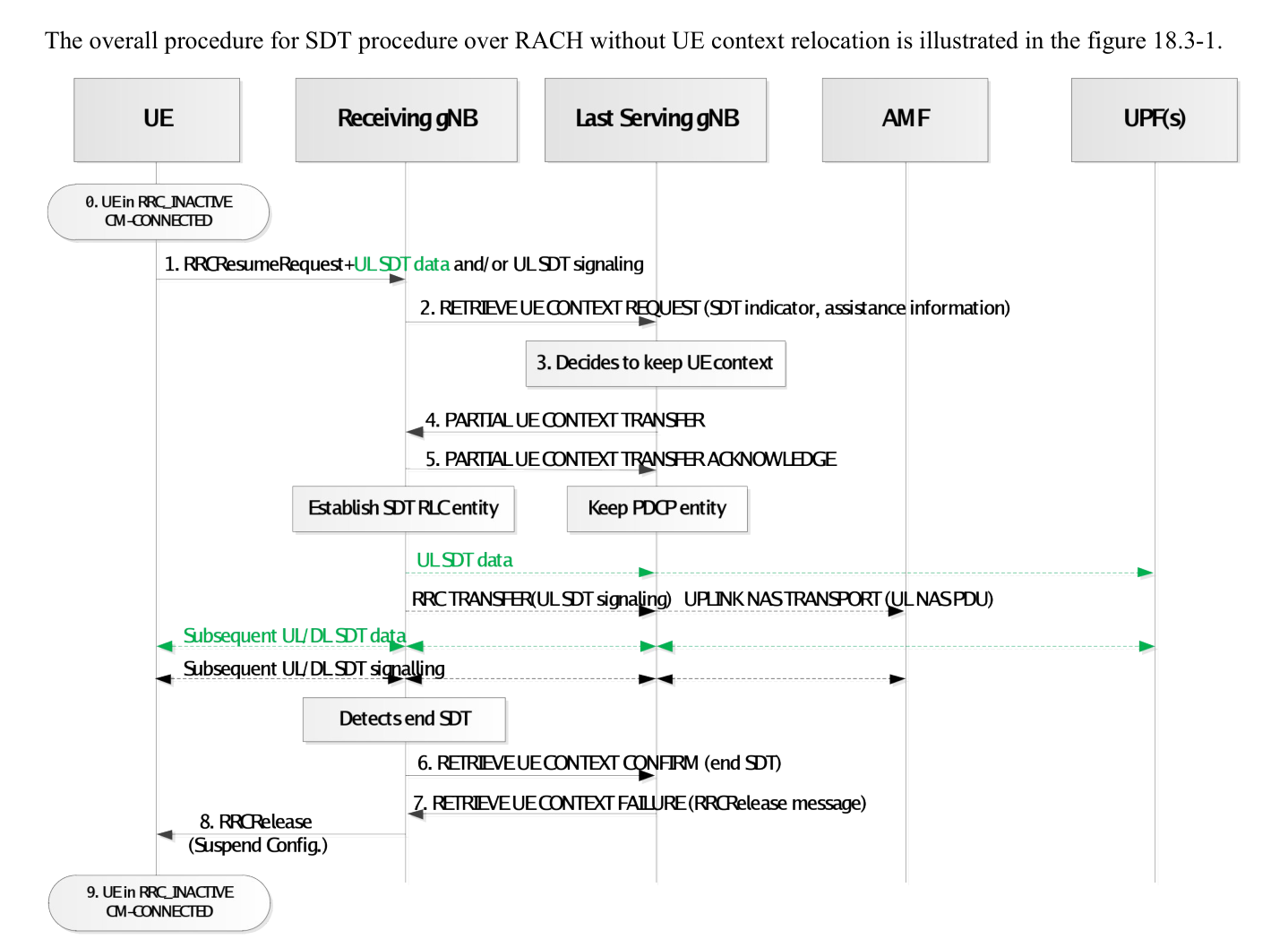
1/2. The steps 1/2 are as defined in steps 1/2 in Figure 18.2-1.
3. The last serving gNB decides not to relocate the full UE context for SDT. In case that the Last Serving gNB has requested AMF for CN Buffering as part of step 0 for the UE in RRC INACTIVE state with eDRX cycle longer than 10.24 seconds, reachability of the UE is indicated to the AMF by the last serving gNB using the MT Communication Handling procedure as described in TS 23.501 [3] and TS 38.413 [26].
4. The last serving gNB transfers a partial UE context including the SDT related RLC context.
5. The receiving gNB acknowledges receiving the partial UE context and provides associated DL TNL address. The UE context is kept at the last serving gNB and the SDT related RLC context is established at the receiving gNB. Then UL/DL GTP-U tunnels are established for DRBs configured for SDT, if any, and the UL SDT data and/or signalling, if any, are forwarded to the last serving gNB, and then delivered to the core network.
NOTE 1: The DL signalling from the last serving gNB, if any, is forwarded to the receiving gNB via the RRC TRANSFER message, for which the receiving gNB delivers it to the UE.
NOTE 1a: In case DL non-SDT data or DL non-SDT signalling arrives, or UE assistance information (i.e. UL non-SDT data arrival indication) is received from the UE, the last serving gNB terminates the SDT procedure by sending the RRCRelease message.
NOTE 1b: The last serving gNB may terminate the SDT procedure by sending the RRCRelease message based on (e.g. large size of) DL SDT data or DL SDT signalling.
6. The receiving gNB detects the end of SDT session and sends the RETRIEVE UE CONTEXT CONFIRM message including whether this is a "normal" end of SDT transaction or a radio link problem, or large SDT volume from BSR.
7. Upon receiving the RETRIEVE UE CONTEXT CONFIRM message and deciding to terminate the SDT, the last serving gNB responds to the receiving gNB with the RETRIEVE UE CONTEXT FAILURE message including an encapsulated RRCRelease message. The receiving gNB shall release the established partial UE context.
NOTE 2: Void.
NOTE 3: Void.
8. The receiving gNB sends the RRCRelease message to the UE.
NOTE 4: Void.
NOTE 5: The last serving gNB may terminate the SDT procedure by sending the RRCRelease message upon receiving the indication about large uplink SDT data from the BSR from the receiving gNB in step 6.
NOTE 6: The Last Serving gNB may send the NGAP MT Communication Handling Request message to the AMF to trigger CN buffering when the UE is put again into RRC_INACTIVE state with eDRX cycle longer than 10.24 seconds.
9. The UE moves to RRC_INACTIVE state if the suspend indication is included in the RRCRelease message, or the UE may initiate RRC resume procedure to transition to RRC_CONNECTED state if the resume indication is included in the RRCRelease message. Or else, the UE moves to RRC_IDLE state.