3GPP 38.300 v19.3.0 — the document's own text
16.12.2.2 L2 UE-to-UE Relay
The protocol stacks for the user plane and the control plane of the L2 U2U Relay architecture are illustrated in Figure 16.12.2.2-1 and Figure 16.12.2.2-2. The SRAP sublayer is placed above the RLC sublayer for both CP and UP at both PC5 interfaces. The sidelink SDAP, PDCP and RRC are terminated between two L2 U2U Remote UEs (i.e., end-to-end), while SRAP, RLC, MAC and PHY are terminated in each hop of PC5 link.
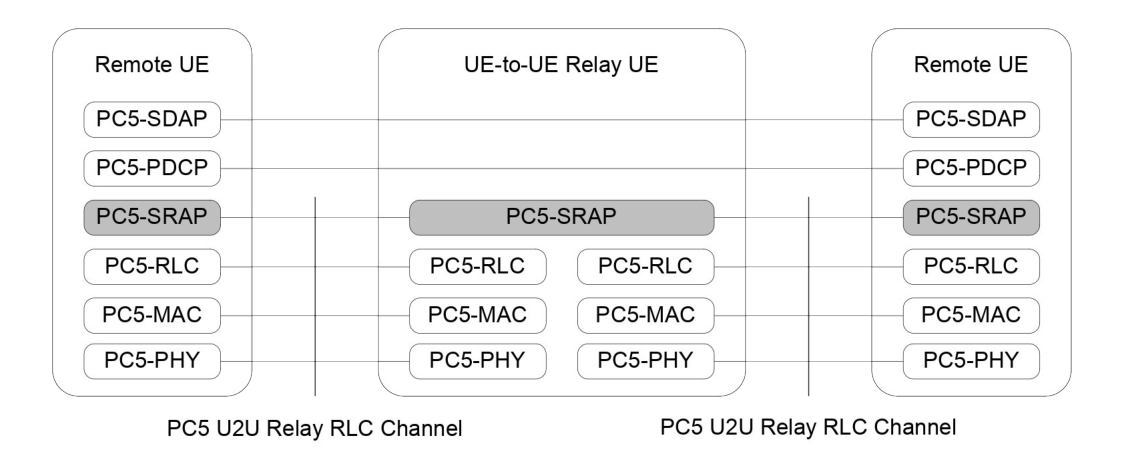
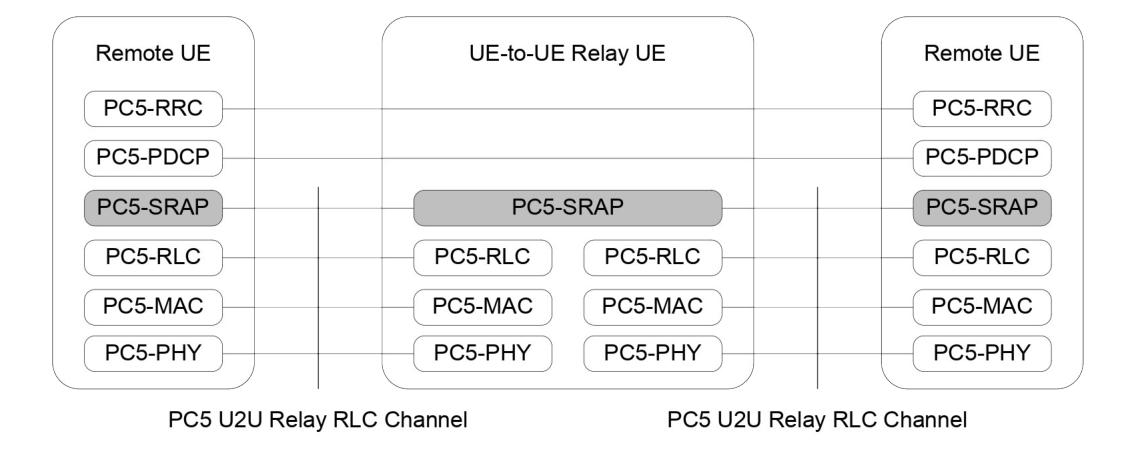
For L2 UE-to-UE Relay, the SRAP sublayer at L2 U2U Remote UE:
- The SRAP sublayer at L2 U2U Remote UE performs bearer mapping between end-to-end PC5 Radio Bearers (SL-SRBs or SL-DRBs) of the L2 U2U Remote UE and PC5 Relay RLC Channels between the L2 U2U Remote UE and the L2 U2U Relay UE.
- For the traffic transmitted from an L2 U2U Remote UE to an L2 U2U Relay UE, the different end-to-end PC5 Radio Bearers (SL-SRBs or SL-DRBs) towards the same peer L2 U2U Remote UE and/or different peer L2 U2U Remote UEs can be multiplexed to the same PC5 Relay RLC channel between the L2 U2U Remote UE(s) and the L2 U2U Relay UE. An end-to-end SL-DRB and an end-to-end SL-SRB cannot be multiplexed to the same PC5 Relay RLC channel.
- For the traffic received at L2 U2U Remote UE, the same PC5 Relay RLC channel from one L2 U2U Relay UE can be de-multiplexed to the different end-to-end PC5 Radio Bearers (SL-SRBs or SL-DRBs) of the same peer L2 U2U Remote UE and/or different peer L2 U2U Remote UEs.
- The SRAP sublayer at L2 U2U Remote UE supports identification of the peer L2 U2U Remote UE and itself. The local IDs are assigned by L2 U2U Relay UE to both L2 U2U Remote UEs for identification. For the two local IDs, one of them identifies L2 U2U Remote UE and the other identifies the peer L2 U2U Remote UE. The local ID of the peer L2 U2U Remote UE and the local ID of L2 U2U Remote UE are delivered by L2 U2U Relay UE to the L2 U2U Remote UEs along with the corresponding L2 ID of the peer L2 U2U Remote UE. The SRAP header includes the identity information of the end-to-end PC5 Radio Bearer and two local IDs. The peer L2 U2U Remote UE matches the received packets with the specific sidelink PDCP entity with the correct end-to-end PC5 Radio Bearer of the L2 U2U Remote UEs.
For L2 UE-to-UE Relay, the SRAP sublayer at L2 U2U Relay UE:
- The SRAP sublayer at L2 U2U Relay UE determines the egress PC5 Relay RLC Channel based on the mapping of the end-to-end PC5 Radio Bearer and egress PC5 Relay RLC Channel for a particular pair of L2 U2U Remote UE and the peer L2 U2U Remote UE.
- For the ingress traffic received from an/multiple L2 U2U Remote UE(s) at L2 U2U Relay UE, the different end-to-end PC5 Radio Bearers (SL-SRBs or SL-DRBs) of the same L2 U2U Remote UE and/or the same/different end-to-end PC5 Radio Bearers (SL-SRBs or SL-DRBs) of L2 U2U Remote UEs can be multiplexed to the same egress PC5 Relay RLC channel in between the L2 U2U Relay UE and the peer L2 U2U Remote UE. An end-to-end SL-DRB and an end-to-end SL-SRB cannot be multiplexed to the same PC5 Relay RLC channel.