3GPP 38.300 v19.3.0 — the document's own text
15.3.3.2 Intra-system Automatic Neighbour Cell Relation Function
ANR relies on NCGI (see clause 8.2) and ANR reporting of E-UTRA cells as specified in TS 36.300 [2].
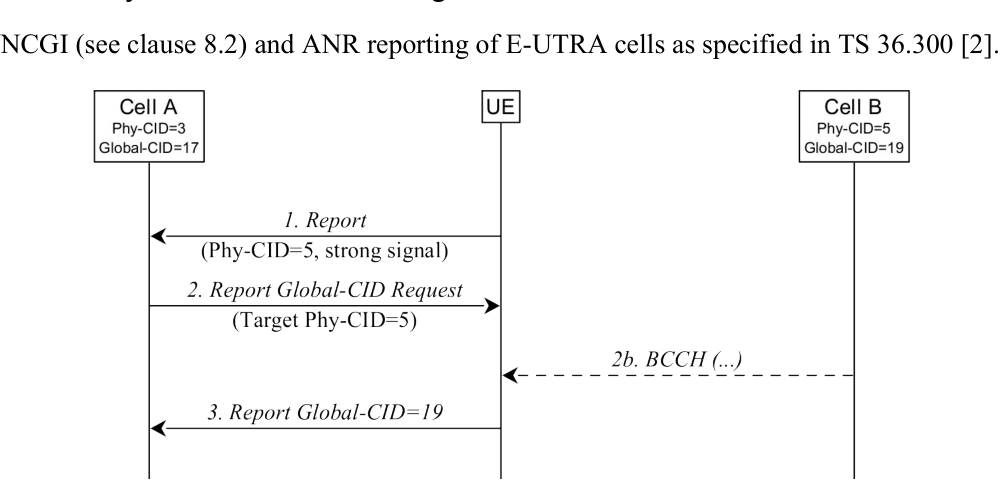
Figure 15.3.3.2-1 depicts an example where the NG-RAN node serving cell A has an ANR function. In RRC_CONNECTED, the NG-RAN node instructs each UE to perform measurements on neighbour cells. The NG-RAN node may use different policies for instructing the UE to do measurements, and when to report them to the NG-RAN node. This measurement procedure is as specified in TS 38.331[12] and TS 36.331 [29].
1. The UE sends a measurement report regarding cell B. This report contains Cell B's PCI, but not its NCGI/ECGI.
When the NG-RAN node receives a UE measurement report containing the PCI, the following sequence may be used.
2. The NG-RAN node instructs the UE, using the newly discovered PCI as parameter, to read all the broadcast NCGI(s) /ECGI(s), TAC(s), RANAC(s), PLMN ID(s) and, for neighbour NR cells, NR frequency band(s) and the gNB ID length(s). To do so, the NG-RAN node may need to schedule appropriate idle periods to allow the UE to read the NCGI/ECGI from the broadcast channel of the detected neighbour cell. How the UE reads the NCGI/ECGI is specified in TS 38.331 [12] and TS 36.331 [29].
3. When the UE has found out the new cell's NCGI(s) /ECGI(s), the UE reports all the broadcast NCGI(s)/ECGI(s) to the serving cell NG-RAN node. In addition, the UE reports all the tracking area code(s), RANAC(s), PLMN IDs and, for neighbour NR cells, NR frequency band(s), and the gNB ID length(s) that have been read by the UE. In case the detected NR cell does not broadcast SIB1, the UE may report noSIB1 indication as specified in TS 38.331 [12].
4. The NG-RAN node decides to add this neighbour relation, and can use PCI and NCGI(s)/ECGI(s) to:
a. Lookup a transport layer address to the new NG-RAN node;
b. Update the Neighbour Cell Relation List;
c. If needed, setup a new Xn interface towards this NG-RAN node.