3GPP 38.300 v19.3.0 — the document's own text
15.3.3.1 General
The purpose of ANR function is to relieve the operator from the burden of manually managing NCRs. Figure 15.3.3.1-1 shows ANR and its environment:
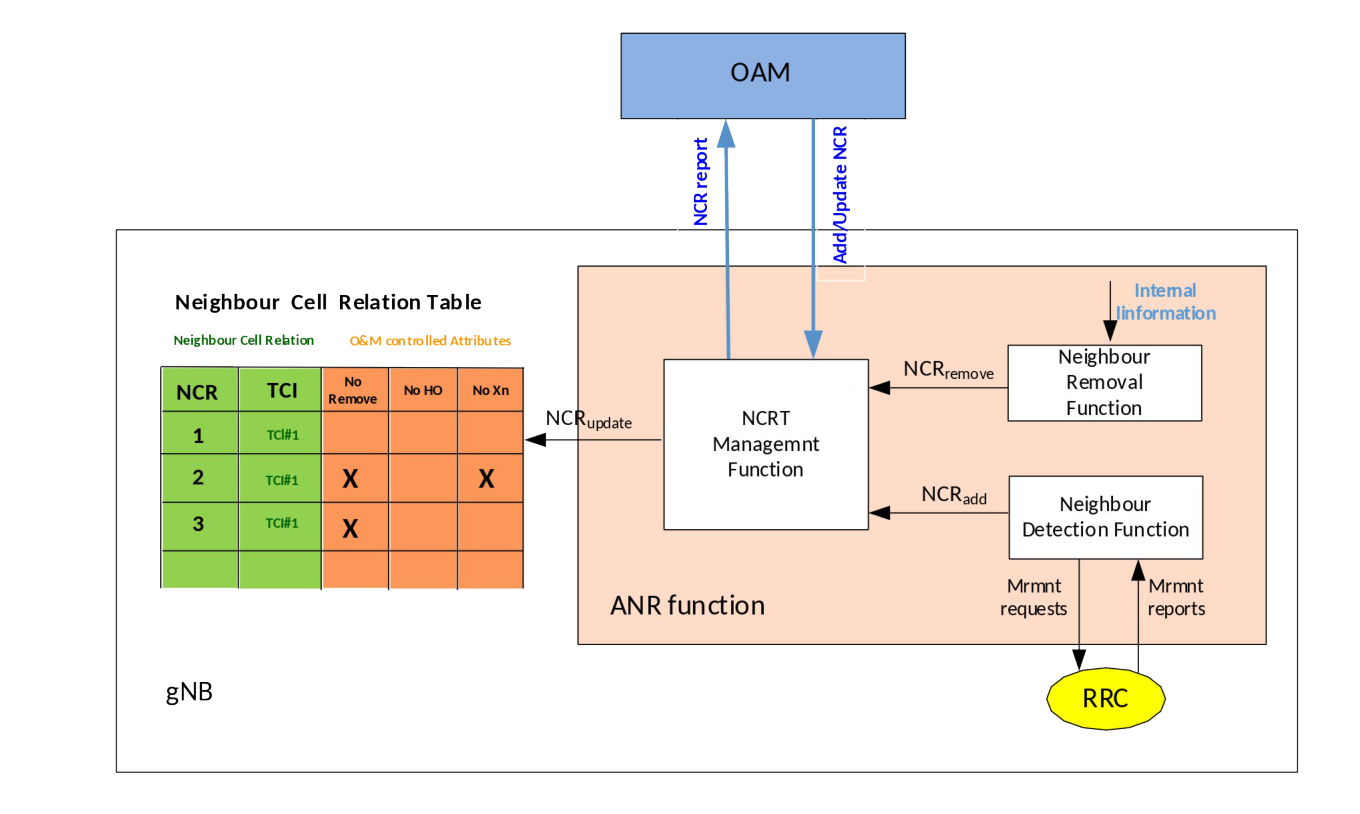
The ANR function resides in the gNB and manages the Neighbour Cell Relation Table (NCRT). Located within ANR, the Neighbour Detection Function finds new neighbours and adds them to the NCRT. ANR also contains the Neighbour Removal Function which removes outdated NCRs. The Neighbour Detection Function and the Neighbour Removal Function are implementation specific.
An existing NCR from a source cell to a target cell means that gNB controlling the source cell:
- Knows the global and physical IDs (e.g. NR CGI/NR PCI, ECGI/PCI) of the target cell; and
- Has an entry in the NCRT for the source cell identifying the target cell; and
- Has the attributes in this NCRT entry defined, either by OAM or set to default values.
NCRs are cell-to-cell relations, while an Xn link is set up between two gNBs. Neighbour Cell Relations are unidirectional, while an Xn link is bidirectional.
NOTE: The neighbour information exchange, which occurs during the Xn Setup procedure or in the gNB Configuration Update procedure, may be used for ANR purpose.
The ANR function also allows OAM to manage the NCRT. OAM can add and delete NCRs. It can also change the attributes of the NCRT. The OAM system is informed about changes in the NCRT.