3GPP 23.369 v20.0.0 — the document's own text
6.2.6 DO-A Capable AIoT Device Registration Procedure
Figure 6.2.6-1 describes the DO-A Capable AIoT Device Registration procedure.
The procedure focuses on the messages and parameters used for the communication between AIOTF and NG-RAN regardless of the path to access NG-RAN, see clause 4.2.2.1.
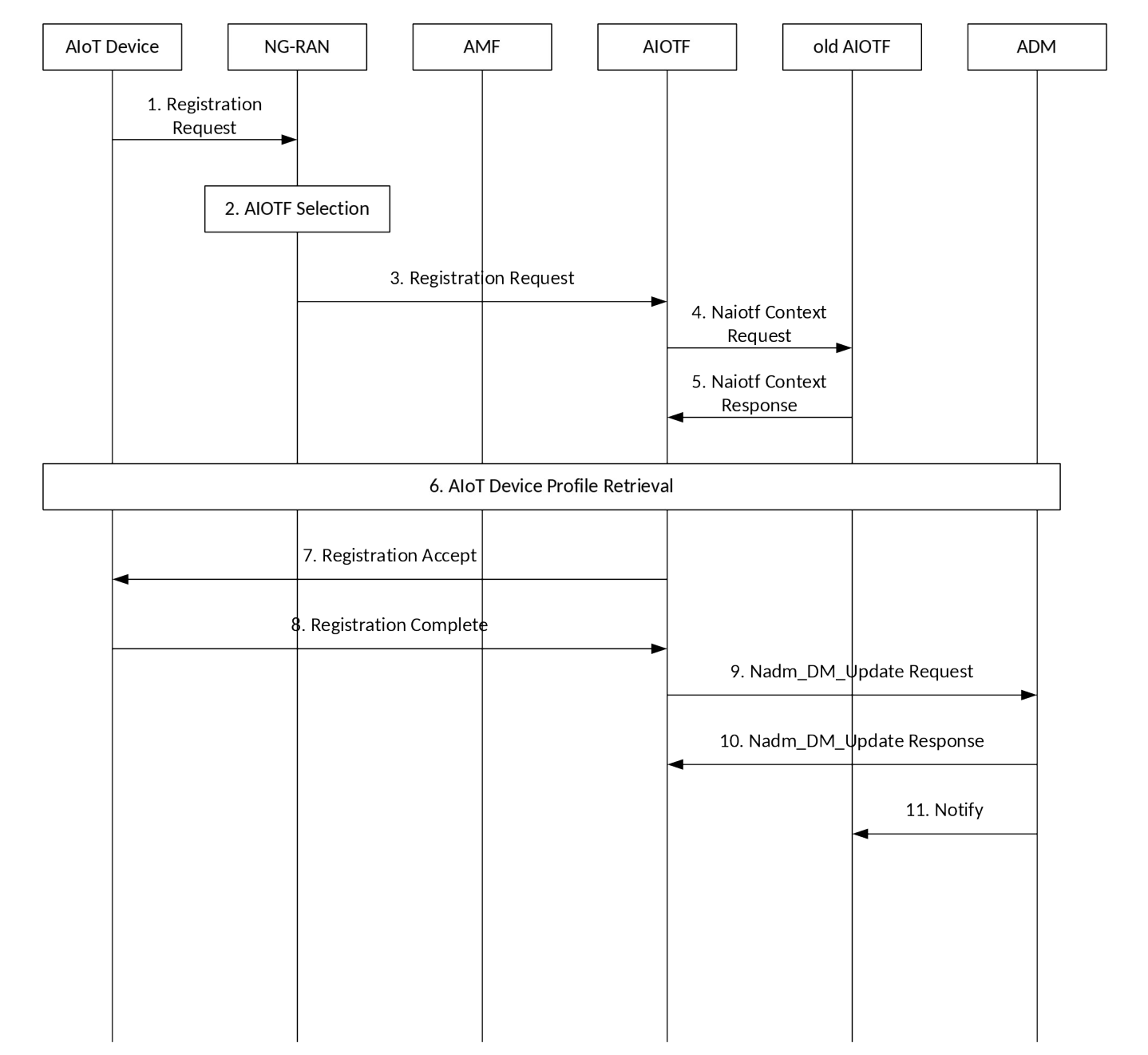
1. The DO-A Capable AIoT Device initiates the Registration Procedure when moving outside of the AIoT Registration Area, or e.g., when powered on. DO-A Capable AIoT Device to NG-RAN: AS message ([AIOTF ID], Registration Request([DO-A Capable AIoT Device Temporary Identifier], [Protected DO-A Capable AIoT Device Identifier])).
If the DO-A Capable AIoT Device has a DO-A Capable AIoT Device Temporary Identifier, the AIOTF ID in the AS message is the AIOTF ID from the DO-A Capable AIoT Device Temporary Identifier, see clause 5.7.5. The AIOTF ID allows NG-RAN to select and route the Registration Request message to the appropriate AIOTF.
2. NG-RAN selects an AIOTF to route the Registration Request message to, based on the AIOTF ID, if provided by the DO-A Capable AIoT Device, or NG-RAN selects an AIOTF based on local configuration.
3. NG-RAN sends AIoT NGAP message including the AIOTF ID (if available) RAN AIoT Device NGAP ID, and the Registration Request message to the selected AIOTF.
4-5. The AIOTF may retrieve the AIoT Device Context if the AIOTF is not serving AIOTF for the AIoT Device and the old AIOTF can be determined from the DO-A Capable AIoT Device Temporary Identifier provided by the DO-A Capable AIoT Device.
6. The AIOTF may perform authentication and security procedures, obtain the AIoT Device Profile Data and establishes an AIoT Device Context.
If the AIOTF does not have an AIoT Device Context for the DO-A Capable AIoT Device, the AIoT Device Permanent Identifier is determined from the Protected DO-A Capable AIoT Device provided in step 1, and the AIOTF obtains the AIoT Device Profile Data for the AIoT Device from its ADM. The AIOTF performs ADM discovery and selection as defined in clause 5.3.2 to find the ADM for the DO-A Capable AIoT Device.
Editor's note: Details of authentication, security procedures and Protected DO-A Capable AIoT Device Identifier will be determined and coordinated by SA WG3.
7. The AIOTF sends an NGAP message to NG-RAN including RAN AIoT Device NGAP ID, and Registration Accept (DO-A Capable AIoT Device Temporary Identifier, [AIoT Registration Area]) to send to the DO-A Capable AIoT Device.
Editor's note: Further parameters (for example a Registration Area) in the Registration Accept are FFS.
8. The DO-A Capable AIoT Device sends a Registration Complete message to the AIOTF to acknowledge the Registration Accept. The DO-A Capable AIoT Device stores the AIoT Registration Area.
When the registration procedure is complete the DO-A Capable AIoT Device Uplink Application Message Delivery Procedure, see clause 6.2.10, can be performed.
9-10. If the AIOTF is not the serving AIOTF for the DO-A Capable AIoT Device the AIOTF registers with the ADM as the serving AIOTF using the Nadm_DM_Update(AIoT Device Permanent Identifier, AIOTF ID) service operation. The ADM updates the serving AIOTF information in the AIoT Device Profile Data for the AIoT Device.
11. If the ADM determines that the serving AIOTF has changed, and there was an old serving AIOTF, then the ADM notifies the old AIOTF that it is no longer the serving AIOTF for the DO-A Capable AIoT Device. The old AIOTF discards any AIoT Device Context it has for the AIoT Device and responds to the ADM.