What it is and who wrote it · chapter 2 of 4 · 4 minutes
2 The pieces a 5G core is made of
What a network function is, the three that carry a connection, the ones standing behind them, and how the whole set talks.
Built from §4.1 §4.2.1 §4.2.2 §4.2.7 §6.1 §6.2.1 §6.2.2 §6.2.3
2.1 Why the core is software and not boxes
An operator wants to run its core network the way it runs anything else: on ordinary servers, in containers, scaled one piece at a time, with some pieces in a central data centre and others in a cabinet beside the radio mast.
A design made of fixed boxes with a fixed cable between every pair of them cannot be deployed like that. So the first clause of the architecture says the 5G system is defined to support exactly those techniques, and then lists the choices that follow §4.1.
Two of them shape everything else. The user plane — the parts that carry your packets — is separated from the control plane, the parts that decide what to do with them, so the two scale on their own and sit in different places.
And behaviour is defined as services that any authorised function may call, rather than as wiring between pairs of boxes.
2.2 What a network function is
A network function is a named list of jobs. It is not a server, not a process and not a vendor's product. Clause 6 is where those lists are written down §6.1, and thirty-three of them are named §4.2.2, plus two the clause calls network entities rather than functions.
2.3 The three that carry a connection
Almost everything a device does passes through these three.
AMF — the Access and Mobility Management Function. The device's one contact point in the core: it knows where the device is, whether it can be reached, and whether its subscription lets it be here at all. It is also the only place the signalling conversation with the device ends §6.2.1.
SMF — the Session Management Function. It sets up, changes and releases a device's connection to a data network, hands out the device's IP address, and picks and programs the user-plane function that will carry the traffic §6.2.2.
UPF — the User Plane Function. The only one of the three that touches a packet. It forwards, inspects, counts, buffers and rate-limits, and it is where the device's traffic meets the outside network §6.2.3.
2.4 The ones standing behind them
-
UDM and UDR — the subscriber's home. The UDM holds who a subscriber is and what they are allowed; the UDR is the store the data sits in.
-
AUSF — runs the exchange that proves a device is who it claims to be.
-
PCF — the Policy Control Function, which decides the rules others enforce.
-
NRF — the directory. Functions register themselves with it and ask it to find each other.
-
NSSF — works out which slices of the network may serve a device.
-
NEF — the door to the outside, through which software that is not part of the network asks the network for things.
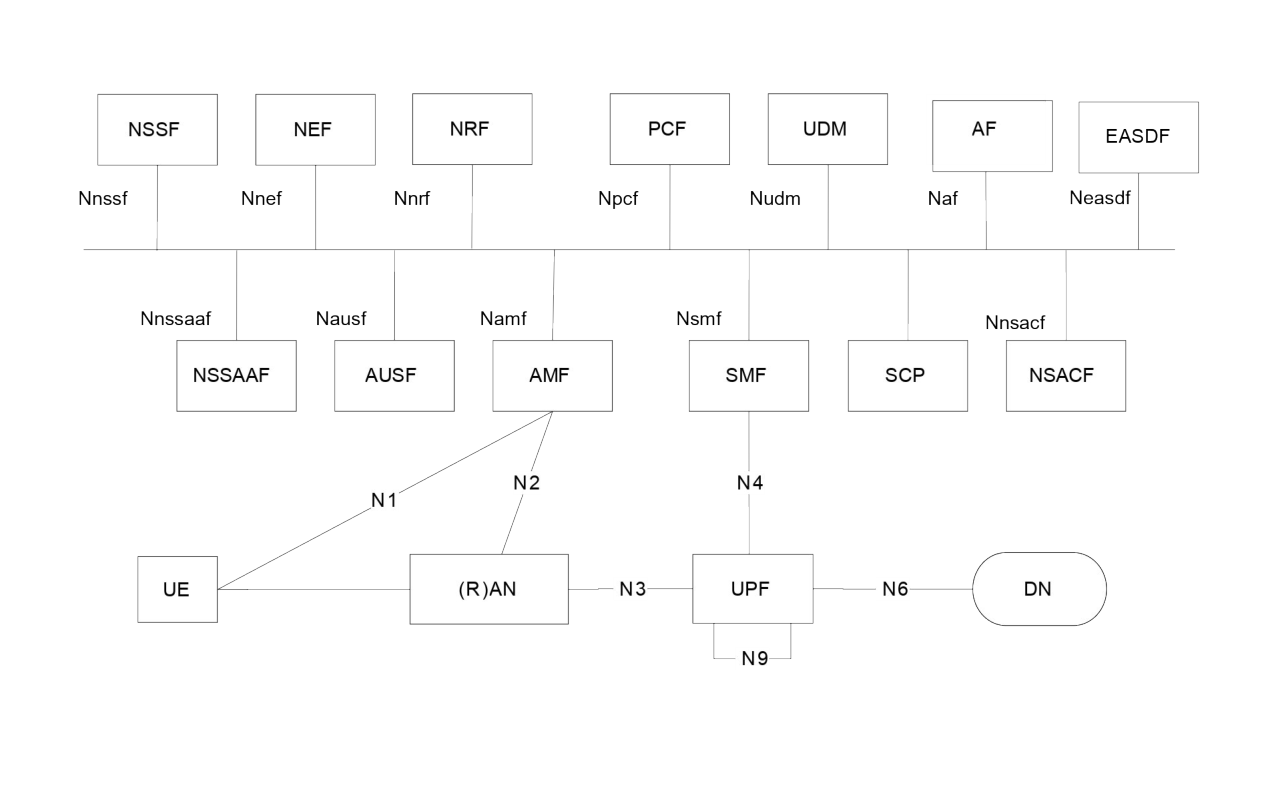
The radio network, the device and the data network appear in the same picture, even though the radio side is specified in other documents §4.2.1.
2.5 How they talk
That drawing puts every control-plane function on one horizontal bar. The bar is not a cable and not a bus. It means: each of these offers services, and any authorised function may call them.
Each function's set of services is named N plus its own name in lower case —
Namf for the AMF, Nsmf for the SMF. The name belongs to the one
offering the services, never to a pair.
The same network is also drawn a second way, as a graph with a labelled edge between each pair of functions that talk.
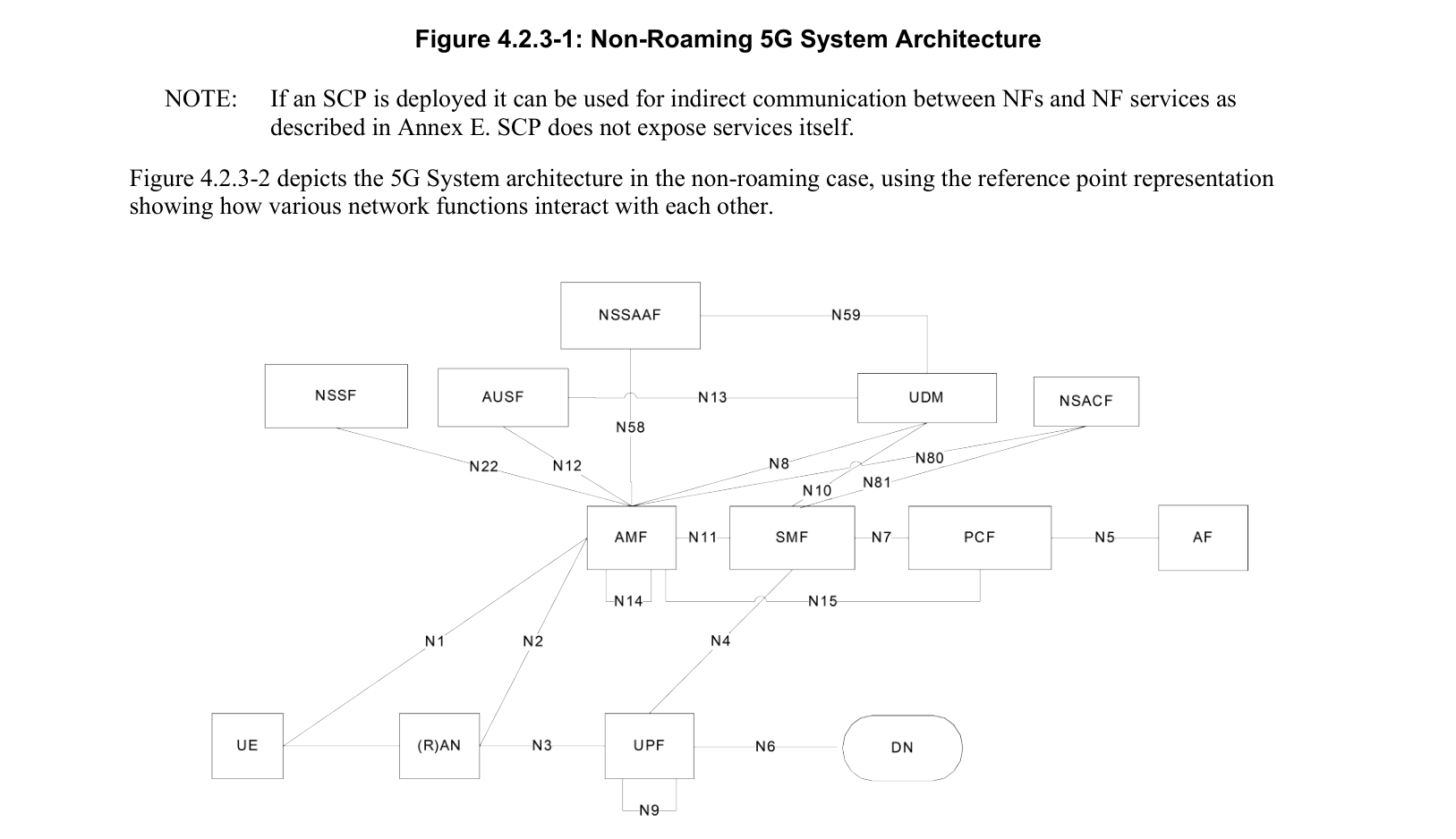
Those labels are the reference points, and they come in two families §4.2.7. Six are genuinely their own link:
| Reference point | Between |
|---|---|
| N1 | the device and the AMF |
| N2 | the radio network and the AMF |
| N3 | the radio network and the UPF |
| N4 | the SMF and the UPF |
| N6 | the UPF and a data network |
| N9 | two UPFs |
Now watch a device use them, in What happens when a phone switches on.
Check yourself
Answers appear when you pick one, with where they come from.
Q2.1 The document says "some or all of the UPF functionalities may be supported in a single instance of a UPF". What does that tell you about a network function?
A function is a bundle of responsibilities with a name. How many machines carry it, and which jobs each one takes, is a deployment choice the specification stays out of. §6.2.3
Q2.2 Which function actually forwards a user's packets?
The UPF is the data path — routing, forwarding, inspection, rate enforcement. The AMF and the SMF only ever handle signalling. §6.2.3
Q2.3 How may two control-plane functions of the 5G core talk to each other?
One sentence of clause 4.2.1 settles it — control-plane network functions shall only use service-based interfaces for their interactions. §4.2.1
Q2.4 Which of these is a real link of its own rather than a name for a set of service calls?
Six reference points are listed before the sentence that says the rest are realized by service-based interfaces. N1, N2, N3, N4, N6 and N9 are those six. §4.2.7
This chapter was written against TS 23.501 version 20.2.0, verified 2026-08-04. A newer version of the document may say something else.