3GPP 24.501 v20.0.0 — the document's own text
6.4.1.2 UE-requested PDU session establishment procedure initiation
Taught in 4. Inside TS 24.501, the document at the centre (CT1 — the group that writes what your phone says, overview).
In order to initiate the UE-requested PDU session establishment procedure, the UE shall create a PDU SESSION ESTABLISHMENT REQUEST message.
NOTE 0: When IMS voice is available over either 3GPP access or non-3GPP access, the "voice centric" UE in 5GMM-REGISTERED state will receive a request from upper layers to establish the PDU session for IMS signalling, if the conditions for performing an initial registration with IMS indicated in 3GPP TS 24.229 [14] clause U.3.1.2 are satisfied.
If the UE requests to establish a new PDU session, the UE shall allocate a PDU session ID which is not currently being used by another PDU session over either 3GPP access or non-3GPP access. If the N5CW device supporting 3GPP access requests to establish a new PDU session via 3GPP access, the N5CW device supporting 3GPP access shall refrain from allocating "PDU session identity value 15". If the TWIF acting on behalf of the N5CW device requests to establish a new PDU session, the TWIF acting on behalf of the N5CW device shall allocate the "PDU session identity value 15".
The UE shall allocate a PTI value currently not used and shall set the PTI IE of the PDU SESSION ESTABLISHMENT REQUEST message to the allocated PTI value.
If the UE is registered for emergency services over the current access, the UE shall not request establishing a non-emergency PDU session over the current access. If the UE is registered for emergency services over the current access it shall not request establishing an emergency PDU session over the non-current access except if the request is for transferring the emergency PDU session to the non-current access. Before transferring an emergency PDU session from non-3GPP access to 3GPP access, or before transferring a PDN connection for emergency bearer services from untrusted non-3GPP access connected to EPC to 3GPP access, the UE shall check whether emergency services are supported in the NG-RAN cell (either an NR cell or an E-UTRA cell) on which the UE is camping.
NOTE 1: Transfer of an existing emergency PDU session or PDN connection for emergency bearer services between 3GPP access and non-3GPP access is needed e.g. if the UE determines that the current access is no longer available.
If the UE requests to establish a new emergency PDU session, the UE shall include the PDU session type IE in the PDU SESSION ESTABLISHMENT REQUEST message and shall set the IE to the IP version capability as specified in clause 6.2.4.2.
If the UE requests to establish a new non-emergency PDU session with a DN, the UE shall include the PDU session type IE in the PDU SESSION ESTABLISHMENT REQUEST message and shall set the IE to one of the following values: "IPv4", "IPv6", "IPv4v6", "Ethernet" or "Unstructured" based on the URSP rules or based on UE local configuration (see 3GPP TS 24.526 [19]) and based on the IP version capability as specified in clause 6.2.4.2.
NOTE 2: When the UE initiates the UE-requested PDU session establishment procedure to transfer an existing non-IP PDN connection in the EPS to the 5GS, the UE can use locally available information associated with the PDN connection to select the PDU session type between "Ethernet" and "Unstructured".
If the UE requests to establish a new non-emergency PDU session with a DN and the UE requests an SSC mode, the UE shall set the SSC mode IE of the PDU SESSION ESTABLISHMENT REQUEST message to the SSC mode. If the UE requests to establish a PDU session of "IPv4", "IPv6" or "IPv4v6" PDU session type, the UE shall either omit the SSC mode IE or set the SSC mode IE to "SSC mode 1", "SSC mode 2", or "SSC mode 3". If the UE requests to establish a PDU session of "Ethernet" or "Unstructured" PDU session type, the UE shall either omit the SSC mode IE or set the SSC mode IE to "SSC mode 1" or "SSC mode 2". If the UE requests transfer of an existing PDN connection in the EPS to the 5GS or the UE requests transfer of an existing PDN connection in an untrusted non-3GPP access connected to the EPC to the 5GS, the UE shall set the SSC mode IE to "SSC mode 1".
If the UE requests to establish a new emergency PDU session, the UE shall set the SSC mode IE of the PDU SESSION ESTABLISHMENT REQUEST message to "SSC mode 1".
A UE supporting PDU connectivity service shall support SSC mode 1 and may support SSC mode 2 and SSC mode 3 as specified in 3GPP TS 23.501 [8].
If the UE requests to establish a new non-emergency PDU session with a DN, the UE may include the SM PDU DN request container IE with a DN-specific identity of the UE complying with network access identifier (NAI) format as specified in IETF RFC 7542 [37].
NOTE 3: The UE can avoid including both the SM PDU DN request container IE and the Extended protocol configuration options IE with PAP/CHAP protocol identifiers in the PDU SESSION ESTABLISHMENT REQUEST message. The way to achieve this is implementation dependent.
If the UE requests to:
- establish a new PDU session;
- perform handover of an existing PDU session from non-3GPP access to 3GPP access;
- transfer an existing PDN connection in the EPS to the 5GS according to clause 4.8.2.3.1;
- transfer an existing PDN connection in untrusted non-3GPP access connected to the EPC to the 5GS; or
- establish user plane resources over 3GPP access of an MA PDU session established over non-3GPP access only;
and the UE at the same time intends to join one or more multicast MBS sessions that is associated to the PDU session, the UE should include the Requested MBS container IE in the PDU SESSION ESTABLISHMENT REQUEST message. In that case, the UE shall set the MBS operation to "Join multicast MBS session" and include the multicast MBS session information(s) and shall set the Type of multicast MBS session ID for each of the multicast MBS session information to either "Temporary Mobile Group Identity (TMGI)" or "Source specific IP multicast address" depending on the type of the multicast MBS session ID available in the UE. Then the remaining values of each of the multicast MBS session information shall be set as following:
- if the Type of multicast MBS session ID is set to "Temporary Mobile Group Identity (TMGI)", the UE shall set the multicast MBS session ID to the TMGI; or
- if the Type of multicast MBS session ID is set to "Source specific IP multicast address for IPv4" or " Source specific IP multicast address for IPv6", the UE shall set the Source IP address information and the Destination IP address information to the corresponding values.
The UE should not request to join a multicast MBS session for local MBS service if neither current TAI nor CGI of the current cell is part of the MBS service area(s) of the multicast MBS session, if the UE has valid information of the MBS service area(s) of the multicast MBS session.
NOTE 4: The UE obtains the details of the MBS session ID(s) e.g. TMGI, Source IP address information and Destination IP address information as a pre-configuration in the UE or during the MBS service announcement, which is out of scope of this specification. Pre-configuration can be provided in one or more of the following ways:
The UE should set the RQoS bit to "Reflective QoS supported" in the 5GSM capability IE of the PDU SESSION ESTABLISHMENT REQUEST message if the UE supports reflective QoS and:
- the UE requests to establish a new PDU session of "IPv4", "IPv6", "IPv4v6" or "Ethernet" PDU session type;
- the UE requests to transfer an existing PDN connection in the EPS of "IPv4", "IPv6", "IPv4v6" or "Ethernet" PDN type or of "Non-IP" PDN type mapping to "Ethernet" PDU session type, to the 5GS; or
- the UE requests to transfer an existing PDN connection in an untrusted non-3GPP access connected to the EPC of "IPv4", "IPv6" or "IPv4v6" PDN type to the 5GS.
NOTE 5: The determination to not request the usage of reflective QoS by the UE for a PDU session is implementation dependent.
The UE shall indicate the maximum number of packet filters that can be supported for the PDU session in the Maximum number of supported packet filters IE of the PDU SESSION ESTABLISHMENT REQUEST message if:
- the UE requests to establish a new PDU session of "IPv4", "IPv6", "IPv4v6", or "Ethernet" PDU session type, and the UE can support more than 16 packet filters for this PDU session;
- the UE requests to transfer an existing PDN connection in the EPS of "IPv4", "IPv6", "IPv4v6", or "Ethernet" PDN type or of "Non-IP" PDN type mapping to "Ethernet" PDU session type, to the 5GS and the UE can support more than 16 packet filters for this PDU session; or
- the UE requests to transfer an existing PDN connection in an untrusted non-3GPP access connected to the EPC of "IPv4", "IPv6" or "IPv4v6" PDN type to the 5GS and the UE can support more than 16 packet filters for this PDU session.
The UE shall set the E8PCPDEI bit to "Extended 802.1Q C-TAG/S-TAG PCP/DEI packet filter component type supported" in the 5GSM capability IE of the PDU SESSION ESTABLISHMENT REQUEST message if the UE supports extended 802.1Q C-TAG/S-TAG PCP/DEI packet filter component type and:
- the UE requests to establish a new PDU session of "Ethernet" PDU session type; or
- the UE requests to transfer an existing PDN connection in the EPS of "Ethernet" PDN type or of "Non-IP" PDN type mapping to "Ethernet" PDU session type, to the 5GS.
The UE shall include the Integrity protection maximum data rate IE in the PDU SESSION ESTABLISHMENT REQUEST message to indicate the maximum data rate per UE for user-plane integrity protection supported by the UE for uplink and the maximum data rate per UE for user-plane integrity protection supported by the UE for downlink.
The UE shall set the MH6-PDU bit to "Multi-homed IPv6 PDU session supported" in the 5GSM capability IE of the PDU SESSION ESTABLISHMENT REQUEST message if the UE supports multi-homed IPv6 PDU session and:
- the UE requests to establish a new PDU session of "IPv6" or "IPv4v6" PDU session type; or.
- the UE requests to transfer an existing PDN connection of "IPv6" or "IPv4v6" PDN type in the EPS or in an untrusted non-3GPP access connected to the EPC to the 5GS.
The UE shall set the EPT-S1 bit to "Ethernet PDN type in S1 mode supported" in the 5GSM capability IE of the PDU SESSION ESTABLISHMENT REQUEST message if the UE supports Ethernet PDN type in S1 mode and requests "Ethernet" PDU session type.
If the UE requests to establish a new PDU session as an always-on PDU session (e.g. because the PDU session is for time synchronization or TSC), the UE shall include the Always-on PDU session requested IE and set the value of the IE to "Always-on PDU session requested" in the PDU SESSION ESTABLISHMENT REQUEST message.
NOTE 6: Determining whether a PDU session is for time synchronization or TSC is UE implementation dependent.
If the UE has an emergency PDU session, the UE shall not perform the UE-requested PDU session establishment procedure to establish another emergency PDU session. The UE may perform the UE-requested PDU session establishment procedure to transfer an existing emergency PDU session or an existing PDN connection for emergency services.
If:
- the UE requests to perform handover of an existing PDU session between 3GPP access and non-3GPP access;
- the UE requests to perform transfer an existing PDN connection in the EPS to the 5GS; or
- the UE requests to perform transfer an existing PDN connection in an untrusted non-3GPP access connected to the EPC to the 5GS;
the UE shall:
- set the PDU session ID in the PDU SESSION ESTABLISHMENT REQUEST message and in the UL NAS TRANSPORT message to the stored PDU session ID corresponding to the PDN connection; and
- set the S-NSSAI in the UL NAS TRANSPORT message to the stored S-NSSAI associated with the PDU session ID of a non-emergency PDU session. The UE shall not request to perform handover of an existing non-emergency PDU session:
- between 3GPP access and non-3GPP access if the S-NSSAI is not included in the allowed NSSAI for the target access; or
- from non-3GPP access to 3GPP access:
- if the S-NSSAI is not in the partially allowed NSSAI for 3GPP access; or
- if the S-NSSAI is in the partially allowed NSSAI for 3GPP access but the current TAI is not in the list of TAs for which the S-NSSAI is allowed.
If the N5CW device supporting 3GPP access requests to perform handover of an existing PDU session from non-3GPP access to 3GPP access, the N5CW device supporting 3GPP access shall set the PDU session ID in the PDU SESSION ESTABLISHMENT REQUEST message and in the UL NAS TRANSPORT message to "PDU session identity value 15".
If the UE is registered to a network which supports ATSSS and the UE requests to establish a new PDU session the UE may allow the network to upgrade the requested PDU session to an MA PDU session. In order to allow the network to upgrade the requested PDU session to an MA PDU session, the UE shall set "MA PDU session network upgrade is allowed" in the MA PDU session information IE and shall set the request type to "initial request" in the UL NAS TRANSPORT message. If the UE is registered to a network which does not support ATSSS, the UE shall not perform the procedure to allow the network to upgrade the requested PDU session to an MA PDU session.
If the UE is registered to a network which supports ATSSS, the UE may request to establish an MA PDU session. If the UE requests to establish an MA PDU session, the UE shall set the request type to "MA PDU request" in the UL NAS TRANSPORT message. If the UE is registered to a network which does not support ATSSS, the UE shall not request to establish an MA PDU session.
When the UE is registered over both 3GPP access and non-3GPP access in the same PLMN and the UE requests to establish a new MA PDU session, the UE may provide an S-NSSAI in the UL NAS TRANSPORT message only if the S-NSSAI is included in the allowed NSSAIs of both accesses.
NOTE 7: If the UE requested DNN corresponds to an LADN DNN, the AMF does not forward the MA PDU session information IE to the SMF but sends the message back to the UE to inform of the unhandled request (see clause 5.4.5.2.5).
NOTE 7B: The "MPQUIC-UDP functionality" is referred to as "MPQUIC functionality" in previous releases of this specification.
If the UE is registered to a network which supports ATSSS and the UE has already an MA PDU session established over one access, the UE may perform the UE-requested PDU session establishment procedure to establish user-plane resources over the other access for the MA PDU session as specified in clause 4.22 of 3GPP TS 23.502 [9] and the S-NSSAI associated with the MA PDU session is included in the allowed NSSAI of the other access. If the UE establishes user-plane resources over the other access for the MA PDU session, the UE shall:
- set the request type to "MA PDU request" in the UL NAS TRANSPORT message;
- set the PDU session ID to the stored PDU session ID corresponding to the established MA PDU session in the PDU SESSION ESTABLISHMENT REQUEST message and in the UL NAS TRANSPORT message; and
- set the S-NSSAI in the UL NAS TRANSPORT message to the stored S-NSSAI associated with the PDU session ID.
If the UE requests to establish a new MA PDU session or if the UE requests to establish a new PDU session and the UE allows the network to upgrade the requested PDU session to an MA PDU session, the UE shall:
- set the ATSSS-ST bits in the 5GSM capability IE of the PDU SESSION ESTABLISHMENT REQUEST message to indicate the ATSSS-LL and MPTCP functionalities, respectively, which the UE supports (see table 9.11.4.1.1) according to what is specified in clause 5.32.6.1 of 3GPP TS 23.501 [8]; and
- set the ATSSS-LL, MPTCP, MPQUIC-UDP, MPQUIC-IP and MPQUIC-E bits in the 5GSM capability IE of the PDU SESSION ESTABLISHMENT REQUEST message to indicate the ATSSS-LL, MPTCP, MPQUIC-UDP, MPQUIC-IP and MPQUIC-E functionalities, respectively, which the UE supports (see table 9.11.4.1.1) according to what is specified in clause 5.32.6.1 of 3GPP TS 23.501 [8].
NOTE 7A: Usage of the ATSSS-ST bits to indicate support for ATSSS functionality was deprecated in Rel-18 in favor of the ATSSS-LL, MPTCP, MPQUIC-UDP, MPQUIC-IP and MPQUIC-E bits. The setting of the ATSSS-ST bits is necessary for backward compatibility with the earlier releases. The UE sets the ATSSS-ST field in the same way as a UE from previous releases.
NOTE 8: The ATSSS LL functionality cannot be used together with the redundant steering mode. When the UE indicates that it is capable of supporting the ATSSS LL functionality with any steering mode allowed for ATSSS-LL, it implies that the UE supports the ATSSS LL functionality with any steering mode except the redundant steering mode.
- void;
- void;
- void;
- void;
- void;
- void.
If a performance measurement function in the UE can perform access performance measurements using the QoS flow of the non-default QoS rule as specified in clause 5.32.5 of 3GPP TS 23.501 [8], the UE shall set the APMQF bit to "Access performance measurements per QoS flow supported" in the 5GSM capability IE of the PDU SESSION ESTABLISHMENT REQUEST message.
Upon receipt of a PDU SESSION ESTABLISHMENT REQUEST message for MA PDU session establishment, the SMF shall check if:
- the ATSSS-LL, MPTCP, MPQUIC-UDP, MPQUIC-IP and MPQUIC-E bits (if any of the ATSSS-LL, MPTCP, MPQUIC-UDP, MPQUIC-IP and MPQUIC-E bits, respectively, is set); or
- the ATSSS-ST bits (if none of the ATSSS-LL, MPTCP, MPQUIC-UDP, MPQUIC-IP and MPQUIC-E bits, respectively, is set);
in the 5GSM capability IE in the PDU SESSION ESTABLISHMENT REQUEST message, indicate:
NOTE 8A: If any of the ATSSS-LL, MPTCP, MPQUIC-UDP, MPQUIC-IP and MPQUIC-E bits, respectively, is set, then the SMF ignores the values in the ATSSS-ST bits.
- support for any of the possible steering functionalities in addition to the ATSSS-LL functionality with only active-standby steering mode. If so, and:
- the DNN configuration allows for the indicated steering functionality(ies) and the ATSSS-LL functionality with any steering mode allowed for ATSSS-LL but does not allow RTT measurement without using PMF protocol, the SMF shall ensure that the PDU session being established has the capability of indicated steering functionality(ies) (except MPQUIC-E functionality if indicated for the case specified in clause 4.22.2.2 of 3GPP TS 23.502 [9]) and the ATSSS-LL with only active-standby steering mode, load balancing steering mode or priority based steering mode steering mode in the downlink and indicated steering functionality(ies) (except MPQUIC-E functionality if indicated for the case specified in clause 4.22.2.2 of 3GPP TS 23.502 [9]) and the ATSSS-LL with only active-standby steering mode in the uplink;
- the DNN configuration allows for indicated steering functionality(ies) and the ATSSS-LL functionality with any steering mode allowed for ATSSS-LL and allows RTT measurement without using PMF protocol, the SMF shall ensure that the PDU session being established has the capability of indicated steering functionality(ies) (except MPQUIC-E functionality if indicated for the case specified in clause 4.22.2.2 of 3GPP TS 23.502 [9]) and the ATSSS-LL functionality with any steering mode in the downlink and indicated steering functionality(ies) (except MPQUIC-E functionality if indicated for the case specified in clause 4.22.2.2 of 3GPP TS 23.502 [9]) and the ATSSS-LL with only active-standby steering mode in the uplink; or
iii) the DNN configuration allows for indicated steering functionality(ies) and the ATSSS-LL functionality with only active-standby steering mode, the SMF shall ensure that the PDU session being established has the capability of indicated steering functionality(ies) (except MPQUIC-E functionality if indicated for the case specified in clause 4.22.2.2 of 3GPP TS 23.502 [9]) and the ATSSS-LL with only active-standby steering mode in the downlink and the uplink;
- support for ATSSS LL functionality with any steering mode allowed for ATSSS-LL. If so, and the DNN configuration allows for the ATSSS-LL functionality with any steering mode allowed for ATSSS-LL, the SMF shall ensure that the PDU session being established has the capability of ATSSS-LL functionality with any steering mode allowed for ATSSS-LL in the downlink and the uplink;
- void;
- void;
- void;
- void;
- void;
- support for any of the possible steering functionalities in addition to the ATSSS-LL functionality with any steering mode allowed for ATSSS-LL. If so, and the DNN configuration does not allow for the indicated steering functionality and allows for the ATSSS-LL functionality with any steering mode, allowed for ATSSS-LL, the SMF shall ensure that the PDU session being established has the capability of ATSSS-LL with any steering mode allowed for ATSSS-LL in the downlink and the uplink;
- support for any of the possible steering functionalities in addition to at least ATSSS-LL functionality with only active-standby steering mode. If so, and the DNN configuration does not allow for the indicated steering functionality and allows at least for the ATSSS-LL functionality with only active-standby steering mode, the SMF shall ensure that the PDU session being established has the capability of ATSSS-LL with only active-standby steering mode in the downlink and the uplink; or
- support for only MPQUIC-IP functionality with any steering mode. If so, and the DNN configuration allows the MPQUIC-IP functionality with any steering mode, the SMF shall ensure that the PDU session being established has the capability of MPQUIC-IP with any steering mode in the downlink and the uplink.
If the UE requests to establish a new MA PDU session and the UE supports to establish a PDN connection as the user plane resource of an MA PDU session, the UE shall include the ATSSS request parameter in the Extended protocol configuration options IE of the PDU SESSION ESTABLISHMENT REQUEST message.
If the UE is registered to a network which does not support ATSSS and the UE has already an MA PDU session established over one access, the UE shall not attempt to establish user-plane resources for the MA PDU session over the network which does not support ATSSS as specified in clause 4.22 of 3GPP TS 23.502 [9].
If the UE supports 3GPP PS data off, except for the transfer of a PDU session from non-3GPP access to 3GPP access and except for the establishment of user plane resources on the other access for the MA PDU session, the UE shall include the Extended protocol configuration options IE in the PDU SESSION ESTABLISHMENT REQUEST message and include the 3GPP PS data off UE status. The UE behaves as described in clause 6.2.10.
If the UE supports Reliable Data Service, the UE shall include the Extended protocol configuration options IE in the PDU SESSION ESTABLISHMENT REQUEST message and include the Reliable Data Service request indicator. The UE behaves as described in clause 6.2.15.
If the UE supports DNS over (D)TLS (see 3GPP TS 33.501 [24]), the UE shall include the Extended protocol configuration options IE in the PDU SESSION ESTABLISHMENT REQUEST message and include DNS server security information indicator and optionally, if the UE wishes to indicate which security protocol type(s) are supported by the UE, it may include the DNS server security protocol support.
NOTE 9: Support of DNS over (D)TLS is based on the requirements as specified in 3GPP TS 33.501 [24].
If:
- the PDU session type value of the PDU session type IE is set to "IPv4", "IPv6" or "IPv4v6";
- the UE indicates "Control plane CIoT 5GS optimization supported" and "IP header compression for control plane CIoT 5GS optimization supported" in the 5GMM capability IE of the REGISTRATION REQUEST message; and
- the network indicates "Control plane CIoT 5GS optimization supported" and "IP header compression for control plane CIoT 5GS optimization supported" in the 5GS network support feature IE of the REGISTRATION ACCEPT message;
the UE shall include the IP header compression configuration IE in the PDU SESSION ESTABLISHMENT REQUEST message.
If:
- the PDU session type value of the PDU session type IE is set to "Ethernet";
- the UE indicates "Control plane CIoT 5GS optimization supported" and "Ethernet header compression for control plane CIoT 5GS optimization supported" in the 5GMM capability IE of the REGISTRATION REQUEST message; and
- the network indicates "Control plane CIoT 5GS optimization supported" and "Ethernet header compression for control plane CIoT 5GS optimization supported" in the 5GS network support feature IE of the REGISTRATION ACCEPT message;
the UE shall include the Ethernet header compression configuration IE in the PDU SESSION ESTABLISHMENT REQUEST message.
If the UE supports transfer of port management information containers, the UE shall:
- set the TPMIC bit to "Transfer of port management information containers supported" in the 5GSM capability IE of the PDU SESSION ESTABLISHMENT REQUEST message;
- if the UE requests to establish a PDU session of "Ethernet" PDU session type, include the DS-TT Ethernet port MAC address IE in the PDU SESSION ESTABLISHMENT REQUEST message and set its contents to the MAC address of the DS-TT Ethernet port used for the PDU session;
- if the UE-DS-TT residence time is available at the UE, include the UE-DS-TT residence time IE and set its contents to the UE-DS-TT residence time; and
- if a Port management information container is provided by the DS-TT, include the Port management information container IE in the PDU SESSION ESTABLISHMENT REQUEST message.
NOTE 10: Only SSC mode 1 is supported for a PDU session which is for time synchronization or TSC.
If the UE supports secondary DN authentication and authorization over EPC, the UE shall set the SDNAEPC bit to "Secondary DN authentication and authorization over EPC supported" in the 5GSM capability IE of the PDU SESSION ESTABLISHMENT REQUEST message.
If the UE supports (S)RTP multiplexed media identification information, the UE shall set the RTPMMII bit to "(S)RTP multiplexed media identification information supported" in the 5GSM capability IE of the PDU SESSION ESTABLISHMENT REQUEST message.
If the UE supporting S1 mode supports receiving QoS rules with the length of two octets or QoS flow descriptions with the length of two octets via the Extended protocol configuration options IE, the UE shall include the QoS rules with the length of two octets support indicator or the QoS flow descriptions with the length of two octets support indicator, respectively, in the Extended protocol configuration options IE in the PDU SESSION ESTABLISHMENT REQUEST message.
If the UE supports URSP provisioning in EPS, the UE shall include the URSP provisioning in EPS support indicator in the Extended protocol configuration options IE of the PDU SESSION ESTABLISHMENT REQUEST message.
If:
- the UE is operating in single-registration mode;
- the UE supports local IP address in traffic flow aggregate description and TFT filter in S1 mode; and
- the PDU session Type requested is different from "Unstructured".
the UE shall indicate the support of local address in TFT in S1 mode in the Extended protocol configuration options IE in the PDU SESSION ESTABLISHMENT REQUEST message.
If the W-AGF acting on behalf of the FN-RG requests to establish a PDU session of "IPv6" or "IPv4v6" PDU session type, the W-AGF acting on behalf of the FN-RG may include in the PDU SESSION ESTABLISHMENT REQUEST message the Suggested interface identifier IE with the PDU session type value field set to "IPv6" and containing the interface identifier for the IPv6 link local address associated with the PDU session suggested to be allocated to the FN-RG.
If the UE supports provisioning of ECS configuration information to the EEC in the UE, then the UE shall include the Extended protocol configuration options IE in the PDU SESSION ESTABLISHMENT REQUEST message and shall include the ECS configuration information provisioning support indicator.
If the UE supports receiving DNS server addresses in protocol configuration options, the UE shall include the Extended protocol configuration options IE in the PDU SESSION ESTABLISHMENT REQUEST message and in the Extended protocol configuration options IE:
- if the UE requests to establish a PDU session of "IPv4" or "IPv4v6" PDU session type, the UE shall include the DNS server IPv4 address request; and
- if the UE requests to establish a PDU session of "IPv6" or "IPv4v6" PDU session type, the UE shall include the DNS server IPv6 address request.
If the UE supporting UAS services requests to establish a PDU session for C2 communication, the UE shall include the Service-level-AA container IE in the PDU SESSION ESTABLISHMENT REQUEST message. In the Service-level-AA container IE, the UE shall include:
- the service-level device ID with the value set to the CAA-level UAV ID of the UE; and
- if available, the service-level-AA payload with the value set to the C2 authorization payload and the service-level-AA payload type with the value set to "C2 authorization payload".
NOTE 11: The C2 authorization payload in the service-level-AA payload can include one, some or all of the pairing information for C2 communication, an indication of the request for direct C2 communication, pairing information for direct C2 communication, and the UAV flight authorization information.
If the UE supports the EAS rediscovery, the UE shall include the Extended protocol configuration options IE in the PDU SESSION ESTABLISHMENT REQUEST message and shall include the EAS rediscovery support indication in the Extended protocol configuration options IE.
If the UE needs to include a PDU session pair ID based on the matching URSP rule or UE local configuration, the UE shall include the PDU session pair ID IE in the PDU SESSION ESTABLISHMENT REQUEST message. If the UE needs to include an RSN based on the matching URSP rule or UE local configuration, the UE shall include the RSN IE in the PDU SESSION ESTABLISHMENT REQUEST message.
If the UE is not registered for onboarding services in SNPN and needs PVS information, the UE shall include the Extended protocol configuration options IE in the PDU SESSION ESTABLISHMENT REQUEST message and include the PVS information request in the Extended protocol configuration options IE.
If the UE supports the EDC, the UE shall include the Extended protocol configuration options IE in the PDU SESSION ESTABLISHMENT REQUEST message and shall include the EDC support indicator in the Extended protocol configuration options IE.
If the UE supports a "destination MAC address range type" packet filter component and a "source MAC address range type" packet filter component, the UE shall include the Extended protocol configuration options IE in the PDU SESSION ESTABLISHMENT REQUEST message and shall include the MS support of MAC address range in 5GS indicator in the Extended protocol configuration options IE.
If the UE supports reporting of URSP rule enforcement and is indicated to send URSP rule enforcement report to network based on the matching URSP rule which contains the URSP rule enforcement report indication set to "URSP rule enforcement report is required", the UE shall include the URSP rule enforcement reports IE in the PDU SESSION ESTABLISHMENT REQUEST message.
The UE shall transport:
- the PDU SESSION ESTABLISHMENT REQUEST message;
- the PDU session ID of the PDU session being established, being handed over, being transferred, or been established as an MA PDU session;
- if the request type is set to:
- "initial request" or "MA PDU request" and the UE determined to establish a new PDU session or an MA PDU session based on either a URSP rule including one or more S-NSSAIs in the URSP (see clause 6.2.9) or UE local configuration, according to clause 4.2.2 of 3GPP TS 24.526 [19]:
- if the UE is in the PLMN whose PLMN code is the PLMN code derived from the IMSI or in the subscribed SNPN, an S-NSSAI in the allowed NSSAI which corresponds to one of the S-NSSAI(s) in the matching URSP rule, if any, or else to the S-NSSAI(s) in the UE local configuration or in the default URSP rule, if any, according to the conditions given in clause 4.2.2 of 3GPP TS 24.526 [19];
- if the UE is in a non-subscribed SNPN, the UE determined according to the conditions given in clause 4.2.2 of 3GPP TS 24.526 [19] to establish a new PDU session or an MA PDU session based on a URSP rule including one or more S-NSSAIs, and the URSP rule is a part of a non-subscribed SNPN signalled URSP (see 3GPP TS 24.526 [19]):
A) an S-NSSAI in the allowed NSSAI, which is one of the S-NSSAI(s) in the URSP rule; and
B) a mapped S-NSSAI associated with the S-NSSAI in A); or
iii) if the UE is in a PLMN whose PLMN code is not the PLMN code derived from the IMSI:
A) one of the mapped S-NSSAI(s) which is equal to one of the S-NSSAI(s) in the matching URSP rule, if any, or else to the S-NSSAI(s) in the UE local configuration or in the default URSP rule, if any, according to the conditions given in clause 4.2.2 of 3GPP TS 24.526 [19]; and
B) the S-NSSAI in the allowed NSSAI associated with the mapped S-NSSAI in A);
NOTE 11A: When the UE is roaming and the AMF is compliant with earlier versions of the specification or when the UE is in an EHPLMN in which the AMF does not provide mapped S-NSSAIs as specified in clause 4.6.1, the AMF can omit providing to the UE a mapped S-NSSAI for one or more S-NSSAIs in the allowed NSSAI. The UE then locally sets the mapped S-NSSAI as specified in clause 4.6.2.1 and uses it for item A), but does not include it in the NAS signalling towards the network.
1a) "initial request" and the UE determined to establish a new PDU session based on the PDU session parameters for 5G ProSe layer-3 UE-to-network relay UE including an S-NSSAI in the UE policies for 5G ProSe UE-to-network relay UE as defined in 3GPP TS 24.555 [19F]:
- if the UE is in the PLMN whose PLMN code is the PLMN code derived from the IMSI, an S-NSSAI in the allowed NSSAI which corresponds to the S-NSSAI in the selected PDU session parameters for 5G ProSe layer-3 UE-to-network relay UE, if any; or
- if the UE is in a PLMN whose PLMN code is not the PLMN code derived from the IMSI:
A) one of the mapped S-NSSAI(s) which corresponds to the S-NSSAI in the selected PDU session parameters for 5G ProSe layer-3 UE-to-network relay UE, if any; and
B) the S-NSSAI in the allowed NSSAI associated with the S-NSSAI in A);
NOTE 12: When the UE is roaming and the AMF is compliant with earlier versions of the specification or when the UE is in an EHPLMN in which the AMF does not provide mapped S-NSSAIs as specified in clause 4.6.1, the AMF can omit providing to the UE a mapped S-NSSAI for one or more S-NSSAIs in the allowed NSSAI. The UE then locally sets the mapped S-NSSAI as specified in clause 4.6.2.1 and uses it for item A), but does not include it in the NAS signalling towards the network.
1b) "initial request" and the UE has the partially allowed NSSAI and determined to establish a new PDU session based on either a URSP rule including one or more S-NSSAIs in the URSP (see clause 6.2.9) or UE local configuration, according to clause 4.2.2 of 3GPP TS 24.526 [19]:
- if the UE is in the PLMN whose PLMN code is the PLMN code derived from the IMSI or in the subscribed SNPN and the current TA is in the list of TAs for which the S-NSSAI is allowed, an S-NSSAI in the partially allowed NSSAI which corresponds to one of the S-NSSAI(s) in the matching URSP rule, if any, or else to the S-NSSAI(s) in the UE local configuration or in the default URSP rule, if any, according to the conditions given in clause 4.2.2 of 3GPP TS 24.526 [19];
- if the UE is in a non-subscribed SNPN, the UE determined according to the conditions given in clause 4.2.2 of 3GPP TS 24.526 [19] to establish a new PDU session based on a URSP rule including one or more S-NSSAIs, the URSP rule is a part of a non-subscribed SNPN signalled URSP (see 3GPP TS 24.526 [19]) and the current TA is in the list of TAs for which the S-NSSAI is allowed:
A) an S-NSSAI in the partially allowed NSSAI, which is one of the S-NSSAI(s) in the URSP rule; and
B) a mapped S-NSSAI associated with the S-NSSAI in A); or
iii) if the UE is in a PLMN whose PLMN code is not the PLMN code derived from the IMSI and the current TA is in the list of TAs for which the S-NSSAI is allowed:
A) one of the mapped S-NSSAI(s) which is equal to one of the S-NSSAI(s) in the matching URSP rule, if any, or else to the S-NSSAI(s) in the UE local configuration or in the default URSP rule, if any, according to the conditions given in clause 4.2.2 of 3GPP TS 24.526 [19]; and
B) the S-NSSAI in the partially allowed NSSAI associated with the mapped S-NSSAI in A); or
NOTE 12A: When the UE is in an EHPLMN in which the AMF does not provide mapped S-NSSAIs as specified in clause 4.6.1, the AMF can omit providing to the UE a mapped S-NSSAI for the S-NSSAIs in the partially allowed NSSAI. The UE then locally sets the mapped S-NSSAI as specified in clause 4.6.2.1 and uses it for item A), but does not include it in the NAS signalling towards the network.
- "existing PDU session", an S-NSSAI, which is an S-NSSAI in the allowed NSSAI associated with the PDU session and a mapped S-NSSAI, with exception when S-NSSAI is not provided by the network as described in clause 4.6.1 or 6.1.4.2;
c1) the alternative S-NSSAI associated with the S-NSSAI to be replaced, if an alternative S-NSSAI for the S-NSSAI or the mapped S-NSSAI exists;
- if the request type is set to:
- "initial request" or "MA PDU request" and the UE determined to establish a new PDU session or an MA PDU session based on either a URSP rule including one or more DNNs in the URSP (see clause 6.2.9) or UE local configuration, according to clause 4.2.2 of 3GPP TS 24.526 [19], a DNN which corresponds to one of the DNN(s) in the matching URSP rule, if any, or else to the DNN(s) in the UE local configuration or in the default URSP rule, if any, according to the conditions given in clause 4.2.2 of 3GPP TS 24.526 [19];
1a) "initial request" and the UE determined to establish a new PDU session based on the PDU session parameters for 5G ProSe layer-3 UE-to-network relay UE including a DNN in the UE policies for 5G ProSe UE-to-network relay UE as defined in 3GPP TS 24.555 [19F], a DNN which corresponds to the DNN in the selected PDU session parameters for 5G ProSe layer-3 UE-to-network relay UE, if any; or
- "existing PDU session", a DNN which is a DNN associated with the PDU session;
- the request type which is set to:
- "initial request", if the UE is not registered for emergency services and the UE requests to establish a new non-emergency PDU session;
- "existing PDU session", if the UE is not registered for emergency services and the UE requests:
- handover of an existing non-emergency PDU session between 3GPP access and non-3GPP access;
- transfer of an existing PDN connection for non-emergency bearer services in the EPS to the 5GS; or
iii) transfer of an existing PDN connection for non-emergency bearer services in an untrusted non-3GPP access connected to the EPC to the 5GS;
- "initial emergency request", if the UE requests to establish a new emergency PDU session;
- "existing emergency PDU session", if the UE requests:
- handover of an existing emergency PDU session between 3GPP access and non-3GPP access;
- transfer of an existing PDN connection for emergency bearer services in the EPS to the 5GS; or
iii) transfer of an existing PDN connection for emergency bearer services in an untrusted non-3GPP access connected to the EPC to the 5GS; or
- "MA PDU request", if:
- the UE requests to establish an MA PDU session;
- the UE requests to establish user plane resources over other access of an MA PDU session established over one access only; or
iii) the UE performs inter-system change from S1 mode to N1 mode according to clause 4.8.2.3.1 and requests transfer of a PDN connection which is a user plane resource of an MA PDU session; and
- the old PDU session ID which is the PDU session ID of the existing PDU session, if the UE initiates the UE-requested PDU session establishment procedure upon receiving the PDU SESSION MODIFICATION COMMAND messages with the 5GSM cause IE set to #39 "reactivation requested";
NOTE 13: If the PDU SESSION MODIFICATION COMMAND message included alternative S-NSSAI, the UE includes alternative S-NSSAI in the PDU SESSION ESTABLISHMENT REQUEST message for PDU session re-establishment.
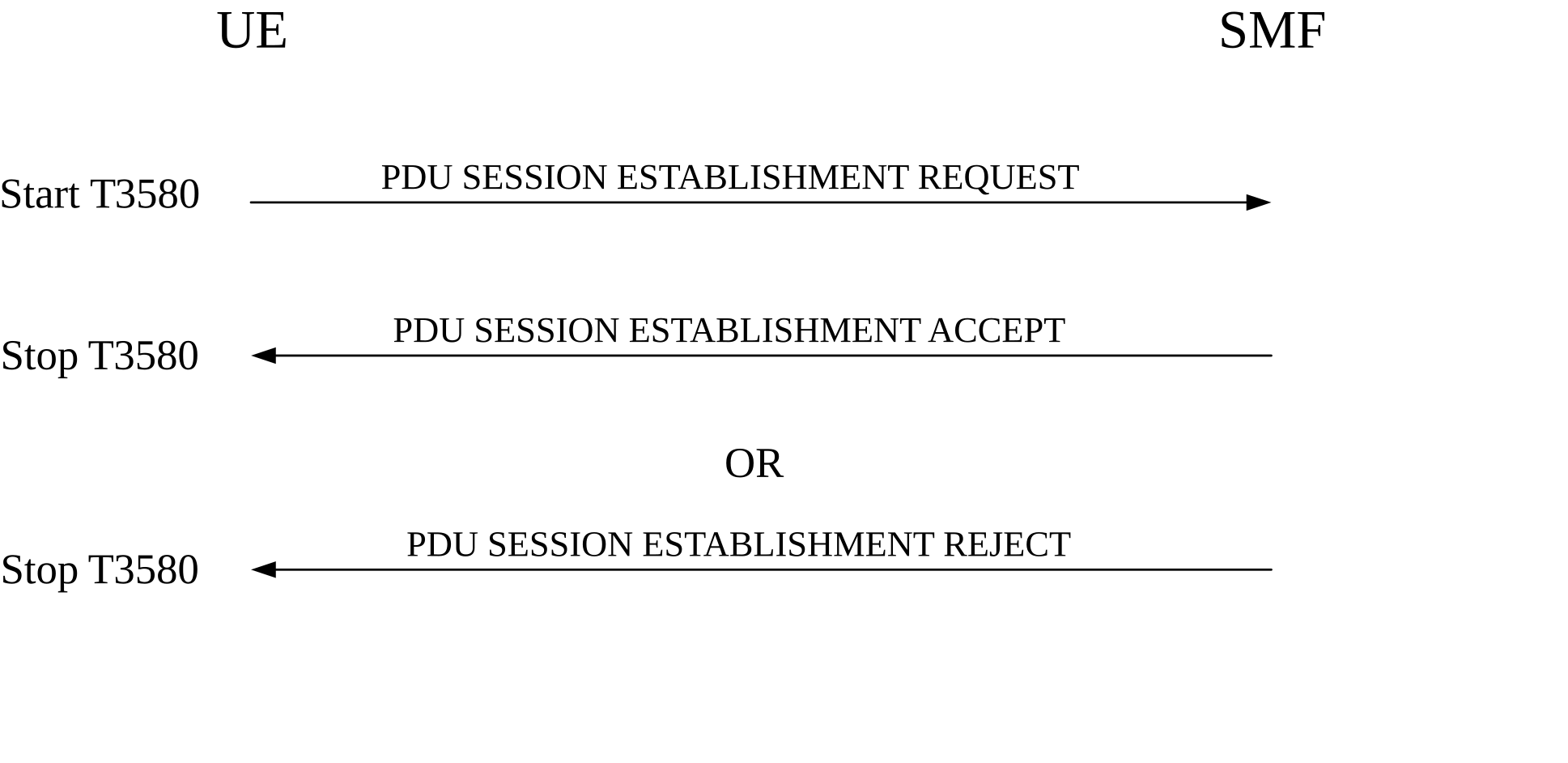
using the NAS transport procedure as specified in clause 5.4.5, and the UE shall start timer T3580 (see example in figure 6.4.1.2.1).
For bullet c) 1), if the matching URSP rule does not have an associated S-NSSAI, or if the UE does not have any matching URSP rule and there is no S-NSSAI in the UE local configuration or in the default URSP rule, the UE shall not provide any S-NSSAI in a PDU session establishment procedure.
For bullet c) 1a), if the selected PDU session parameters for 5G ProSe layer-3 UE-to-network relay UE do not have an associated S-NSSAI, the UE shall not provide any S-NSSAI in a PDU session establishment procedure.
For bullet d) 1),
- If the matching non-default URSP rule does not have an associated DNN, then the UE shall not provide any DNN in a PDU session establishment procedure;
- If the UE does not have any matching non-default URSP rule, the UE requests a connectivity that requires PAP/CHAP and the UE is configured with the default DNN for the S-NSSAI in the UE local configuration corresponding to the request, then the UE should provide such DNN in a PDU session establishment procedure;
- If the UE does not have any matching non-default URSP rule, the UE requests a connectivity that requires PAP/CHAP, the UE is not configured with the default DNN for the S-NSSAI in the UE local configuration corresponding to the request, and the application provides the DNN, then the UE shall use such DNN in a PDU session establishment procedure;
- If the UE does not have any matching non-default URSP rule, the UE requests a connectivity that does not require PAP/CHAP, the UE is not configured with the DNN for the S-NSSAI in the UE local configuration corresponding to the request, and the application provides the DNN, then the UE shall use such DNN in a PDU session establishment procedure;
- If the UE does not have any matching non-default URSP rule, the UE requests a connectivity that requires PAP/CHAP, the UE is not configured with the default DNN for the S-NSSAI in the UE local configuration corresponding to the request, the application does not provide the DNN and there is no DNN in the default URSP rule, then the UE shall not provide any DNN in a PDU session establishment procedure; or
- If the UE does not have any matching non-default URSP rule, the UE requests a connectivity that does not require PAP/CHAP, the UE is not configured with the DNN for the S-NSSAI in the UE local configuration corresponding to the request, the application does not provide the DNN and there is no DNN in the default URSP rule, then the UE shall not provide any DNN in a PDU session establishment procedure.
For bullet d) 1a), if the selected the PDU session parameters for 5G ProSe layer-3 UE-to-network relay UE do not have an associated DNN, the UE shall not provide any DNN in a PDU session establishment procedure.
If the request type is set to "initial emergency request" or "existing emergency PDU session" or the UE is registered for onboarding services in SNPN, neither DNN nor S-NSSAI is transported by the UE using the NAS transport procedure as specified in clause 5.4.5.
Upon receipt of a PDU SESSION ESTABLISHMENT REQUEST message, a PDU session ID, optionally an S-NSSAI associated with optionally a mapped S-NSSAI, optionally a DNN determined by the AMF, optionally a DNN selected by the network (if different from the DNN determined by the AMF), the request type, and optionally an old PDU session ID, the SMF checks whether connectivity with the requested DN can be established. If the requested DNN is not included, the SMF shall use the default DNN.
If the PDU session being established is a non-emergency PDU session, the request type is not set to "existing PDU session" and the PDU session authentication and authorization by the external DN is required due to local policy, the SMF shall check whether the PDU SESSION ESTABLISHMENT REQUEST message includes the SM PDU DN request container IE or the Service-level-AA container IE.
If the PDU session being established is a non-emergency PDU session, the request type is not set to "existing PDU session", the SM PDU DN request container IE is included in the PDU SESSION ESTABLISHMENT REQUEST message, the PDU session authentication and authorization by the external DN is required due to local policy and user's subscription data, and:
- the information for the PDU session authentication and authorization by the external DN in the SM PDU DN request container IE is compliant with the local policy and user's subscription data, the SMF shall proceed with the EAP Authentication procedure specified in 3GPP TS 33.501 [24] and refrain from accepting or rejecting the PDU SESSION ESTABLISHMENT REQUEST message until the EAP Authentication procedure finalizes; or
- the information for the PDU session authentication and authorization by the external DN in the SM PDU DN request container IE is not compliant with the local policy and user's subscription data, the SMF shall consider it as an abnormal case and proceed as specified in clause 6.4.1.7.
If the PDU session being established is a non-emergency PDU session, the request type is not set to "existing PDU session", the SM PDU DN request container IE is not included in the PDU SESSION ESTABLISHMENT REQUEST message and the PDU session authentication and authorization by the external DN is required due to local policy and user's subscription data, the SMF shall proceed with the EAP Authentication procedure specified in 3GPP TS 33.501 [24] and refrain from accepting or rejecting the PDU SESSION ESTABLISHMENT REQUEST message until the EAP Authentication procedure finalizes.
If the SMF receives the old PDU session ID from the AMF and a PDU session exists for the old PDU session ID, the SMF shall consider that the request for the relocation of SSC mode 3 PDU session anchor with multiple PDU sessions as specified in 3GPP TS 23.502 [9] is accepted by the UE.
If the SMF receives the onboarding indication from the AMF, the SMF shall consider that the PDU session is established for onboarding services in SNPN.
If the UE has set the TPMIC bit to "Transfer of port management information containers supported" in the 5GSM capability IE of the PDU SESSION ESTABLISHMENT REQUEST message and has included a DS-TT Ethernet port MAC address IE (if the PDU session type is "Ethernet"), the Port management information container IE, and, optionally, the UE-DS-TT residence time IE in the PDU SESSION ESTABLISHMENT REQUEST message, the SMF shall operate as specified in 3GPP TS 23.502 [9] clause 4.3.2.2.1.
If requested by the upper layers, the UE supporting UAS services shall initiate a request to establish a PDU session for UAS services, where the UE:
- shall include the service-level device ID with the value set to the CAA-level UAV ID;
- if provided by the upper layers, shall include the service-level-AA server address, with the value set to the USS address; and
- if provided by the upper layers, shall include:
- the service-level-AA payload type, with the value set to "UUAA payload"; and
- the service-level-AA payload, with the value set to UUAA payload,
in the Service-level-AA container IE of the PDU SESSION ESTABLISHMENT REQUEST message.
If the PDU session being established is a non-emergency PDU session, the request type is not set to "existing PDU session", the Service-level-AA container IE is included in the PDU SESSION ESTABLISHMENT REQUEST message, and
- the service-level authentication and authorization by the external DN is required due to local policy;
- there is a valid user's subscription information for the requested DNN or for the requested DNN and S-NSSAI; and
- the information for the service-level authentication and authorization by the external DN in the Service-level-AA container IE includes CAA-level UAV ID,
then the SMF shall proceed with the UUAA-SM procedure as specified in 3GPP TS 23.256 [6AB] and refrain from accepting or rejecting the PDU SESSION ESTABLISHMENT REQUEST message until the service-level authentication and authorization procedure is completed.
The UE supporting UAS services shall not request a PDU session establishment procedure to the same DNN (or no DNN, if no DNN was indicated by the UE) and the same S-NSSAI (or no S-NSSAI, if no S-NSSAI was indicated by the UE) for which the UE has requested a service level authentication and authorization procedure which is ongoing.
If the PDU SESSION ESTABLISHMENT REQUEST message includes the PDU session pair ID IE, the RSN IE, or both, the SMF shall operate as specified in clause 5.33.2 of 3GPP TS 23.501 [8].