3GPP 24.501 v20.0.0 — the document's own text
6.3.2.2 Network-requested PDU session modification procedure initiation
Taught in 4. Inside TS 24.501, the document at the centre (CT1 — the group that writes what your phone says, overview).
In order to initiate the network-requested PDU session modification procedure, the SMF shall create a PDU SESSION MODIFICATION COMMAND message.
If the authorized QoS rules of the PDU session is modified or is marked as to be synchronised with the UE, the SMF shall set the Authorized QoS rules IE of the PDU SESSION MODIFICATION COMMAND message to the authorized QoS rules of the PDU session. The SMF shall ensure that the number of the packet filters used in the authorized QoS rules of the PDU Session does not exceed the maximum number of packet filters supported by the UE for the PDU session. The SMF may bind service data flows for which the UE has requested traffic segregation to a dedicated QoS flow for the PDU session, if possible. Otherwise the SMF may bind the service data flows to an existing QoS flow. The SMF shall use only one dedicated QoS flow for traffic segregation. If the UE has requested traffic segregation for multiple service data flows with different QoS handling, the SMF shall bind all these service data flows to a single QoS flow. If the SMF allows traffic segregation for service data flows in a QoS rule, then the SMF shall create a new authorized QoS rule for these service data flows and shall delete packet filters corresponding to these service data flows from the other authorized QoS rules.
If the authorized QoS flow descriptions of the PDU session is modified or is marked as to be synchronised with the UE, the SMF shall set the Authorized QoS flow descriptions IE of the PDU SESSION MODIFICATION COMMAND message to the authorized QoS flow descriptions of the PDU session.
If SMF creates a new authorized QoS rule for a new QoS flow, then SMF shall include the authorized QoS flow description for that QoS flow in the Authorized QoS flow descriptions IE of the PDU SESSION MODIFICATION COMMAND message, if:
- the newly created authorized QoS rules is for a new GBR QoS flow;
- the QFI of the new QoS flow is not the same as the 5QI of the QoS flow identified by the QFI;
- the new QoS flow can be mapped to an EPS bearer as specified in clause 4.11.1 of 3GPP TS 23.502 [9]; or
- the new QoS flow is established for the PDU session used for relaying, as specified in clause 5.6.2.1 of 3GPP TS 23.304 [6E].
NOTE 0: In cases other than above listed cases, it is up to the SMF implementation to include the authorized QoS flow description of the new QoS flow for the new authorized QoS rule in the Authorized QoS flow descriptions IE of the PDU SESSION MODIFICATION COMMAND message.
If the session-AMBR of the PDU session is modified, the SMF shall set the selected Session-AMBR IE of the PDU SESSION MODIFICATION COMMAND message to the session-AMBR of the PDU session.
If interworking with EPS is supported for the PDU session and if the mapped EPS bearer contexts of the PDU session is modified, the SMF shall set the Mapped EPS bearer contexts IE of the PDU SESSION MODIFICATION COMMAND message to the mapped EPS bearer contexts of the PDU session. If the association between a QoS flow and the mapped EPS bearer context is changed, the SMF shall set the EPS bearer identity parameter in Authorized QoS flow descriptions IE of the PDU SESSION MODIFICATION COMMAND message to the new EPS bearer identity associated with the QoS flow.
NOTE 0A: The SMF can include multiple mapped EPS bearer context fields with the same EPS bearer identity in the Mapped EPS bearer contexts IE of the PDU SESSION MODIFICATION COMMAND message in cases, e.g. the packet filters need to be modified and the modification requires more than one TFT operation codes or the mapped traffic flow template needs to be modified and the modification exceeds the maximum size of the TFT IE.
If the network-requested PDU session modification procedure is triggered by a UE-requested PDU session modification procedure and the PDU SESSION MODIFICATION REQUEST message includes a 5GSM capability IE, the SMF shall:
- if the RQoS bit is set to:
- "Reflective QoS supported", consider that the UE supports reflective QoS for this PDU session; or
- "Reflective QoS not supported", consider that the UE does not support reflective QoS for this PDU session; and;
- if the MH6-PDU bit is set to:
- "Multi-homed IPv6 PDU session supported", consider that this PDU session is supported to use multiple IPv6 prefixes; or
- "Multi-homed IPv6 PDU session not supported", consider that this PDU session is not supported to use multiple IPv6 prefixes.
If the SMF considers that reflective QoS is supported for QoS flows belonging to this PDU session, the SMF may include the RQ timer IE set to an RQ timer value in the PDU SESSION MODIFICATION COMMAND message.
If a port management information container needs to be delivered (see 3GPP TS 23.501 [8] and 3GPP TS 23.502 [9]) and the UE has set the TPMIC bit to "Transfer of port management information containers supported" in the 5GSM capability IE, the SMF shall include a Port management information container IE in the PDU SESSION MODIFICATION COMMAND message.
For a PDN connection established when in S1 mode, upon an inter-system change from S1 mode to N1 mode, if the network-requested PDU session modification procedure is triggered by a UE-requested PDU session modification procedure and a UE-requested PDU session modification procedure has not been successfully performed yet, the PDU session type is "IPv4", "IPv6", "IPv4v6" or "Ethernet" and the PDU SESSION MODIFICATION REQUEST message includes a Maximum number of supported packet filters IE, the SMF shall consider this number as the maximum number of packet filters that can be supported by the UE for this PDU session. Otherwise the SMF considers that the UE supports 16 packet filters for this PDU session.
For a PDN connection established when in S1 mode, upon an inter-system change from S1 mode to N1 mode, if the network-requested PDU session modification procedure is triggered by a UE-requested PDU session modification procedure and a UE-requested PDU session modification procedure has not been successfully performed yet, the SMF shall consider that the maximum data rate per UE for user-plane integrity protection supported by the UE for uplink and the maximum data rate per UE for user-plane integrity protection supported by the UE for downlink are valid for the lifetime of the PDU session.
For a PDN connection established when in S1 mode, upon an inter-system change from S1 mode to N1 mode, if the network-requested PDU session modification procedure is triggered by a UE-requested PDU session modification procedure and a UE-requested PDU session modification procedure has not been successfully performed yet, and the SMF determines, based on local policies or configurations in the SMF and the Always-on PDU session requested IE in the PDU SESSION MODIFICATION REQUEST message (if available), that either:
- the requested PDU session needs to be an always-on PDU session, the SMF shall include the Always-on PDU session indication IE in the PDU SESSION MODIFICATION COMMAND message and shall set the value to "Always-on PDU session required"; or
- the requested PDU session shall not be an always-on PDU session and:
- if the UE included the Always-on PDU session requested IE, the SMF shall include the Always-on PDU session indication IE in the PDU SESSION MODIFICATION COMMAND message and shall set the value to "Always-on PDU session not allowed"; or
- if the UE did not include the Always-on PDU session requested IE, the SMF shall not include the Always-on PDU session indication IE in the PDU SESSION MODIFICATION COMMAND message.
For a PDN connection established when in S1 mode, upon an inter-system change from S1 mode to N1 mode, if the network-requested PDU session modification procedure is triggered by a UE-requested PDU session modification procedure, a UE-requested PDU session modification procedure has not been successfully performed yet, the UE supports EDC and the network allows the use of EDC, then the SMF shall include the Extended protocol configuration options IE in the PDU SESSION MODIFICATION COMMAND message with the EDC usage allowed indicator.
For a PDN connection established when in S1 mode, upon an inter-system change from S1 mode to N1 mode, if the network-requested PDU session modification procedure is triggered by a UE-requested PDU session modification procedure, a UE-requested PDU session modification procedure has not been successfully performed yet, the UE supports EDC and the network requires the use of EDC, then the SMF shall include the Extended protocol configuration options IE in the PDU SESSION MODIFICATION COMMAND message with the EDC usage required indicator.
If a QoS flow for URLLC is created in a PDU session and the SMF has not provided the Always-on PDU session indication IE with the value set to "Always-on PDU session required" in the UE-requested PDU session establishment procedure or a network-requested PDU session modification procedure for the PDU session, the SMF shall include the Always-on PDU session indication IE in the PDU SESSION MODIFICATION COMMAND message and shall set the value to "Always-on PDU session required".
For a PDN connection, upon an inter-system change from S1 mode to N1 mode, if the network-requested PDU session modification procedure is triggered by a UE-requested PDU session modification procedure and a UE-requested PDU session modification procedure has not been successfully performed yet, the PDU session is a single access PDU session over 3GPP access with IP PDU session type, the SMF may decide to provide the protocol description associated with the PDU session and may include the Protocol description IE in the PDU SESSION MODIFICATION COMMAND message.
If the value of the RQ timer is set to "deactivated" or has a value of zero, the UE considers that RQoS is not applied for this PDU session and remove the derived QoS rule(s) associated with the PDU session, if any.
If the network-requested PDU session modification procedure is triggered by a UE-requested PDU session modification procedure, the SMF shall set the PTI IE of the PDU SESSION MODIFICATION COMMAND message to the PTI of the PDU SESSION MODIFICATION REQUEST message received as part of the UE-requested PDU session modification procedure.
If the network-requested PDU session modification procedure is triggered by a UE-requested PDU session modification procedure and the UE has included the Requested MBS container IE in the PDU SESSION MODIFICATION REQUEST message with the MBS operation set to "Join multicast MBS session", the SMF:
- shall include the TMGI for the multicast MBS session IDs that the UE is allowed to join, if any, in the Received MBS container IE, shall set the MBS decision to "MBS join is accepted" for each of those Received MBS information, may include the MBS start time to indicate the time when the multicast MBS session starts, and shall include the MBS security container in each of those Received MBS information if security protection is applied for that multicast MBS session and the control plane security procedure is used as specified in clause W.4.1.2 in 3GPP TS 33.501 [24], and shall use separate QoS flows dedicated for multicast by including the Authorized QoS flow descriptions IE if no separate QoS flows dedicated for multicast exist or if the SMF wants to establish new QoS flows dedicated for multicast;
NOTE 1: The network determines whether security protection applies or not for the multicast MBS session as specified in 3GPP TS 33.501 [24].
- shall include the TMGI for multicast MBS session IDs that the UE is rejected to join, if any, in the Received MBS container IE, shall set the MBS decision to "MBS join is rejected" for each of those Received MBS information, shall set the Rejection cause for each of those Received MBS information with the reason of rejection and, if the Rejection cause is set to "multicast MBS session has not started or will not start soon", may include an MBS back-off timer value; and
- may include in the Received MBS container IE the MBS service area for each multicast MBS session and include in it the MBS TAI list, the NR CGI list or both, that identify the service area(s) for the local MBS service;
NOTE 2: For an multicast MBS session that has multiple MBS service areas, the MBS service areas are indicated to the UE using MBS service announcement as described in 3GPP TS 23.247 [53], which is out of scope of this specification.
in the PDU SESSION MODIFICATION COMMAND message. If the UE has set the Type of multicast MBS session ID to "Source specific IP multicast address" in the Requested MBS container IE for certain multicast MBS session(s) in the PDU SESSION MODIFICATION REQUEST message, the SMF shall include the Source IP address information and Destination IP address information in the Received MBS information together with the TMGI for each of those multicast MBS sessions.
NOTE 3: Including the Source IP address information and Destination IP address information in the Received MBS information in that case is to allow the UE to perform the mapping between the requested multicast MBS session ID and the provided TMGI.
NOTE 4: In SNPN, TMGI is used together with NID to identify an MBS Session.
If:
- the SMF wants to remove joined UE from one or more multicast MBS sessions; or
- the network-requested PDU session modification procedure is triggered by a UE-requested PDU session modification procedure and the UE has included the Requested MBS container IE in the PDU SESSION MODIFICATION REQUEST message with the MBS operation set to "Leave multicast MBS session",
the SMF shall include the multicast MBS session IDs that the UE is removed from, if any, in the Received MBS container IE in the PDU SESSION MODIFICATION COMMAND message and shall set the MBS decision to "Remove UE from multicast MBS session" for each of those Received MBS information. The SMF may include the updated MBS service area in each of the Received MBS information, if any. The SMF may delete the QoS flows associated for the multicast by including the Authorized QoS flow descriptions IE in the PDU SESSION MODIFICATION COMMAND message. If the UE is removed from multicast MBS session due to the MBS session release, the SMF shall set the Rejection cause to "multicast MBS session is released". The SMF shall include the Rejection cause for each of the Received MBS information, if any, and set its value with the reason of removing the UE from the corresponding multicast MBS session.
NOTE 5: based on operator's policy, e.g. after a locally configured time period, the SMF is allowed to trigger the removal of joined UE from an multicast MBS session when the UE moves outside all the MBS service area(s) of that multicast MBS session.
If the SMF wants to update the MBS security information of an multicast MBS session that the UE has joined, the SMF shall include the corresponding multicast MBS session ID and the MBS security container in the Received MBS container IE in the PDU SESSION MODIFICATION COMMAND message, and shall set the MBS Decision to "MBS security information update" in the Received MBS information.
If the SMF wants to update the MBS service area of an multicast MBS session that the UE has joined, the SMF shall include the corresponding multicast MBS session ID and the updated MBS service area in the Received MBS container IE in the PDU SESSION MODIFICATION COMMAND message, and shall set the MBS decision to "MBS service area update" in the Received MBS information.
NOTE 6: The MBS service area of an multicast MBS session is also allowed to be updated to the UE using the MBS service announcement as described in 3GPP TS 23.247 [53], which is out of scope of this specification.
If the network needs to update ATSSS parameters (see clause 5.2.4 of 3GPP TS 24.193 [13B]), the SMF shall include the ATSSS container IE with the updates of ATSSS parameters in the PDU SESSION MODIFICATION COMMAND message.
If the network-requested PDU session modification procedure is not triggered by a UE-requested PDU session modification procedure, the SMF shall set the PTI IE of the PDU SESSION MODIFICATION COMMAND message to "No procedure transaction identity assigned".
If the selected SSC mode of the PDU session is "SSC mode 3" and the SMF requests the relocation of SSC mode 3 PDU session anchor with multiple PDU sessions as specified in 3GPP TS 23.502 [9], the SMF shall include 5GSM cause #39 "reactivation requested", in the PDU SESSION MODIFICATION COMMAND message, and may include the PDU session address lifetime in a PDU session address lifetime parameter in the Extended protocol configuration options IE of the PDU SESSION MODIFICATION COMMAND message. If the selected SSC mode of the PDU session is "SSC mode 3", the S-NSSAI or the mapped S-NSSAI associated with the PDU session needs to be replaced and the SMF determines that the PDU session needs to be re-established on the alternative S-NSSAI, the SMF shall include the Alternative S-NSSAI IE and 5GSM cause #39 "reactivation requested" in the PDU SESSION MODIFICATION COMMAND message. If the selected SSC mode of the PDU session is "SSC mode 3", the replaced S-NSSAI is available and the SMF determines that the PDU session needs to be re-established on the replaced S-NSSAI, the SMF shall include and 5GSM cause #39 "reactivation requested" and include the replaced S-NSSAI in the Alternative S-NSSAI IE in the PDU SESSION MODIFICATION COMMAND message.
NOTE 7: The relocation of SSC mode 3 PDU session anchor with multiple PDU sessions can also be initiated by the SMF in case of the SMF is requested by the AMF to release the PDU session due to the network slice instance of the PDU session is changed as specified in clause 5.15.5.3 of 3GPP TS 23.501 [8].
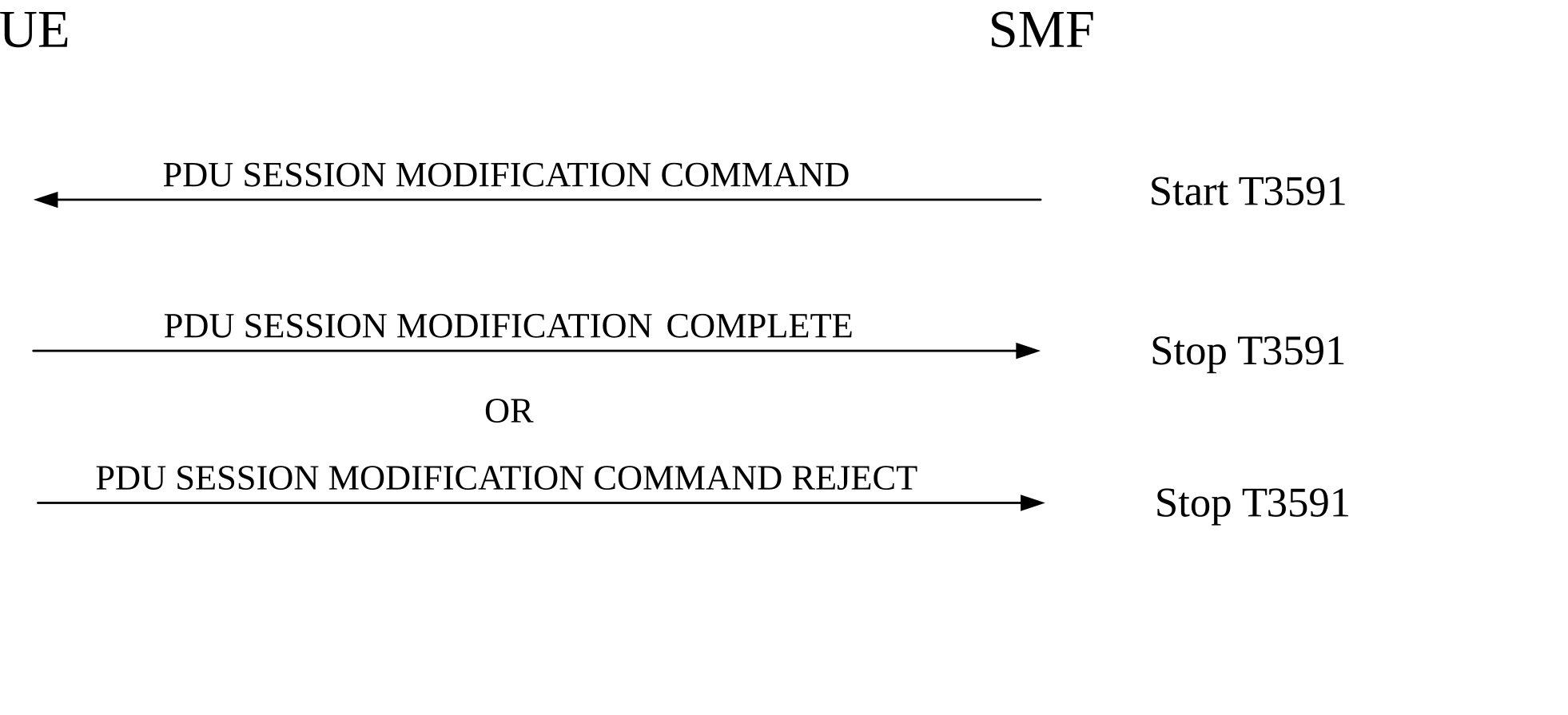
The SMF shall send the PDU SESSION MODIFICATION COMMAND message, and the SMF shall start timer T3591 (see example in figure 6.3.2.2.1).
NOTE 8: If the SMF requests the relocation of SSC mode 3 PDU session anchor with multiple PDU sessions as specified in 3GPP TS 23.502 [9], the reallocation requested indication indicating whether the SMF is to be reallocated or the SMF is to be reused is provided to the AMF.
If the control plane CIoT 5GS optimization is enabled for a PDU session and the IP header compression configuration IE was included in the PDU SESSION ESTABLISHMENT REQUEST message or the PDU SESSION MODIFICATION REQUEST message, and the SMF supports control plane CIoT 5GS optimization and IP header compression for control plane CIoT 5GS optimization, the SMF may include the IP header compression configuration IE in the PDU SESSION MODIFICATION COMMAND message to re-negotiate IP header compression configuration associated to the PDU session.
If the control plane CIoT 5GS optimization is enabled for a PDU session and the Ethernet header compression configuration IE was included in the PDU SESSION ESTABLISHMENT REQUEST message or the PDU SESSION MODIFICATION REQUEST message, and the SMF supports control plane CIoT 5GS optimization and Ethernet header compression for control plane CIoT 5GS optimization, the SMF may include the Ethernet header compression configuration IE in the PDU SESSION MODIFICATION COMMAND message to re-configure Ethernet header compression configuration associated with the PDU session.
If the network-requested PDU session modification procedure is associated with C2 authorization procedure, the SMF shall send the PDU SESSION MODIFICATION COMMAND message by including the Service-level-AA container IE containing:
- the service-level-AA response with the value of C2AR field set to the "C2 authorization was successful";
- if a payload is provided from the UAS-NF, the service-level-AA payload with the value set to the payload; and
- if a payload type associated with the payload is provided from the UAS-NF, the service-level-AA payload type with the value set to the payload type; and
- if the CAA-level UAV ID is provided from the UAS-NF, the service-level device ID set to the CAA-level UAV ID.
NOTE 9: The C2 authorization payload in the service-level-AA payload can include one, some or all of the pairing information for C2 communication, and the pairing information for direct C2 communication,
NOTE 9A: The C2 authorization payload in the service-level-AA payload can include the security information for C2 session as specified in TS 33.256 [24B].
If the service-level-AA procedure is triggered for the established PDU session for UAS services with re-authentication purpose, and the SMF is provided by the UAS-NF with the successful UUAA-SM result, the SMF shall transmit a PDU SESSION MODIFICATION COMMAND message to the UE, where the PDU SESSION MODIFICATION COMMAND message shall include the Service-level-AA container IE containing:
- the service-level-AA response with the value of SLAR field set to "Service level authentication and authorization was successful";
- if received the CAA-level UAV ID from the UAS-NF, the service-level device ID with the value set to the CAA-level UAV ID;
- if received a payload from the UAS-NF, the service-level-AA payload with the value set to the payload; and
- if received a payload type associated with the payload, the service-level-AA payload type with the value set to the payload type.
If the SMF needs to provide new ECS configuration information to the UE and the UE has indicated support for ECS configuration information provisioning in the PDU SESSION ESTABLISHMENT REQUEST message or while in S1 mode, then the SMF may include the Extended protocol configuration options IE in the PDU SESSION MODIFICATION COMMAND message with:
- at least one of ECS IPv4 Address(es), ECS IPv6 Address(es), ECS FQDN(s);
- at least one associated ECSP identifier;
- optionally, spatial validity conditions associated with the ECS address;
- optionally, ECS authentication methods associated with the ECS address; and
- optionally, ECS supported PLMNs information list, including the associated ECSP information for which the EDN configuration information can be provided by the ECS.
NOTE 10: The IP address(es), FQDN(s), or both are associated with the ECSP identifier and replace previously provided ECS configuration information associated with the same ECSP identifier, if any.
If the SMF needs to provide DNS server address(es) to the UE and the UE has provided the DNS server IPv4 address request, the DNS server IPv6 address request or both of them, in the PDU SESSION ESTABLISHMENT REQUEST message or a PDU SESSION MODIFICATION REQUEST message, then the SMF shall include the Extended protocol configuration options IE in the PDU SESSION MODIFICATION COMMAND message with one or more DNS server IPv4 address(es), one or more DNS server IPv6 address(es) or both of them.
If the SMF needs to trigger EAS rediscovery and the UE has indicated support of the EAS rediscovery in the PDU SESSION ESTABLISHMENT REQUEST message or the PDU SESSION MODIFICATION REQUEST message, then the SMF shall include the Extended protocol configuration options IE in the PDU SESSION MODIFICATION COMMAND message:
- with the EAS rediscovery indication without indicated impact; or
- with the following:
- one or more EAS rediscovery indication(s) with impacted EAS IPv4 address range, if the UE supports EAS rediscovery indication(s) with impacted EAS IPv4 address range;
- one or more EAS rediscovery indication(s) with impacted EAS IPv6 address range, if the UE supports EAS rediscovery indication(s) with impacted EAS IPv6 address range;
- one or more EAS rediscovery indication(s) with impacted EAS FQDN, if the UE supports EAS rediscovery indication(s) with impacted EAS FQDN; or
- any combination of the above.
When UE has requested P-CSCF IPv6 address or P-CSCF IPv4 address and the SMF has provided P-CSCF address(es) during the PDU session establishment procedure, if the network-requested PDU session modification procedure is triggered for P-CSCF restoration, the SMF shall include the P-CSCF IP address(es) in the Extended protocol configuration options IE in the PDU SESSION MODIFICATION COMMAND message as specified in clause 5.8.2.2 of 3GPP TS 23.380 [54].
If the S-NSSAI or the mapped S-NSSAI of the PDU session needs to be replaced and the SMF determines that the PDU session needs to be retained, the SMF shall include the Alternative S-NSSAI IE in the PDU SESSION MODIFICATION COMMAND message. If the replaced S-NSSAI is available and the SMF determines that the PDU session needs to be retained, the SMF include replaced S-NSSAI in the Alternative S-NSSAI IE in the PDU SESSION MODIFICATION COMMAND message.
If the SMF includes the authorized QoS flow descriptions and the SMF determines to provide the N3QAI to the UE, the SMF shall include the N3QAI IE in the PDU SESSION MODIFICATION COMMAND message.
If the PDU session was a single access PDU session established with IP PDU session type and based on operator policy the SMF determines to provide the protocol description for UL PDU set based handling to the UE, the SMF may include the Protocol description IE in the PDU SESSION MODIFICATION COMMAND message.
If the UE has indicated support for (S)RTP multiplexed media identification information in the PDU SESSION ESTABLISHMENT REQUEST message or in the PDU SESSION MODIFICATION REQUEST message, then the SMF may include the (S)RTP multiplexed media packet filter component in the packet filters of the QoS rules IE in the PDU SESSION MODIFICATION COMMAND message.
If the PDU session was a single access PDU session established over wireline access with IP PDU session type and based on operator policy the SMF determines the ECN marking for L4S for the 5G-RG (see clause 4.17.2 of 3GPP TS 23.316 [6D]), the SMF may include the ECN marking for L4S indication IE in the PDU SESSION MODIFICATION COMMAND message.