3GPP 24.501 v20.0.0 — the document's own text
5.5.4.1 General
Taught in 4. Inside TS 24.501, the document at the centre (CT1 — the group that writes what your phone says, overview).
The purpose of the authentication and key agreement procedure:
- for 5G ProSe UE-to-network relay, is to perform the authentication for 5G ProSe remote UE initiated by the 5G ProSe UE-to-network relay UE and to agree on the KAUSF_P and KNR_ProSe when the security for 5G ProSe communication via 5G ProSe UE-to-network relay is performed over control plane as specified in 3GPP TS 33.503 [56]; or
- for 5G ProSe UE-to-UE relay, is to perform the authentication for 5G ProSe end UE initiated by the 5G ProSe UE-to-UE relay UE and to agree on the KAUSF_P and KNR_ProSe when the security for 5G ProSe communication via 5G ProSe UE-to-UE relay is performed over control plane as specified in 3GPP TS 33.503 [56].
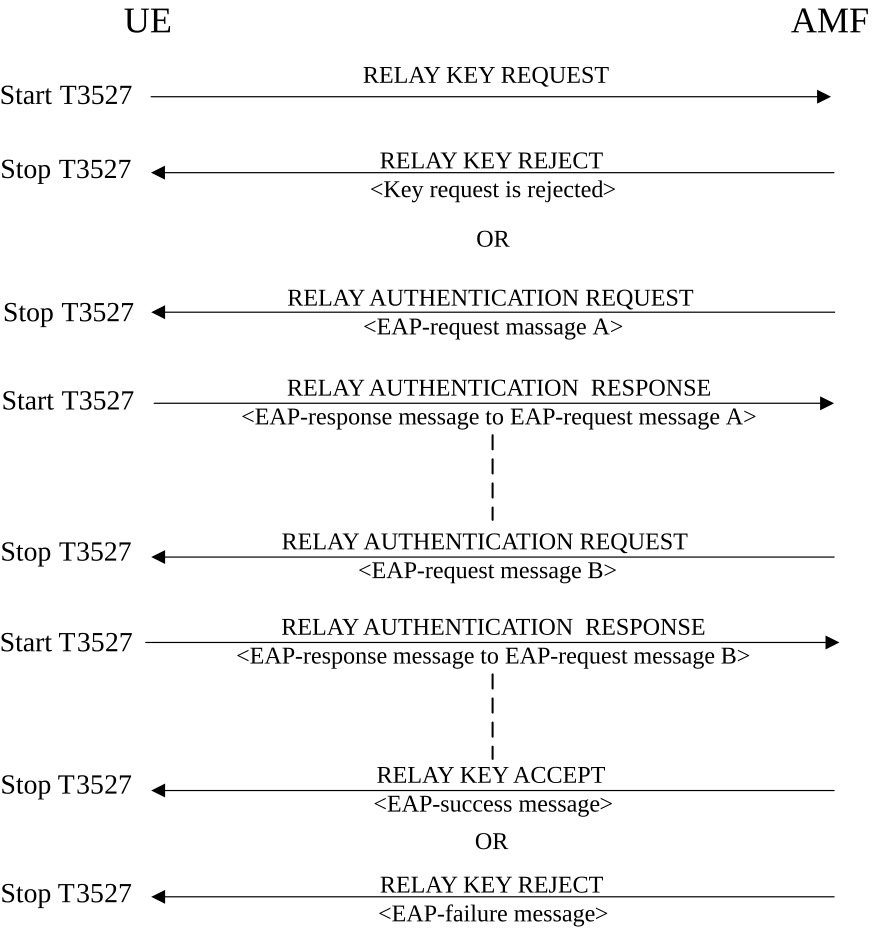
The procedure as shown in figure 5.5.4.1.1 is initiated by the UE when the UE receives the ProSe direct link establishment request including the SUCI or the CP-PRUK ID of:
- the 5G ProSe remote UE from the 5G ProSe remote UE; or
- the 5G ProSe end UE from the 5G ProSe end UE,
for establishing secure PC5 unicast link as specified in 3GPP TS 24.554 [19E].
If the network decides to process the relay key request message, the EAP based authentication and key agreement procedure is initiated and controlled by the network. The exchanges of EAP messages between:
- the 5G ProSe remote UE and the network; or
- the 5G ProSe end UE and the network,
are relayed by the UE.