3GPP 24.501 v20.0.0 — the document's own text
5.5.2.2.1 UE-initiated de-registration procedure initiation
Taught in 4. Inside TS 24.501, the document at the centre (CT1 — the group that writes what your phone says, overview).
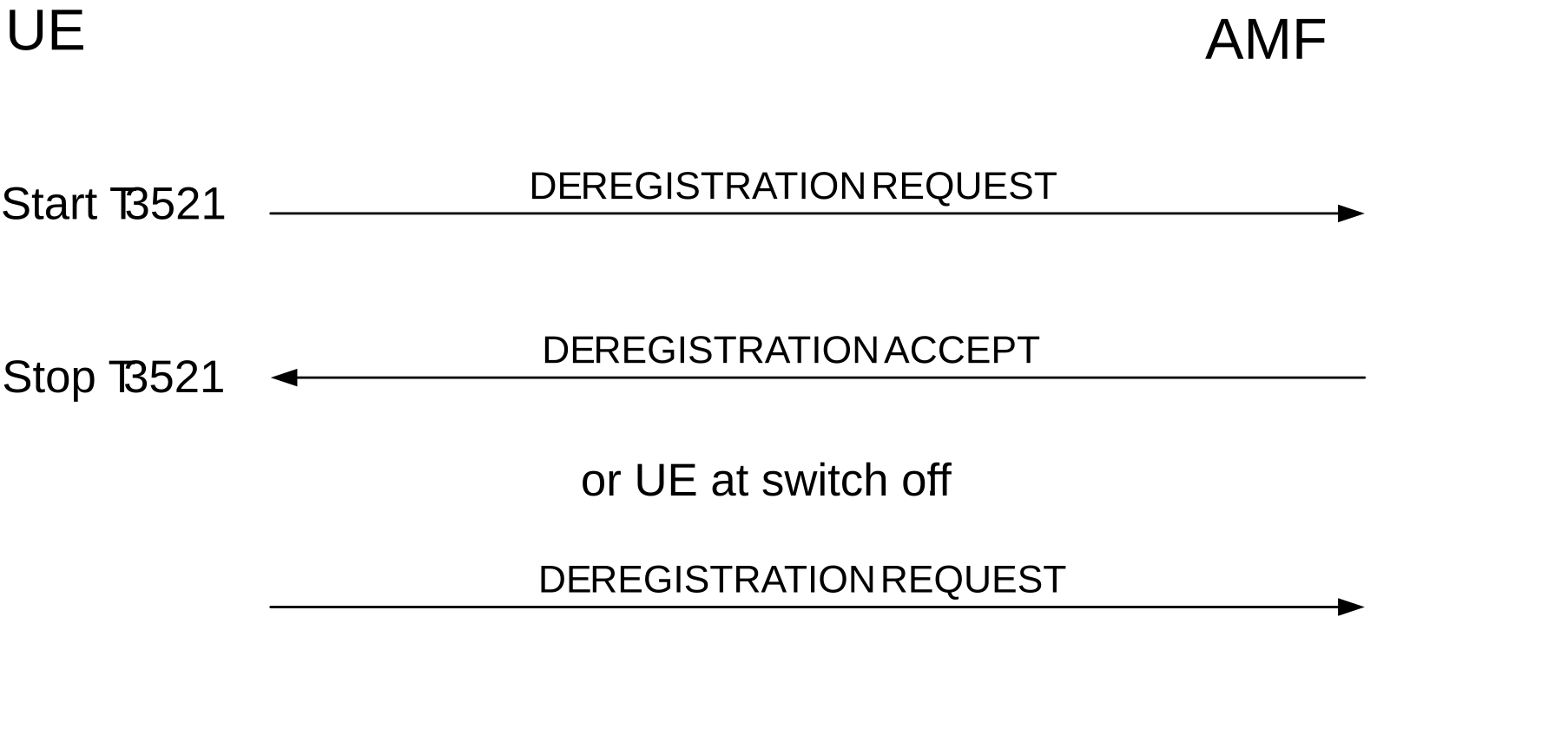
The de-registration procedure is initiated by the UE by sending a DEREGISTRATION REQUEST message (see example in figure 5.5.2.2.1). The De-registration type IE included in the message indicates whether the de-registration procedure is due to a "switch off" or not. The access type included in the message indicates whether the de-registration procedure is:
- for 5GS services over 3GPP access when the UE is registered over 3GPP access;
- for 5GS services over non-3GPP access when the UE is registered over non-3GPP access; or
- for 3GPP access, non-3GPP access or both when the UE is registered in the same PLMN over both accesses.
If the UE has a valid 5G-GUTI, the UE shall populate the 5GS mobile identity IE with the valid 5G-GUTI.
NOTE 1: In some abnormal cases, the 5G-GUTI can be a 5G-GUTI mapped from a valid native 4G-GUTI (see clause 5.5.1.2.7, item f and clause 5.5.1.3.7, item l.
If the UE does not have a valid 5G-GUTI, the UE shall populate the 5GS mobile identity IE with its SUCI as follows:
- if timer T3519 is not running and the de-registration is not due to USIM removal, generate a fresh SUCI as specified in 3GPP TS 33.501 [24], send a DEREGISTRATION REQUEST message with the SUCI, start timer T3519 and store the value of the SUCI sent in the DEREGISTRATION REQUEST message; and
- if timer T3519 is running, send a DEREGISTRATION REQUEST message with the stored SUCI.
If the UE does not have a valid 5G-GUTI and it does not have a valid SUCI, then the UE shall populate the 5GS mobile identity IE with its PEI.
NOTE 2: During the initial registration for emergency services when the UE (with no USIM or invalid USIM) is in 5GMM-REGISTERED-INITIATED state, the UE has neither a valid 5G-GUTI nor a valid SUCI.
If the de-registration request is not due to switch off and the UE is in the state 5GMM-REGISTERED or 5GMM-REGISTERED-INITIATED, timer T3521 shall be started in the UE after the DEREGISTRATION REQUEST message has been sent. The UE shall enter the state 5GMM-DEREGISTERED-INITIATED.
If the UE is to be switched off, the UE shall try for a period of 5 seconds to send the DEREGISTRATION REQUEST message. During this period, the UE may be switched off as soon as the DEREGISTRATION REQUEST message has been sent.
If the network indicated support for the unavailability period in the last registration procedure; and an event is triggered in the UE that would make the UE unavailable for a certain period, the use of unavailability period is not due to NR satellite access discontinuous coverage and the UE is unable to store its 5GMM and 5GSM contexts, the UE shall include the unavailability period duration in the Unavailability information IE, set the Unavailability type to "unavailability due to UE reasons" and set the De-registration type IE to "Normal de-registration" in the DEREGISTRATION REQUEST message. The UE shall start the timer T3521 and enter the state 5GMM-DEREGISTERED-INITIATED.
If the UE is sending the DEREGISTRATION REQUEST message from 5GMM-IDLE mode and the UE needs to send non-cleartext IEs, the UE shall send the DEREGISTRATION REQUEST message including the NAS message container IE as described in clause 4.4.6.
The 5G-RG shall not initiate the de-registration procedure for itself until it successfully de-registers all the AUN3 devices connected to it, if any, by initiating the de-registration procedure on behalf of the AUN3 device.