3GPP 24.501 v20.0.0 — the document's own text
5.5.1.2.2 Initial registration initiation
Taught in 4. Inside TS 24.501, the document at the centre (CT1 — the group that writes what your phone says, overview).
The UE in state 5GMM-DEREGISTERED shall initiate the registration procedure for initial registration by sending a REGISTRATION REQUEST message to the AMF,
- when the UE performs initial registration for 5GS services;
- when the UE performs initial registration for emergency services;
- when the UE performs initial registration for SMS over NAS;
- when the UE moves from GERAN to NG-RAN coverage or the UE moves from a UTRAN to NG-RAN coverage and the following applies:
- the UE initiated a GPRS attach or routing area updating procedure while in A/Gb mode or Iu mode; or
- the UE has performed 5G-SRVCC from NG-RAN to UTRAN as specified in 3GPP TS 23.216 [6A],
and since then the UE did not perform a successful EPS attach or tracking area updating procedure in S1 mode or registration procedure in N1 mode;
- when the UE performs initial registration for onboarding services in SNPN;
- when the UE performs initial registration for disaster roaming services; and
- when the UE performs initial registration to come out of unavailability period and resume normal services;
with the following clarifications to initial registration for emergency services:
- the UE shall not initiate an initial registration for emergency services over the current access, if the UE is already registered for emergency services over the non-current access, unless the initial registration has to be initiated to perform handover of an existing emergency PDU session from the non-current access to the current access; and
NOTE 1: Transfer of an existing emergency PDU session between 3GPP access and non-3GPP access is needed e.g. if the UE determines that the current access is no longer available.
- the UE can only initiate an initial registration for emergency services over non-3GPP access if it cannot register for emergency services over 3GPP access.
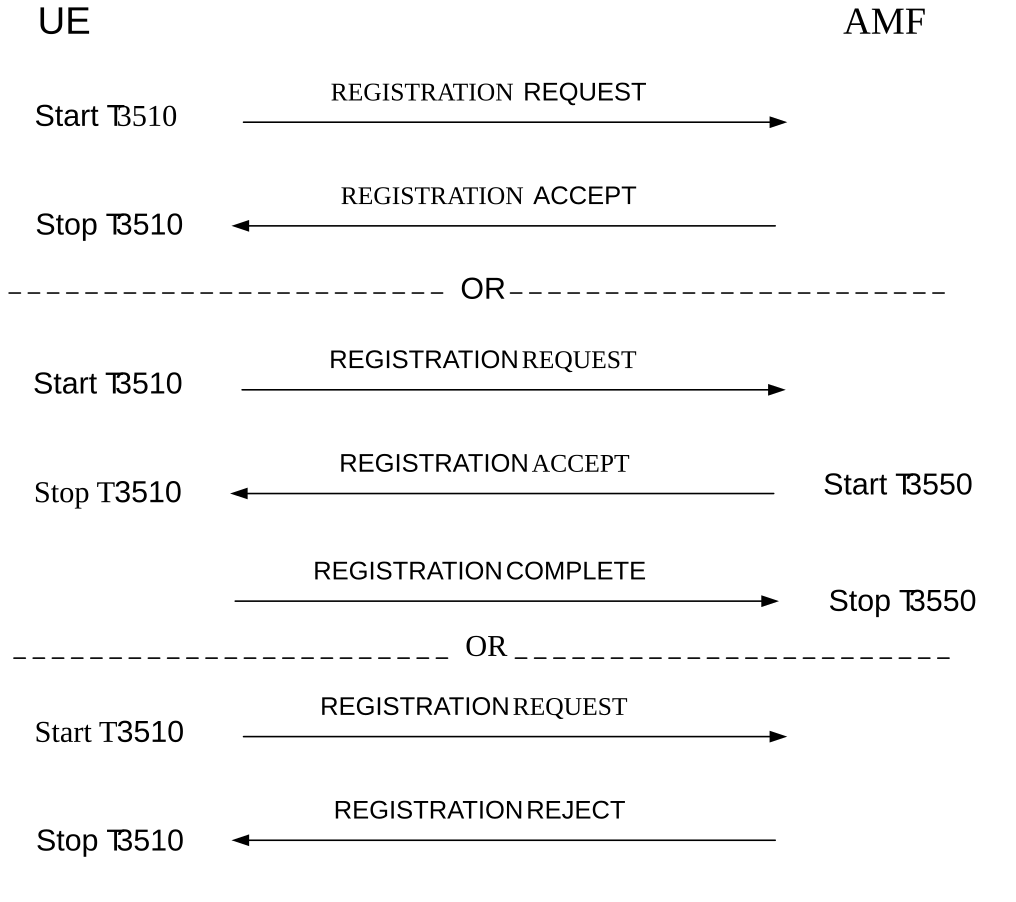
The UE initiates the registration procedure for initial registration by sending a REGISTRATION REQUEST message to the AMF, starting timer T3510. If timer T3502 is currently running, the UE shall stop timer T3502. If timer T3511 is currently running, the UE shall stop timer T3511.
During initial registration the UE handles the 5GS mobile identity IE in the following order:
- if:
- the UE:
- was previously registered in S1 mode before entering state EMM-DEREGISTERED; and
- has received an "interworking without N26 interface not supported" indication from the network; and
- EPS security context and a valid native 4G-GUTI are available;
then the UE shall create a 5G-GUTI mapped from the valid native 4G-GUTI as specified in 3GPP TS 23.003 [4] and indicate the mapped 5G-GUTI in the 5GS mobile identity IE. The UE shall include the UE status IE with the EMM registration status set to "UE is not in EMM-REGISTERED state" and shall include an ATTACH REQUEST message as specified in 3GPP TS 24.301 [15] in the EPS NAS message container IE.
Additionally, if the UE holds a valid 5GGUTI, the UE shall include the 5G-GUTI in the Additional GUTI IE in the REGISTRATION REQUEST message in the following order:
- a valid 5G-GUTI that was previously assigned by the same PLMN with which the UE is performing the registration, if available;
- a valid 5G-GUTI that was previously assigned by an equivalent PLMN, if available; and
- a valid 5G-GUTI that was previously assigned by any other PLMN, if available;
- if:
- the UE is registering with a PLMN and the UE holds a valid 5G-GUTI that was previously assigned, over 3GPP access or non-3GPP access, by the same PLMN with which the UE is performing the registration, the UE shall indicate the 5G-GUTI in the 5GS mobile identity IE; or
- the UE is registering with a SNPN, the UE holds a valid 5G-GUTI that was previously assigned, over 3GPP access or non-3GPP access, by the same SNPN with which the UE is performing the registration, and the UE is not initiating the initial registration for onboarding services in SNPN, the UE shall indicate the 5G-GUTI in the 5GS mobile identity IE;
- if:
- the UE is registering with a PLMN and the UE holds a valid 5G-GUTI that was previously assigned, over 3GPP access or non-3GPP access, by an equivalent PLMN, the UE shall indicate the 5G-GUTI in the 5GS mobile identity IE; or
- the UE is registering with an SNPN, the UE holds a valid 5G-GUTI that was previously assigned, over 3GPP access or non-3GPP access, by an equivalent SNPN identified by a globally unique SNPN identity, and the UE is not initiating the initial registration for onboarding services in SNPN, the UE shall indicate the 5G-GUTI in the 5GS mobile identity IE and shall additionally include the NID of the equivalent SNPN in the NID IE;
- if:
- the UE is registering with a PLMN and the UE holds a valid 5G-GUTI that was previously assigned, over 3GPP access or non-3GPP access, by any other PLMN, the UE shall indicate the 5G-GUTI in the 5GS mobile identity IE; or
- the UE is registering with an SNPN, the UE holds a valid 5G-GUTI that was previously assigned, over 3GPP access or non-3GPP access, by any other SNPN identified by a globally unique SNPN identity, and the UE is not initiating the initial registration for onboarding services in SNPN, the UE shall indicate the 5G-GUTI in the 5GS mobile identity IE and shall additionally include the NID of the other SNPN in the NID IE;
- if a SUCI other than an onboarding SUCI is available, and the UE is not initiating the initial registration for onboarding services in SNPN, the UE shall include the SUCI other than an onboarding SUCI in the 5GS mobile identity IE;
- if the UE does not hold a valid 5G-GUTI or SUCI other than an onboarding SUCI, and is initiating the initial registration for emergency services, the PEI shall be included in the 5GS mobile identity IE; and
- if the UE is initiating the initial registration for onboarding services in SNPN, an onboarding SUCI shall be included in the 5GS mobile identity IE.
NOTE 2: The AMF in ON-SNPN uses the onboarding SUCI as specified in 3GPP TS 23.501 [8].
If the SUCI is included in the 5GS mobile identity IE and the timer T3519 is not running, the UE shall start timer T3519 and store the value of the SUCI sent in the REGISTRATION REQUEST message. The UE shall include the stored SUCI in the REGISTRATION REQUEST message while timer T3519 is running.
If the UE is operating in the dual-registration mode and it is in EMM state EMM-REGISTERED, the UE shall include the UE status IE with the EMM registration status set to "UE is in EMM-REGISTERED state".
NOTE 3: Inclusion of the UE status IE with this setting corresponds to the indication that the UE is "moving from EPC" as specified in 3GPP TS 23.502 [9].
NOTE 4: The value of the 5GMM registration status included by the UE in the UE status IE is not used by the AMF.
If the last visited registered TAI is available, the UE shall include the last visited registered TAI in the REGISTRATION REQUEST message.
NOTE 5: The AMF can use the last visited registered TAI included in the REGISTRATION REQUEST message, if available, in the procedure of slice-based N3IWF selection as specified in 3GPP TS 23.502 [9] when the registration procedure is performed over non-3gpp access.
If the UE requests the use of SMS over NAS, the UE shall include the 5GS update type IE in the REGISTRATION REQUEST message with the SMS requested bit set to "SMS over NAS supported". When the 5GS update type IE is included in the REGISTRATION REQUEST for reasons other than requesting the use of SMS over NAS, and the UE does not need to register for SMS over NAS, the UE shall set the SMS requested bit of the 5GS update type IE to "SMS over NAS not supported" in the REGISTRATION REQUEST message.
If the UE supports MICO mode and requests the use of MICO mode, then the UE shall include the MICO indication IE in the REGISTRATION REQUEST message. If the UE requests to use an active time value, it shall include the active time value in the T3324 IE in the REGISTRATION REQUEST message. If the UE includes the T3324 IE, it may also request a particular T3512 value by including the Requested T3512 IE in the REGISTRATION REQUEST message. Additionally, if the UE supports strictly periodic registration timer, the UE shall set the Strictly Periodic Registration Timer Indication bit of the MICO indication IE in the REGISTRATION REQUEST message to "strictly periodic registration timer supported".
If the UE needs to use the UE specific DRX parameters, the UE shall include the Requested DRX parameters IE in the REGISTRATION REQUEST message.
If the UE is in NB-N1 mode and if the UE needs to use the UE specific DRX parameters for NB-N1 mode, the UE shall include the Requested NB-N1 mode DRX parameters IE in the REGISTRATION REQUEST message.
If the UE supports eDRX and requests the use of eDRX, the UE shall include the Requested extended DRX parameters IE in the REGISTRATION REQUEST message.
If the UE needs to request LADN information for specific LADN DNN(s) or indicates a request for LADN information as specified in 3GPP TS 23.501 [8], the UE shall include the LADN indication IE in the REGISTRATION REQUEST message and:
- request specific LADN DNNs by including a LADN DNN value in the LADN indication IE for each LADN DNN for which the UE requests LADN information; or
- to indicate a request for LADN information by not including any LADN DNN value in the LADN indication IE.
The UE shall include the requested NSSAI containing the S-NSSAI(s) corresponding to the slice(s) to which the UE intends to register with and shall include the mapped S-NSSAI(s) for the requested NSSAI, if mapped S-NSSAI(s) were provided by the network, in the REGISTRATION REQUEST message. If the UE has allowed NSSAI, partially allowed NSSAI or configured NSSAI for the current PLMN or SNPN, the requested NSSAI shall be either:
- the configured NSSAI for the current PLMN or SNPN, or a subset thereof as described below;
- the allowed NSSAI or partially allowed NSSAI for the current PLMN or SNPN, or a subset thereof as described below; or
- the allowed NSSAI or partially allowed NSSAI for the current PLMN or SNPN, or a subset thereof as described below, plus the configured NSSAI for the current PLMN or SNPN, or a subset thereof as described below.
If both the S-NSSAI to be replaced and the alternative S-NSSAI are included in the configured NSSAI, and the UE needs to request the S-NSSAI to be replaced, the UE shall include the S-NSSAI to be replaced in the requested NSSAI.
If the UE supports the S-NSSAI time validity information, S-NSSAI time validity information is available for an S-NSSAI, and the S-NSSAI time validity information indicates that the S-NSSAI is not available, the UE shall not include the S-NSSAI in the Requested NSSAI IE of the REGISTRATION REQUEST message. If the UE has S-NSSAI time validity information over the other access in the same PLMN and the S-NSSAI time validity information indicates that the S-NSSAI is not available, the UE shall not include the S-NSSAI in the Requested NSSAI IE of the REGISTRATION REQUEST message for the current access type.
If the UE has neither allowed NSSAI, partially allowed NSSAI for the current PLMN or SNPN nor configured NSSAI for the current PLMN or SNPN and has a default configured NSSAI, the UE shall:
- include the S-NSSAI(s) in the Requested NSSAI IE of the REGISTRATION REQUEST message using the default configured NSSAI; and
- include the Network slicing indication IE with the Default configured NSSAI indication bit set to "Requested NSSAI created from default configured NSSAI" in the REGISTRATION REQUEST message.
If the UE has no allowed NSSAI or partially allowed NSSAI for the current PLMN or SNPN, no configured NSSAI for the current PLMN or SNPN, and no default configured NSSAI, the UE shall not include a requested NSSAI in the REGISTRATION REQUEST message.
If all the S-NSSAI(s) corresponding to the slice(s) to which the UE intends to register are included in the pending NSSAI, the UE shall not include a requested NSSAI in the REGISTRATION REQUEST message.
The subset of configured NSSAI provided in the requested NSSAI consists of one or more S-NSSAIs in the configured NSSAI applicable to the current PLMN or SNPN, where any included S-NSSAI is:
- neither in the rejected NSSAI nor associated to an S-NSSAI in the rejected NSSAI. If the UE is inside the NS-AoS of an S-NSSAI in the rejected NSSAI with a rejection cause value set to "S-NSSAI not available in the current registration area", the S-NSSAI may be included in the requested NSSAI; or
- in the partially rejected NSSAI and the current TAI is not in the list of TAs for which the S-NSSAI is rejected. If the UE is inside the NS-AoS of an S-NSSAI in the partially rejected NSSAI and the current TAI is in the list of TAs for which the S-NSSAI is rejected, the S-NSSAI may be included in the requested NSSAI.
In addition, if the NSSRG information is available, the subset of configured NSSAI provided in the requested NSSAI shall be associated with at least one common NSSRG value. The UE may also include in the requested NSSAI, the S-NSSAI(s) which were added to configured NSSAI in S1 mode and for which the associated NSSRG information is not available. If the UE is in 5GMM-REGISTERED state over the other access and has already an allowed NSSAI for the other access in the same PLMN or in different PLMNs, all the S-NSSAI(s) in the requested NSSAI for the current access shall share at least an NSSRG value common to all the S-NSSAI(s) of the allowed NSSAI for the other access. If the UE is simultaneously performing the registration procedure on the other access in different PLMNs, the UE shall include S-NSSAIs that share at least a common NSSRG value across all access types. If the UE has pending NSSAI which the UE is still interested in using, then S-NSSAIs in the pending NSSAI and requested NSSAI shall be associated with at least one common NSSRG value.
NOTE 6: If the UE has stored mapped S-NSSAI(s) for the rejected NSSAI, and one or more S-NSSAIs in the stored mapped S-NSSAI(s) for the configured NSSAI are not included in the stored mapped S-NSSAI(s) for the rejected NSSAI, then a S-NSSAI in the configured NSSAI associated to one or more of these mapped S-NSSAI(s) for the configured NSSAI are available to be included in the requested NSSAI together with their mapped S-NSSAI (if the mapped S-NSSAI was provided by the network).
NOTE 7: If one or more mapped S-NSSAIs in the stored mapped S-NSSAI(s) for the configured NSSAI are not included in the stored rejected NSSAI for the failed or revoked NSSAA, a S-NSSAI in the configured NSSAI associated to one or more of these mapped S-NSSAI(s) for the configured NSSAI are available to be included in the registration request together with their mapped S-NSSAI (if the mapped S-NSSAI was provided by the network).
NOTE 8: There is no need to consider the case that the UE is simultaneously performing the registration procedure on the other access in the same PLMN, due to that the UE is not allowed to initiate the registration procedure over one access when the registration over the other access to the same PLMN is going on.
The subset of allowed NSSAI provided in the requested NSSAI consists of one or more S-NSSAIs in the allowed NSSAI or partially allowed NSSAI for the current PLMN.
NOTE 9: How the UE selects the subset of configured NSSAI or allowed NSSAI or partially allowed NSSAI to be provided in the requested NSSAI is implementation specific. The UE can take preferences indicated by the upper layers (e.g. policies like URSP, applications) and UE local configuration into account.
NOTE 10: The number of S-NSSAI(s) included in the requested NSSAI cannot exceed eight.
If the UE initiates an initial registration for onboarding services in SNPN, the UE shall not include the Requested NSSAI IE in the REGISTRATION REQUEST message.
If the UE supports NSAG, the UE shall set the NSAG bit to "NSAG supported" in the 5GMM capability IE of the REGISTRATION REQUEST message. If the UE supports sending of REGISTRATION COMPLETE message for acknowledging the reception of NSAG information IE in the REGISTRATION ACCEPT message, the UE shall set the RCMAN bit to "Sending of REGISTRATION COMPLETE message for NSAG information supported" in the 5GMM capability IE of the REGISTRATION REQUEST message.
If the UE initiates an initial registration for emergency services or needs to prolong the established NAS signalling connection after the completion of the initial registration procedure (e.g. due to uplink signalling pending), the UE shall set the Follow-on request indicator to "Follow-on request pending".
NOTE 11: The UE does not have to set the Follow-on request indicator to 1, even if the UE has to request resources for V2X communication over PC5 reference point, 5G ProSe direct discovery over PC5, 5G ProSe direct communication over PC5 or A2X communication over PC5 reference point.
If the UE supports S1 mode and the UE has not disabled its E-UTRA capability and the 5GS registration type IE in the REGISTRATION REQUEST message is not set to "disaster roaming initial registration", the UE shall:
- set the S1 mode bit to "S1 mode supported" in the 5GMM capability IE of the REGISTRATION REQUEST message;
- include the S1 UE network capability IE in the REGISTRATION REQUEST message; additionally, if the UE supports EPS-UPIP, the UE shall set the EPS-UPIP bit to "EPS-UPIP supported" in the S1 UE network capability IE in the REGISTRATION REQUEST message; and
- if the UE supports sending an ATTACH REQUEST message containing a PDN CONNECTIVITY REQUEST message with request type set to "handover" to transfer a PDU session from N1 mode to S1 mode, set the HO attach bit to "attach request message containing PDN connectivity request with request type set to handover to transfer PDU session from N1 mode to S1 mode supported" in the 5GMM capability IE of the REGISTRATION REQUEST message.
If the UE supports the LTE positioning protocol (LPP) in N1 mode as specified in 3GPP TS 37.355 [26], the UE shall set the LPP bit to "LPP in N1 mode supported" in the 5GMM capability IE of the REGISTRATION REQUEST message.
If the UE supports the Location Services (LCS) notification mechanisms in N1 mode as specified in 3GPP TS 23.273 [6B], the UE shall set the 5G-LCS bit to "LCS notification mechanisms supported" in the 5GMM capability IE of the REGISTRATION REQUEST message.
If the UE supports the user plane positioning using LCS-UPP as specified in 3GPP TS 23.273 [6B], the UE shall set the LCS-UPP bit to "LCS-UPP user plane positioning supported" in the 5GMM capability IE of the REGISTRATION REQUEST message.
If the UE supports multiple LCS secured user plane connections as specified in 3GPP TS 23.273 [6B], the UE shall set the MLCSUP bit to "multiple LCS secured user plane connections supported" and the LCS-UPP bit to "LCS-UPP user plane positioning supported" in the 5GMM capability IE of the REGISTRATION REQUEST message.
If the UE supports the user plane positioning using SUPL as described in 3GPP TS 38.305 [67] and 3GPP TS 23.271 [68], the UE shall set the SUPL bit to "SUPL user plane positioning supported" in the 5GMM capability IE of the REGISTRATION REQUEST message.
If the UE supports network verified UE location over satellite NG-RAN as specified in 3GPP TS 23.501 [8], the UE shall set the NVL-SATNR bit to "Network verified UE location over satellite NG-RAN supported" in the 5GMM capability IE of the REGISTRATION REQUEST message.
If the UE supports ExtendedFacility IE for 5G LCS, the UE shall set the EF5L bit to "ExtendedFacility IE for 5G LCS supported" in the 5GMM capability IE of the REGISTRATION REQUEST message.
If the UE is in NB-N1 mode, then the UE shall set the Control plane CIoT 5GS optimization bit to "Control plane CIoT 5GS optimization supported" in the 5GMM capability IE of the REGISTRATION REQUEST message. If the UE is capable of NB-S1 mode, then the UE shall set the Control plane CIoT EPS optimization bit to "Control plane CIoT EPS optimization supported" in the S1 UE network capability IE of the REGISTRATION REQUEST message.
If the UE supports N3 data transfer and multiple user-plane resources in NB-N1 mode (see 3GPP TS 36.306 [25D], 3GPP TS 36.331 [25A]), then the UE shall set the Multiple user-plane resources support bit to "Multiple user-plane resources supported" in the 5GMM capability IE of the REGISTRATION REQUEST message.
If the UE supports 5G-SRVCC from NG-RAN to UTRAN as specified in 3GPP TS 23.216 [6A], the UE shall:
- set the 5G-SRVCC from NG-RAN to UTRAN capability bit to "5G-SRVCC from NG-RAN to UTRAN supported" in the 5GMM capability IE of the REGISTRATION REQUEST message; and
- include the Mobile station classmark 2 IE and the Supported codecs IE in the REGISTRATION REQUEST message.
If the UE supports service gap control, then the UE shall set the SGC bit to "service gap control supported" in the 5GMM capability IE of the REGISTRATION REQUEST message.
If the UE supports the restriction on use of enhanced coverage, the UE shall set the RestrictEC bit to "Restriction on use of enhanced coverage supported" in the 5GMM capability IE of the REGISTRATION REQUEST message.
If the UE supports network slice-specific authentication and authorization, the UE shall set the NSSAA bit to "network slice-specific authentication and authorization supported" in the 5GMM capability IE of the REGISTRATION REQUEST message.
If the UE supports CAG feature, the UE shall set the CAG bit to "CAG Supported" in the 5GMM capability IE of the REGISTRATION REQUEST message.
If the UE supports extended CAG information list, the UE shall set the Ex-CAG bit to "Extended CAG information list supported" in the 5GMM capability IE of the REGISTRATION REQUEST message.
If the UE supports enhanced CAG information, the UE shall set the ECI bit to "enhanced CAG information supported" in the 5GMM capability IE of the REGISTRATION REQUEST message.
If the UE supports network slice replacement, the UE shall set the NSR bit to "network slice replacement supported" in the 5GMM capability IE of the REGISTRATION REQUEST message.
If the UE supports sending of REGISTRATION COMPLETE message for acknowledging the reception of Negotiated PEIPS assistance information IE in the REGISTRATION ACCEPT message, the UE shall set the RCMAP bit to "Sending of REGISTRATION COMPLETE message for negotiated PEIPS assistance information supported" in the 5GMM capability IE of the REGISTRATION REQUEST message.
When the UE is not in NB-N1 mode, if the UE supports RACS, the UE shall:
- set the RACS bit to "RACS supported" in the 5GMM capability IE of the REGISTRATION REQUEST message;
- if the UE has an applicable network-assigned UE radio capability ID for the current UE radio configuration in the selected PLMN or SNPN, include the applicable network-assigned UE radio capability ID in the UE radio capability ID IE of the REGISTRATION REQUEST message; and
- if the UE:
- does not have an applicable network-assigned UE radio capability ID for the current UE radio configuration in the selected PLMN or SNPN; and
- has an applicable manufacturer-assigned UE radio capability ID for the current UE radio configuration,
include the applicable manufacturer-assigned UE radio capability ID in the UE radio capability ID IE of the REGISTRATION REQUEST message.
If the UE has one or more stored UE policy sections:
- identified by a UPSI with the PLMN ID part indicating the HPLMN or the selected PLMN; or
- identified by a UPSI with the PLMN ID part indicating the PLMN ID part of the SNPN identity of the selected SNPN and associated with the NID of the selected SNPN;
then the UE shall set the Payload container type IE to "UE policy container" and include the UE STATE INDICATION message (see annex D) in the Payload container IE of the REGISTRATION REQUEST message.
If the UE does not have any stored UE policy section:
- identified by a UPSI with the PLMN ID part indicating the HPLMN or the selected PLMN; or
- identified by a UPSI with the PLMN ID part indicating the PLMN ID part of the SNPN identity of the selected SNPN and associated with the NID of the selected SNPN;
and the UE needs to send a UE policy container to the network, then the UE shall set the Payload container type IE to "UE policy container" and include the UE STATE INDICATION message (see annex D) in the Payload container IE of the REGISTRATION REQUEST message.
NOTE 12: In this version of the protocol, the UE can only include the Payload container IE in the REGISTRATION REQUEST message to carry a payload of type "UE policy container".
If the UE does not have a valid 5G NAS security context, the UE shall send the REGISTRATION REQUEST message without including the NAS message container IE. The UE shall include the entire REGISTRATION REQUEST message (i.e. containing cleartext IEs and non-cleartext IEs, if any) in the NAS message container IE that is sent as part of the SECURITY MODE COMPLETE message as described in clauses 4.4.6 and 5.4.2.3.
If the UE has a valid 5G NAS security context and the UE needs to send non-cleartext IEs, the UE shall send a REGISTRATION REQUEST message including the NAS message container IE as described in clause 4.4.6. If the UE does not need to send non-cleartext IEs, the UE shall send a REGISTRATION REQUEST message without including the NAS message container IE.
If the UE supports ciphered broadcast assistance data and needs to obtain new ciphering keys, the UE shall include the Additional information requested IE with the CipherKey bit set to "ciphering keys for ciphered broadcast assistance data requested" in the REGISTRATION REQUEST message.
The UE shall set the WUSA bit to "WUS assistance information reception supported" in the 5GMM capability IE if the UE supports WUS assistance information. The UE may include its UE paging probability information in the Requested WUS assistance information IE if the UE has set the WUSA bit to "WUS assistance information reception supported" in the 5GMM capability IE and the UE is not performing the initial registration for emergency services.
The UE shall set the NR-PSSI bit to "NR paging subgrouping supported" in the 5GMM capability IE if the UE supports PEIPS assistance information and the 5GS registration type IE in the REGISTRATION REQUEST message is not set to "emergency registration". The UE may include its UE paging probability information in the Requested PEIPS assistance information IE if the UE has set the NR-PSSI bit to "NR paging subgrouping supported" in the 5GMM capability IE.
The UE shall set the LP-WUSPSAI-SI bit to "LP-WUSPS assistance information supported" in the 5GMM capability IE if the UE supports the LP-WUSPS assistance information. The UE may include its UE paging probability information in the Requested LP-WUSPS assistance information IE if the UE has set the LP-WUSPSAI-SI bit to "LP-WUSPS assistance information supported" in the 5GMM capability IE.
The UE shall set the LWD bit to "LP-WUS disabling supported" in the 5GMM capability IE if the UE supports the LP-WUSPS disabling.
If the REGISTRATION REQUEST message includes a NAS message container IE, the AMF shall process the REGISTRATION REQUEST message that is obtained from the NAS message container IE as described in clause 4.4.6.
If the UE supports V2X over Uu as specified in 3GPP TS 24.587 [19B], the UE shall set the V2X-Uu bit to "V2X over Uu supported" in the 5GMM capability IE of the REGISTRATION REQUEST message. If the UE supports V2X communication over E-UTRA-PC5 as specified in 3GPP TS 24.587 [19B], the UE shall set the V2XCEPC5 bit to "V2X communication over E-UTRA-PC5 supported" in the 5GMM capability IE of the REGISTRATION REQUEST message. If the UE supports V2X communication over NR-PC5 as specified in 3GPP TS 24.587 [19B], the UE shall set the V2XCNPC5 bit to "V2X communication over NR-PC5 supported" in the 5GMM capability IE of the REGISTRATION REQUEST message.
NOTE 12A: In previous releases of the specification the "V2X-Uu" capability bit is referred to as "V2X" but its meaning is the same.
The UE shall set the ER-NSSAI bit to "Extended rejected NSSAI supported" in the 5GMM capability IE of the REGISTRATION REQUEST message.
If the UE supports the NSSRG, then the UE shall set the NSSRG bit to "NSSRG supported" in the 5GMM capability IE of the REGISTRATION REQUEST message.
If the W-AGF acting on behalf of an N5GC device initiates an initial registration as specified in 3GPP TS 23.316 [6D], the W-AGF acting on behalf of the N5GC device shall include the N5GC indication IE with the N5GC device indication bit set to "N5GC device registration is requested" in the REGISTRATION REQUEST message.
If the 5G-RG acting on behalf of an AUN3 device initiates an initial registration as specified in 3GPP TS 23.316 [6D], the 5G-RG acting on behalf of an AUN3 device shall include the AUN3 indication IE with the AUN3 device indication bit set to "AUN3 device registration is requested" in the REGISTRATION REQUEST message.
If the UE supports UAS services, the UE shall set the UAS bit to "UAS services supported" in the 5GMM capability IE of the REGISTRATION REQUEST message. If the UE supports A2X over E-UTRA-PC5 as specified in 3GPP TS 24.577 [60], the UE shall set the A2XEPC5 bit to "A2X over E-UTRA-PC5 supported" in the 5GMM capability IE of the REGISTRATION REQUEST message. If the UE supports A2X over NR-PC5 as specified in 3GPP TS 24.577 [60], the UE shall set the A2XNPC5 bit to "A2X over NR-PC5 supported" in the 5GMM capability IE of the REGISTRATION REQUEST message. If the UE supports A2X over Uu as specified in 3GPP TS 24.577 [60], the UE shall set the A2X-Uu bit to "A2X over Uu supported" in the 5GMM capability IE of the REGISTRATION REQUEST message.
When the UE supporting UAS services initiates an initial registration for UAS services, the UE shall include the service-level device ID in the Service-level-AA container IE of the REGISTRATION REQUEST message and set the value to the CAA-level UAV ID. The UE shall include the service-level-AA server address in the Service-level-AA container IE of the REGISTRATION REQUEST message and set the value to the USS address, if it is provided by the upper layers. The UE shall include the service-level-AA payload in the Service-level-AA container IE of the REGISTRATION REQUEST message and shall set the service-level-AA payload type, if the service-level-AA payload is provided by upper layers.
NOTE 13: The service-level-AA payload can be of type "C2 authorization payload". The C2 authorization payload can include one or both of an indication of the request for direct C2 communication and pairing information for direct C2 communication.
If the UE supports 5G ProSe direct discovery as specified in 3GPP TS 24.554 [19E], the UE shall set the 5G ProSe-dd bit to "5G ProSe direct discovery supported" in the 5GMM capability IE of the REGISTRATION REQUEST message. If the UE supports 5G ProSe direct communication as specified in 3GPP TS 24.554 [19E], the UE shall set the 5G ProSe-dc bit to "5G ProSe direct communication supported" in the 5GMM capability IE of the REGISTRATION REQUEST message. If the UE supports acting as 5G ProSe layer-2 UE-to-network relay UE as specified in 3GPP TS 24.554 [19E], the UE shall set the 5G ProSe-l2relay bit to "Acting as a 5G ProSe layer-2 UE-to-network relay UE supported" in the 5GMM capability IE of the REGISTRATION REQUEST message. If the UE supports acting as 5G ProSe layer-3 UE-to-network relay UE as specified in 3GPP TS 24.554 [19E], the UE shall set the 5G ProSe-l3relay bit to "Acting as a 5G ProSe layer-3 UE-to-network relay UE supported" in the 5GMM capability IE of the REGISTRATION REQUEST message.
If the UE supports acting as 5G ProSe layer-2 UE-to-network remote UE as specified in 3GPP TS 24.554 [19E], the UE shall set the 5G ProSe-l2rmt bit to "Acting as a 5G ProSe layer-2 UE-to-network remote UE supported" in the 5GMM capability IE of the REGISTRATION REQUEST message. If the UE supports acting as 5G ProSe layer-3 UE-to-network remote UE as specified in 3GPP TS 24.554 [19E], the UE shall set the 5G ProSe-l3rmt bit to "Acting as a 5G ProSe layer-3 UE-to-network remote UE supported" in the 5GMM capability IE of the REGISTRATION REQUEST message. If the UE supports acting as 5G ProSe layer-2 UE-to-UE relay UE as specified in 3GPP TS 24.554 [19E], the UE shall set the 5G ProSe-l2U2U relay bit to "Acting as a 5G ProSe layer-2 UE-to-UE relay UE supported" in the 5GMM capability IE of the REGISTRATION REQUEST message. If the UE supports acting as 5G ProSe layer-3 UE-to-UE relay UE as specified in 3GPP TS 24.554 [19E], the UE shall set the 5G ProSe-l3U2U relay bit to "Acting as a 5G ProSe layer-3 UE-to-UE relay UE supported" in the 5GMM capability IE of the REGISTRATION REQUEST message. If the UE supports acting as 5G ProSe layer-2 end UE as specified in 3GPP TS 24.554 [19E], the UE shall set the 5G ProSe-l2end bit to "Acting as a 5G ProSe layer-2 end UE supported" in the 5GMM capability IE of the REGISTRATION REQUEST message. If the UE supports acting as 5G ProSe layer-3 end UE as specified in 3GPP TS 24.554 [19E], the UE shall set the 5G ProSe-l3end bit to "Acting as a 5G ProSe layer-3 end UE supported" in the 5GMM capability IE of the REGISTRATION REQUEST message.
If the UE supports acting as 5G ProSe multi-hop layer-3 UE-to-network relay UE as specified in 3GPP TS 24.554 [19E], the UE shall set the 5G ProSe-l3relay bit to "Acting as a 5G ProSe layer-3 UE-to-network relay UE supported" and set 5G ProSe-MCI bit to "Multi-hop relay communication supported" in the 5GMM capability IE of the REGISTRATION REQUEST message. If the UE supports acting as 5G ProSe multi-hop layer-3 UE-to-network remote UE as specified in 3GPP TS 24.554 [19E], the UE shall set the 5G ProSe-l3rmt bit to "Acting as a 5G ProSe layer-3 UE-to-network remote UE supported" and set 5G ProSe-MCI bit to "Multi-hop relay communication supported" in the 5GMM capability IE of the REGISTRATION REQUEST message. If the UE supports acting as 5G ProSe multi-hop layer-2 UE-to-network relay UE as specified in 3GPP TS 24.554 [19E], the UE shall set the 5G ProSe-l2relay bit to "Acting as a 5G ProSe layer-2 UE-to-network relay UE supported" and set 5G ProSe-MCI bit to "Multi-hop relay communication supported" in the 5GMM capability IE of the REGISTRATION REQUEST message. If the UE supports acting as 5G ProSe multi-hop layer-2 UE-to-network remote UE as specified in 3GPP TS 24.554 [19E], the UE shall set the 5G ProSe-l2rmt bit to "Acting as a 5G ProSe layer-2 UE-to-network remote UE supported" and set 5G ProSe-MCI bit to "Multi-hop relay communication supported" in the 5GMM capability IE of the REGISTRATION REQUEST message. If the UE supports acting as 5G ProSe multi-hop layer-3 UE-to-UE relay UE as specified in 3GPP TS 24.554 [19E], the UE shall set the 5G ProSe-l3U2U relay bit to "Acting as a 5G ProSe layer-3 UE-to-UE relay UE supported" and set 5G ProSe-MCI bit to "Multi-hop relay communication supported" in the 5GMM capability IE of the REGISTRATION REQUEST message. If the UE supports acting as 5G ProSe multi-hop layer-3 end UE as specified in 3GPP TS 24.554 [19E], the UE shall set the 5G ProSe-l3end bit to "Acting as a 5G ProSe layer-3 end UE supported" and set 5G ProSe-MCI bit to "Multi-hop relay communication supported" in the 5GMM capability IE of the REGISTRATION REQUEST message. If the UE supports acting as 5G ProSe layer-3 intermediate UE-to-network relay UE as specified in 3GPP TS 24.554 [19E], the UE shall set the 5G ProSe-L3IMrelay bit to "Acting as a 5G ProSe layer-3 intermediate UE-to-network relay UE supported" and set 5G ProSe-MCI bit to "Multi-hop relay communication supported" in the 5GMM capability IE of the REGISTRATION REQUEST message. If the UE supports acting as 5G ProSe layer-2 intermediate UE-to-network relay UE as specified in 3GPP TS 24.554 [19E], the UE shall set the 5G ProSe-L2IMrelay bit to "Acting as a 5G ProSe layer-2 intermediate UE-to-network relay UE supported" and set 5G ProSe-MCI bit to "Multi-hop relay communication supported" in the 5GMM capability IE of the REGISTRATION REQUEST message.
If the MUSIM UE supports the N1 NAS signalling connection release, then the UE shall set the N1 NAS signalling connection release bit to "N1 NAS signalling connection release supported" in the 5GMM capability IE of the REGISTRATION REQUEST message otherwise the UE shall not set the N1 NAS signalling connection release bit to "N1 NAS signalling connection release supported" in the 5GMM capability IE of the REGISTRATION REQUEST message.
If the MUSIM UE supports the paging indication for voice services, then the UE shall set the paging indication for voice services bit to "paging indication for voice services supported" in the 5GMM capability IE of the REGISTRATION REQUEST message otherwise the UE shall not set the paging indication for voice services bit to "paging indication for voice services supported" in the 5GMM capability IE of the REGISTRATION REQUEST message.
If the MUSIM UE supports the reject paging request, then the UE shall set the reject paging request bit to "reject paging request supported" in the 5GMM capability IE of the REGISTRATION REQUEST message otherwise the UE shall not set the reject paging request bit to "reject paging request supported" in the 5GMM capability IE of the REGISTRATION REQUEST message.
If the MUSIM UE sets:
- the reject paging request bit to "reject paging request supported";
- the N1 NAS signalling connection release bit to "N1 NAS signalling connection release supported"; or
- both of them;
and supports the paging restriction, then the UE shall set the paging restriction bit to "paging restriction supported" in the 5GMM capability IE of the REGISTRATION REQUEST message otherwise the UE shall not set the paging restriction bit to "paging restriction supported" in the 5GMM capability IE of the REGISTRATION REQUEST message.
If the UE supports MINT, the UE shall set the MINT bit to "MINT supported" in the 5GMM capability IE of the REGISTRATION REQUEST message.
If the UE supports MINT-EPS, the UE shall set the MINT-EPS bit to "MINT-EPS supported" in the 5GMM capability IE of the REGISTRATION REQUEST message.
If the UE supports slice-based N3IWF selection, the UE shall set the SBNS bit to "Slice-based N3IWF selection supported" in the 5GMM capability IE of the REGISTRATION REQUEST message.
If the UE supports slice-based TNGF selection, the UE shall set the SBTS bit to "Slice-based TNGF selection supported" in the 5GMM capability IE of the REGISTRATION REQUEST message.
If the UE initiates the registration procedure for disaster roaming services, the UE has determined the UE determined PLMN with disaster condition as specified in 3GPP TS 23.122 [5] and:
- the UE determined PLMN with disaster condition is the HPLMN and:
- the Additional GUTI IE is included in the REGISTRATION REQUEST message and does not contain a valid 5G-GUTI that was previously assigned by the HPLMN; or
- the Additional GUTI IE is not included in the REGISTRATION REQUEST message and the 5GS mobile identity IE contains neither the SUCI nor a valid 5G-GUTI that was previously assigned by the HPLMN; or
- the UE determined PLMN with disaster condition is not the HPLMN and:
- the Additional GUTI IE is included in the REGISTRATION REQUEST message and does not contain a valid 5G-GUTI that was previously assigned by the UE determined PLMN with disaster condition; or
- the Additional GUTI IE is not included in the REGISTRATION REQUEST message and the 5GS mobile identity IE does not contain a valid 5G-GUTI that was previously assigned by the UE determined PLMN with disaster condition;
the UE shall include in the REGISTRATION REQUEST message the UE determined PLMN with disaster condition IE indicating the UE determined PLMN with disaster condition.
NOTE 14: If the UE initiates the registration procedure for disaster roaming services, and the UE determined PLMN with disaster condition cannot be determined when an NG-RAN cell of the PLMN broadcasts the disaster related indication as specified in 3GPP TS 23.122 [5], the UE does not include in the REGISTRATION REQUEST message the UE determined PLMN with disaster condition IE but includes the Additional GUTI IE or the 5GS mobile identity IE or both as specified in clauses 5.5.1.2.2.
If the UE supports event notification, the UE shall set the EventNotification bit to "Event notification supported" in the 5GMM capability IE of the REGISTRATION REQUEST message.
If the UE supports access to an SNPN using credentials from a credentials holder and:
- the UE is in its HPLMN or EHPLMN or the subscribed SNPN; or
- the UE is in a non-subscribed SNPN and supports equivalent SNPNs;
the UE shall set the SSNPNSI bit to "SOR-SNPN-SI supported" in the 5GMM capability IE of the REGISTRATION REQUEST message.
If the UE supports equivalent SNPNs, the UE shall set the ESI bit to "equivalent SNPNs supported" in the 5GMM capability IE of the REGISTRATION REQUEST message.
If the UE supports the unavailability period, the UE shall set the UN-PER bit to "unavailability period supported" in the 5GMM capability IE of the REGISTRATION REQUEST message.
If the UE supports the reconnection to the network due to RAN timing synchronization status change, the UE shall set the Reconnection to the network due to RAN timing synchronization status change (RANtiming) bit to "Reconnection to the network due to RAN timing synchronization status change supported" in the 5GMM capability IE of the REGISTRATION REQUEST message.
If the UE supports LADN per DNN and S-NSSAI, the UE shall set the LADN-DS bit to "LADN per DNN and S-NSSAI supported" in the 5GMM capability IE of the REGISTRATION REQUEST message.
If the UE supports MPS indicator update via the UE configuration update procedure, the UE shall set the MPSIU bit to "MPS indicator update supported" in the 5GMM capability IE of the REGISTRATION REQUEST message.
If the UE supports MCS indicator update via the UE configuration update procedure, the UE shall set the MCSIU bit to "MCS indicator update supported" in the 5GMM capability IE of the REGISTRATION REQUEST message.
If the UE supports ranging and sidelink positioning as specified in 3GPP TS 24.514 [62] and supports:
- V2X communication over PC5 as specified in 3GPP TS 24.587 [19B];
- 5G ProSe direct discovery and 5G ProSe direct communication as specified in 3GPP TS 24.554 [19E]; or
- both a) and b),
the UE shall set
- the RSLP bit to "Ranging and sidelink positioning supported" if the UE supports ranging and sidelink positioning as target UE or SL reference UE or both;
- the RSLPL bit to "Ranging and sidelink positioning for located UE supported" if the UE supports ranging and sidelink positioning as located UE;
- the RSLPS bit to "Ranging and sidelink positioning for SL positioning server UE supported" if the UE supports ranging and sidelink positioning as SL positioning server UE; or
- any combination of a), b) and c), in the 5GMM capability IE of the REGISTRATION REQUEST message;
and in addition:
- if the UE supports ranging and sidelink positioning with V2X capable UE, the UE shall set the RSLPVU bit to "Ranging and sidelink positioning with V2X capable UE supported" in the 5GMM capability IE of the REGISTRATION REQUEST message; and
- if the UE supports ranging and sidelink positioning with 5G ProSe capable UE, the UE shall set the RSLPPU bit to "Ranging and sidelink positioning with 5G ProSe capable UE supported" in the 5GMM capability IE of the REGISTRATION REQUEST message.
If the UE supports the partial network slice, the UE shall set the PNS bit to "Partial network slice supported" in the 5GMM capability IE of the REGISTRATION REQUEST message.
If the UE supports network slice usage control, the UE shall set the NSUC bit to "Network slice usage control supported" in the 5GMM capability IE of the REGISTRATION REQUEST message.
If the UE supports the S-NSSAI time validity information, the UE shall set the TempNS bit to "S-NSSAI time validity information supported" in the 5GMM capability IE of the REGISTRATION REQUEST message.
If the UE supports the S-NSSAI location validity information, the UE shall set the SLVI bit to "S-NSSAI location validity information supported" in the 5GMM capability IE of the REGISTRATION REQUEST message.
If the UE supports access technology utilization control, the UE shall set the ATUC bit to "access technology utilization control supported" in the 5GMM capability IE of the REGISTRATION REQUEST message over 3GPP access.
If the UE supports HPAEOP, the UE shall set the OPHPAE bit to "Operator policy for high priority access exemption for service area restrictions is supported" in the 5GMM capability IE of the REGISTRATION REQUEST message.
If the UE supports the "Operator controlled lower selection-priority PLMN selector with access technology" list as defined in 3GPP TS 23.122 [5] and the UE supports the selected features that are normally applied in the satellite access as defined in "SelectedSATFeature" leaf, the UE shall set NonSATLSP bit to "NonSATLSP supported" in the 5GMM capability IE of the REGISTRATION REQUEST message.
If the UE supports NSSAA over EPC, the UE shall set the NSSAA-EPC bit to "NSSAA over EPC supported" in the 5GMM capability IE of the REGISTRATION REQUEST message.
If the UE supports operating as an AIoT UE reader as specified in 3GPP TS 23.369 [79], the UE shall set the AIoTUR bit to "Operating as an AIoT UE reader supported" in the 5GMM capability IE of the REGISTRATION REQUEST message.