3GPP 23.501 v20.2.0 — the document's own text
P.2 Session management and traffic routing for PIN
Taught in 24. Networks that are not for everybody (The 5G system architecture, in depth).
The general session management principles as described in clause 5.6, the QoS model as defined in clause 5.7 and the User Plane management for 5GS as defined in clause 5.8 are applicable to PIN-DN communication and PIN indirect communication.
If a PIN has multiple PEGCs, 5G VN group communication mechanisms can be used for PIN indirect communication. In this case a dedicated SMF set is used for managing the PIN related PDU Sessions from all the PEGCs of that PIN and the PDU session management principles for 5G VN-LAN-type services as specified in clause 5.29.3 are applicable. The user plane handling for 5G LAN-type services as specified in 5.29.4 are applicable with following differences:
- For PIN indirect communication N19-based traffic forwarding is not used i.e. the PIN traffic is forwarded using:
- N6-based traffic forwarding method, where the UL/DL traffic for the PIN communication is forwarded to/from the DN;
- local switching as depicted in Figure P.2-1 below, following the principles of local switching of traffic for 5G VN LAN-type service.
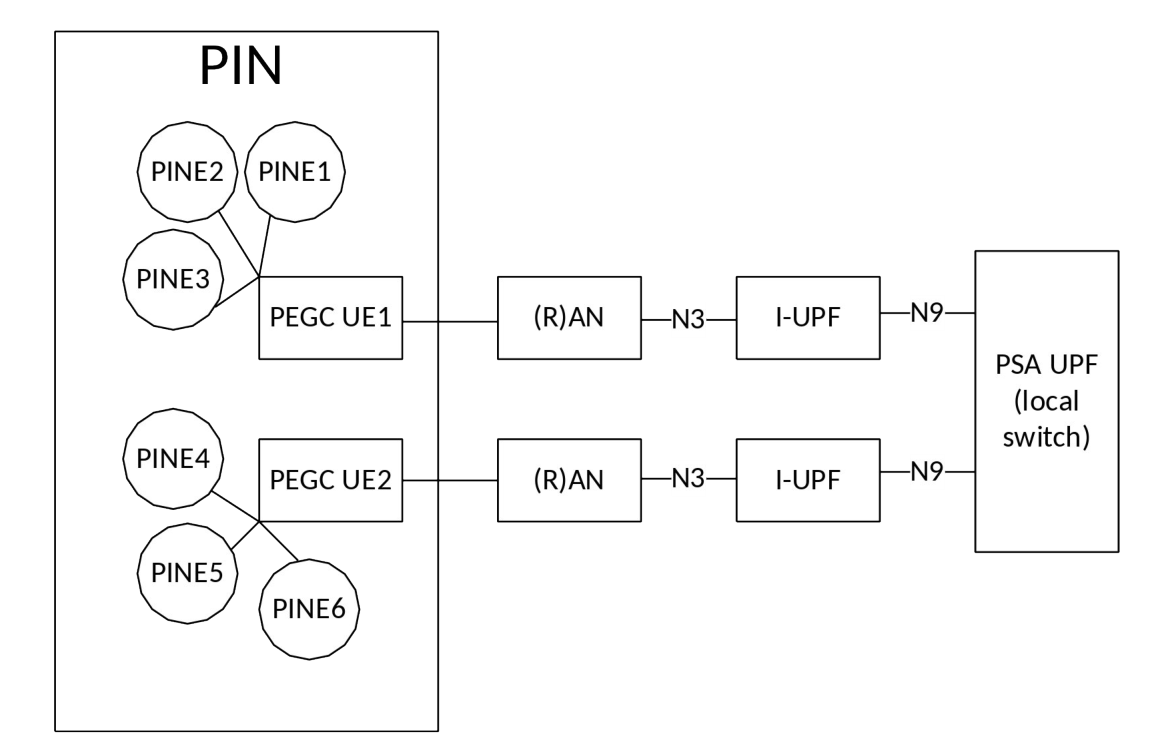
NOTE: Figure P.2-1 does not show traffic from a PEMC.
The SMF configures the UPF(s) to apply N6-based traffic forwarding to route traffic between PDU Sessions of different PEGCs of a PIN as specified in clause 5.8.2.13. The SMF can apply local switching as specified in clause 5.8.2.13 in order to enable UPF locally forward uplink stream from one PDU session of one PEGC of a PIN as downlink stream of PDU session of one or more PEGC(s) of the same PIN. For local switching of PIN traffic between PIN related PDU sessions from different PEGCs of a single PIN, based on the (DNN, S-NSSAI) combination that is used for the PDU session related to PIN, the SMF provides a Network Instance to the UPF in FAR and/or PDR via N4 Session Establishment/Modification procedures.