3GPP 23.501 v20.2.0 — the document's own text
5.18.1 General concepts
Taught in 26. Relays, satellites, femtos and shared networks (The 5G system architecture, in depth).
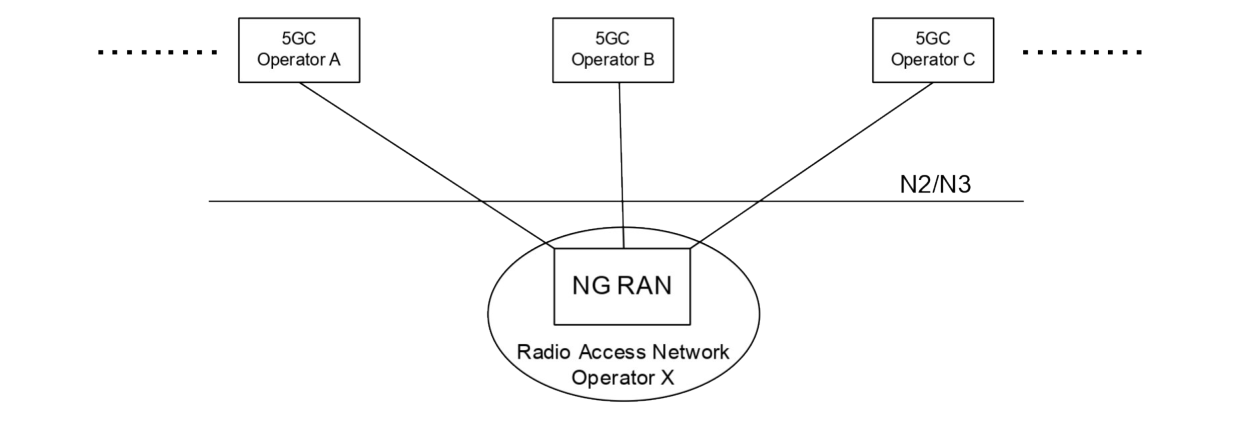
A network sharing architecture shall allow multiple participating operators to share resources of a single shared network according to agreed allocation schemes. The shared network includes a radio access network. The shared resources include radio resources.
The shared network operator allocates shared resources to the participating operators based on their planned and current needs and according to service level agreements.
In this Release of the specification, the 5G Multi-Operator Core Network (5G MOCN) network sharing architecture, in which only the RAN is shared in 5G System, is supported. The 5G System may also support Indirect Network Sharing deployment between hosting operator (i.e. shared network operator) and participating operator (see clause 6.21 of TS 22.261 [2], Figure 5.18.1-2 and Annex R), in which the RAN is shared. The communication between the shared RAN and the core network of the participating operator is routed through the core network of the hosting operator that connects to the shared RAN.
NOTE 0: Indirect Network Sharing includes cases where one participating operator has relationships with multiple hosting operators and cases where one hosting operator has relationships with multiple participating operators.
5G MOCN for 5G System, including UE, RAN and AMF, shall support operators' ability to use more than one PLMN ID (i.e. with same or different country code (MCC) some of which is specified in TS 23.122 [17] and different network codes (MNC)) or combinations of PLMN ID and NID. 5G MOCN supports NG-RAN Sharing with or without multiple Cell Identity broadcast as described in TS 38.300 [27]. Indirect Network Sharing for 5G system, including UE, shared RAN and CP NFs of hosting operator, shall support each participating operator to use more than one PLMN ID.
For Indirect Network Sharing, the shared RAN broadcasts multiple PLMN IDs, including the PLMN ID which represents the hosting operator and the PLMN IDs which represent participating operators. Multiple PLMN IDs are supported by the serving AMF (i.e. the AMF in the core network of the hosting operator). A UE from a participating operator can select the PLMN ID representing the participating operator in the shared RAN area based on existing procedures specified in TS 23.122 [17]. The serving AMF selects core network functions in the PLMN of the participating operator for the UE, based on home routed roaming architecture principle as specified in clause 4.2.4. In addition, the serving AMF selects the SMF of participating operator possibly considering UE location information and also selects a V-SMF in its own network during the PDU session establishment procedure. The serving PLMN ID used in the procedures is determined as follows:
- For interaction between the Network Functions in the hosting operator network and the participating operator network (e.g. AUSF, UDM), the NF of hosting operator network sets the serving PLMN ID to the selected PLMN ID. This includes the cases when the interaction is via another NF (e.g. V-PCF for UE policy, V-SMF) in the hosting operator network.
- For interactions between the Network Functions only in the hosting operator network (e.g. V-PCF for AM policy), the NF of hosting operator network sets the serving PLMN ID to the PLMN ID of the hosting operator.
For Indirect Network Sharing, in order to enable the NFs of the participating operator's network (e.g. UDM, SMF, PCF for the PDU session) to detect the Indirect Network Sharing case and identify the specific hosting operator's network, the corresponding service operation messages sent to the NFs of the participating operator's network include the PLMN ID of the hosting operator and the serving PLMN ID.
NOTE 1: In this Release of specification, the Indirect Network Sharing is only applicable for NR with 5GC of hosting operator and 5GC of participating operator. There are maximum of two SMFs (i.e. V-SMF of the hosting operator and H-SMF of the participating operator) controlling a PDU session.
5G MOCN also supports the following sharing scenarios involving non-public networks, i.e.NG-RAN can be shared by any combination of PLMNs, PNI-NPNs (with CAG) and SNPNs (each identified by PLMN ID and NID).
NOTE 2: PNI-NPNs (without CAG) are not explicitly listed above as it does not require additional NG-RAN sharing functionality compared to sharing by one or multiple PLMNs.
In all non-public network sharing scenarios, each Cell Identity as specified in TS 38.331 [28] is associated with one of the following configuration options:
- one or multiple SNPNs;
- one or multiple PNI-NPNs (with CAG); or
- one or multiple PLMNs only.
NOTE 3: This allows the assignment of multiple cell identities to a cell and also allows the cell identities to be independently assigned, i.e. without need for coordination, by the network sharing partners, between PLMNs and/or non-public networks.
NOTE 4: Different PLMN IDs (or combinations of PLMN ID and NID) can also point to the same 5GC. When same 5GC supports multiple SNPNs (identified by PLMN ID and NID), it is up to the operator's policy whether they are used as equivalent SNPNs for a UE.
NOTE 5: There is no standardized mechanism to avoid paging collisions if the same 5G-S-TMSI is allocated to different UEs by different PLMNs or SNPNs of the shared network, as the risk of paging collision is assumed to be very low. If such risk is to be eliminated then PLMNs and SNPNs of the shared network needs to coordinate the value space of the 5G-S-TMSI to differentiate the PLMNs and SNPNs of the shared network.
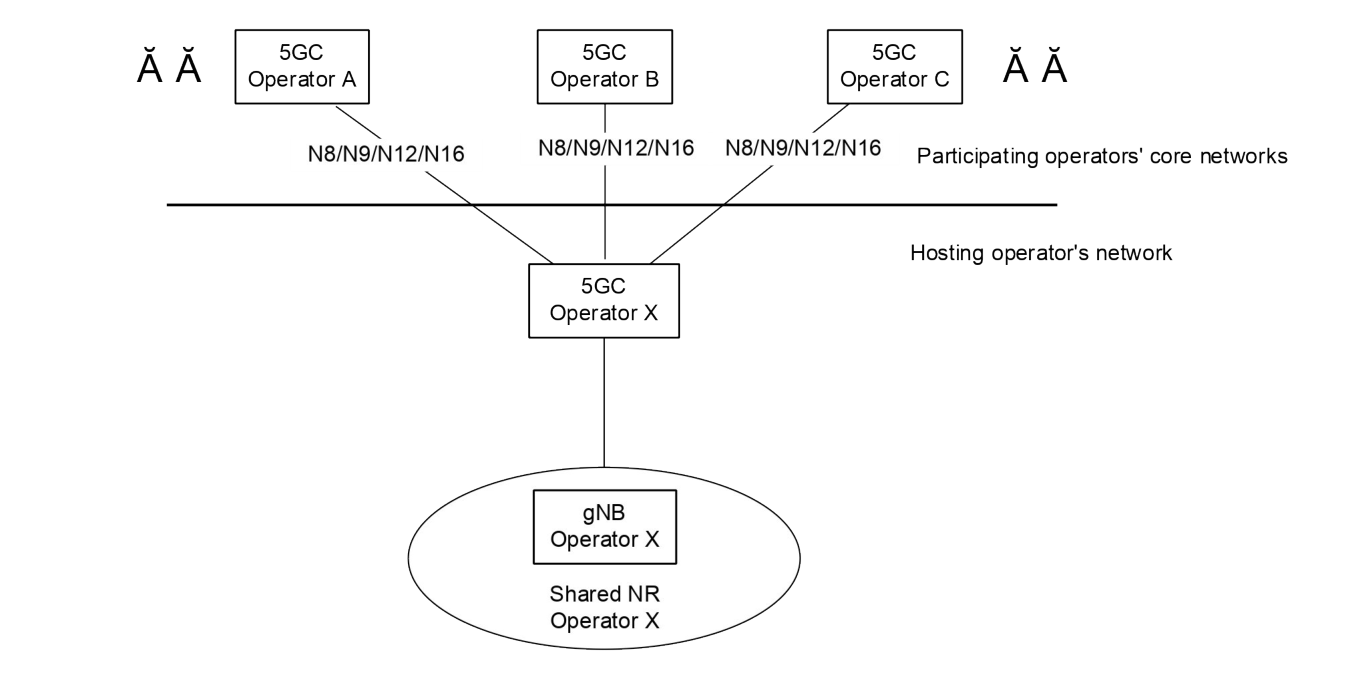
NOTE 6: Not all interfaces between the hosting operator and the participating operator are depicted in the Figure 5.18.1-2 for simplicity.
NOTE 7: For the sake of clarity, SEPPs are not depicted in the Figure 5.18.1-2.
NOTE 8: In this Release, if the participating operator deploys the Indirect Network Sharing and non-3GPP access (e.g. N3IWF) to 5GC simultaneously, and if the same PLMN ID is used for 3GPP access via Indirect Network Sharing and non 3GPP access (e.g. via N3IWF) to 5GC of HPLMN/participating PLMN, and if there is no N2 interface between the AMF supporting Indirect Network Sharing at the hosting PLMN and the non-3GPP access (e.g. N3IWF) to 5GC of the HPLMN, then the UE cannot be served simultaneously by the 3GPP access via Indirect Network Sharing and non-3GPP access (e.g. via N3IWF) to 5GC of the HPLMN.
To avoid this case, if the participating operator plans to deploy the Indirect Network Sharing and non-3GPP access (e.g. N3IWF) to 5GC simultaneously, it is recommended that one of following measures is used:
- the different PLMN IDs are used for 3GPP access via Indirect Network Sharing and non 3GPP access (e.g. via N3IWF) to 5GC of HPLMN.
- the N2 interface is deployed between the AMF(s) of the hosting PLMN supporting Indirect Network Sharing and the non-3GPP access (e.g. N3IWF) to 5GC of the HPLMN.
If none of the two measures in NOTE 8 can be used, the network rejects the UE access via non-3GPP access (e.g. via N3IWF) to 5GC of HPLMN with an existing cause value that will not allow access to 5GC of HPLMN via non-3GPP access (e.g. via N3IWF) when it detects the UE has been registered to its HPLMN ID over 3GPP access via Indirect Network Sharing.
NOTE 9: If none of the two measures in the NOTE 8 can be used and the UE registers the non 3GPP access (e.g. via N3IWF) to 5GC of HPLMN first, then the network can accept the registration to HPLMN ID over 3GPP access via Indirect Network Sharing. How to handle this is up to implementation.