3GPP 23.501 v20.2.0 — the document's own text
5.17.7.1 Architecture Principles for Configuration Transfer between NG-RAN and E-UTRAN
Taught in 19. Living next to 4G (The 5G system architecture, in depth), 7. Roaming, other accesses, the edge and the outside (The 5G system architecture, overview).
The purpose of the Configuration Transfer between NG-RAN and E-UTRAN is to enable the transfer the RAN configuration information between the gNB and eNodeB via MME and AMF.
In order to make the information transparent for the MME and AMF, the information is included in a transparent container. The source and target RAN node addresses, which allows the Core Network nodes to route the messages. The mechanism depicted in Figure 5.17.7.1-1.
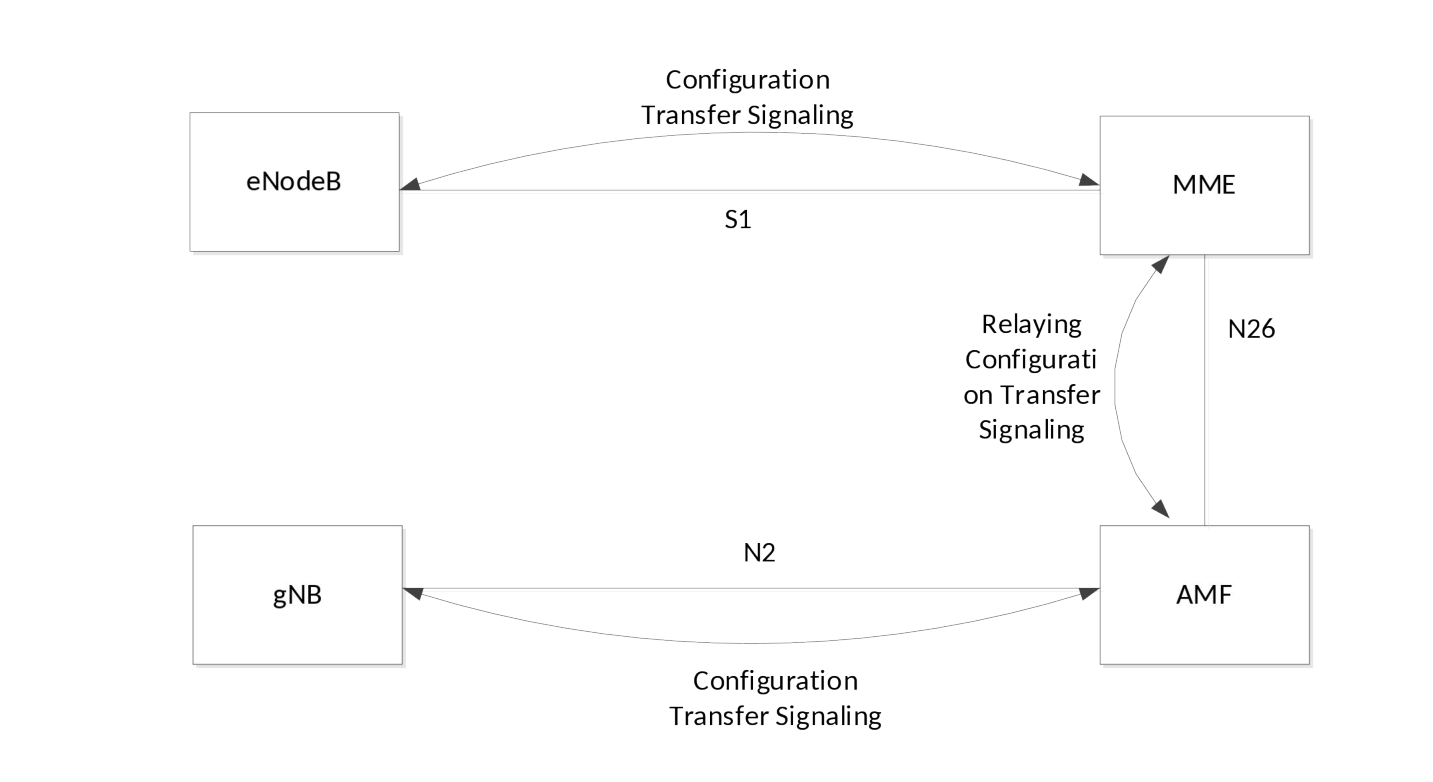
The NG-RAN transparent containers are transferred from the source NG-RAN node to the destination E-UTRAN node and vice versa by use of Configuration Transfer messages.
An ENB Configuration Transfer message is used from the E-UTRAN node to the MME over S1 interface as described in TS 36.413 [100], the destination RAN node includes the en-gNB Identifier and may include a TAI associated with the en-gNB. If MME is aware that the en-gNB serves cells which provide access to 5GC, the MME relays the request towards a suitable AMF via inter-system signalling based on a broadcast 5G TAC. An AMF Configuration Transfer message is used from the AMF to the NG-RAN over N2 interface.
A Configuration Transfer message is used by the gNB node to the AMF over N2 interface for the reply and a Configuration Transfer Tunnel message is used to tunnel the transparent container from AMF to MME over the N26 interface. MME relays this reply to the target eNB using a MME CONFIGURATION TRANSFER message. Transport of the RAN containers in E-UTRAN is specified in TS 23.401 [26].
Each Configuration Transfer message carrying the transparent container is routed and relayed independently by the core network node(s). Any relation between messages is transparent for the AMF and MME, i.e. a request/response exchange between applications, for example SON applications, is routed and relayed as two independent messages by the AMF and MME.