3GPP 21.900 v20.0.0 — the document's own text
6.6 Work Item model
Taught in 2. The shape of 3GPP, and what the record does not say about it (How standards actually get made, in depth), 16. What this record cannot tell you (How standards actually get made, in depth), 2. The shape of 3GPP, and where the data stops (How standards actually get made, overview).
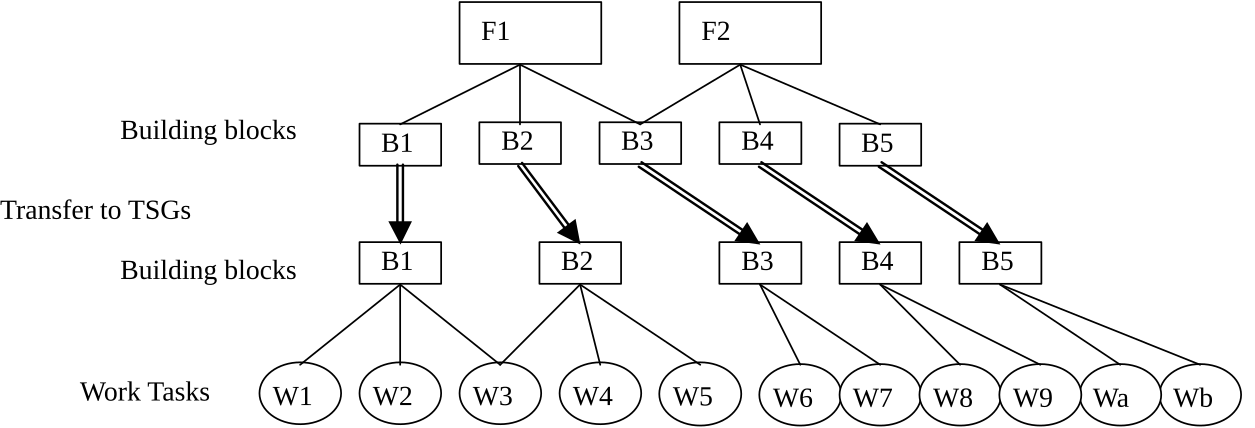
The model described below can be thought of as a reference model for structuring the work. It is not the intention to rigorously enforce the usage of the model on all ongoing work, but merely to use it as the common reference model across the TSGs and to structure future work.
The description below uses TSG SA as an illustration; it can easily be extended to apply to any TSG (or combination of TSGs).
TSG SA is, through SA1, responsible for defining the features and services required in the 3GPP specifications. SA1 is responsible of producing the stage 1 descriptions (requirements) for the relevant features and passing them to SA2. SA1 may also forward their considerations on possible architecture and implementation to SA2, but is not responsible for this part of the work.
SA2 should then define the architecture for the features and the system, and then divide the features into building blocks based on the architectural decisions made in SA2. SA2 shall then forward the building blocks to the relevant TSGs for the detailed work. These proposals shall be reviewed and discussed in an interactive way together with TSGs/WGs, until a common understanding of the required work is reached. During the detailed the work of the TSGs and their Working Groups, SA2 shall be kept informed about the progress.
The TSGs and their WGs treat the building block as one or several dedicated work tasks. Typical output of a work task is new specification(s), updated specification(s), technical report(s) or the conclusion that the necessary support is already provided in the existing specifications.
SA2's role is in co-operation with the TSGs and their WGs to identify if synergy can be obtained by using some of the building blocks for more than one feature. Part of SA2's task is to verify that all required work for a full system specification of the features relevant will take place within 3GPP without overlap between groups. In order for SA2 to be successful, this has to be done in co-operation with other TSGs/WGs.
The following guidelines are proposed for project scheduling. SA1 sets a target, SA2 performs a first technical review and comments on the target. SA2 indicates target for time schedule together with allocation of the defined building blocks. The TSGs and their WGs comment back on these targets. SA2 tries if necessary to align the new target amongst the involved parties. SA1 and SA are kept informed of the overall schedule.
It is the task of TSG SA, SA1 and SA2 to ensure early involvement of SA3 to ensure that the potential security requirements, service requirements and the architectural requirements are aligned and communicated to the TSGs and their WGs.
In order for TSGs CT and RAN and their subgroups to plan and perform their horizontal tasks on conformance testing and mobile station capabilities, SA2 should invite those TSGs to evaluate the potential impact of a new feature. If work on horizontal tasks is required, this should be included in the overall work plan.