3GPP 38.300 v19.3.0 — the document's own text
9.2.3.7.1 General
CLTM cell switch is executed by the UE when L1-based or L3-based LTM cell switch execution conditions are met. The same LTM procedures as described in clause 9.2.3.5.1 on network activation of TCI states for DL synchronization and on configuration and initiation of UL TA acquisition (via PDCCH order) are also applicable for CLTM. CLTM can coexist with network triggered L3 HO, CHO and network triggered PSCell change, while the coexistence of CLTM and DAPS HO is not supported. The overall procedure for CLTM is as shown in Figure 9.2.3.7.1-1:
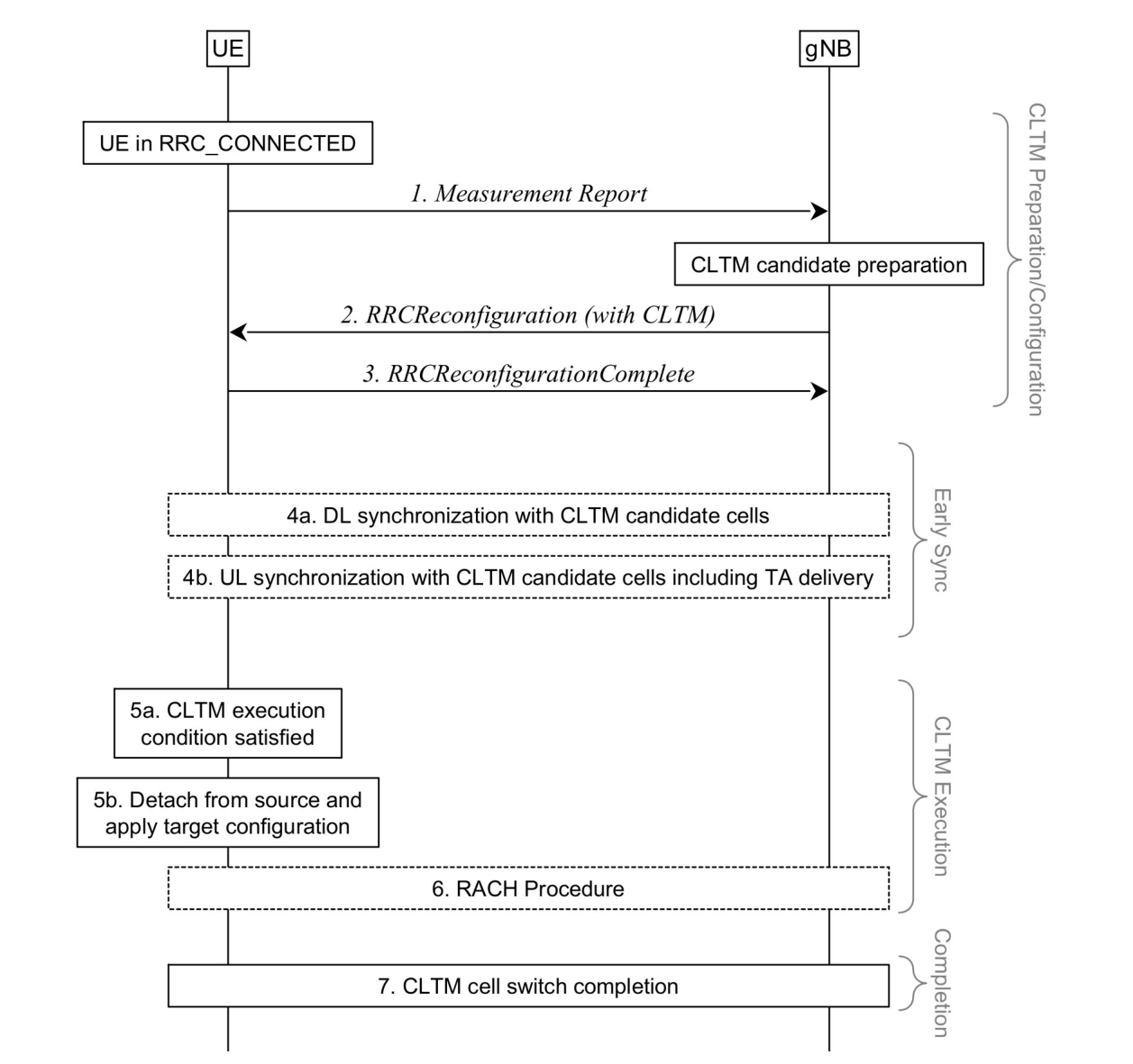
The procedure for CLTM is as follows:
1. The UE sends a MeasurementReport message to the gNB. The gNB decides to configure CLTM and initiates CLTM preparation.
2. The source gNB can request the candidate cells to provide conditional execution configurations and the candidate cells provide the conditional configuration including their own execution conditions, to be used in subsequent CLTM. The source gNB sends an RRCReconfiguration message to the UE and this includes the configurations of CLTM candidate cells as well as the execution condition for CLTM.
3. The UE stores the CLTM candidate configurations and transmits an RRCReconfigurationComplete message to the gNB. The UE starts evaluating the execution conditions based on the provided configuration.
4a/4b. Early DL and UL synchronization to some CLTM candidate cell(s) may be performed. The source gNB may activate or deactivate the TCI states of the candidate LTM cells. The source gNB can trigger early synchronization (for example, based on the L1 or L3 measurement reports from the UE, if configured) to the UE and the UE may perform early UL synchronization with CLTM candidate cell(s) by transmitting a preamble towards the candidate cell, as triggered by the source gNB. In addition, the source gNB can provide the TA value for each of the candidate cells the UE has performed UL synchronization with. Depending on network configuration, the UE may perform early UL synchronization with CLTM candidate cell(s), by using UE-based TA measurement, if configured.
5a/5b. The CLTM execution condition is satisfied at the UE and on (at least) one satisfied candidate CLTM cell, the UE performs the CLTM execution by applying the configuration of the satisfied CLTM candidate cell.
6. If the UE has valid TA as part of the UL early synchronization from step 4b, the UE skips RACH. Otherwise, RACH is performed as part of the CLTM execution.
7. The UE completes the CLTM cell switch procedure by sending RRCReconfigurationComplete message to the target CLTM cell. For RACH-based CLTM, the UE considers that CLTM cell switch execution is successfully completed when the random access procedure is successfully completed. For RACH-less CLTM, the UE considers that CLTM cell switch execution is successfully completed when the UE determines that the network has successfully received its first UL data. The UE does not release any valid TA value(s) of CLTM candidate cells with CLTM configuration.
The steps 4-7 can be performed multiple times for subsequent CLTM cell switch executions using the CLTM candidate configuration(s) provided in step 2.
The following principles apply to CLTM:
- CLTM is supported for intra-gNB LTM when DC is not configured. Inter-gNB CLTM is not supported;
- CLTM can be RACH-based or RACH-less. RACH-based CLTM includes CFRA and CBRA, and only CG based RACH-less CLTM is supported;
- U-Plane handling from clause 9.2.3.5.3 applies to CLTM as well and since there is no LTM cell switch command MAC CE reception for CLTM, the UE performs MAC reset as part of the CLTM execution.