3GPP 38.300 v19.3.0 — the document's own text
7.3.1 Overview
Taught in 2. The six working groups and the line between them (TSG RAN — the group that specifies the radio, overview).
System Information (SI) consists of a MIB and a number of SIBs, which are divided into Minimum SI and Other SI:
- Minimum SI comprises basic information required for initial access and information for acquiring any other SI. Minimum SI consists of:
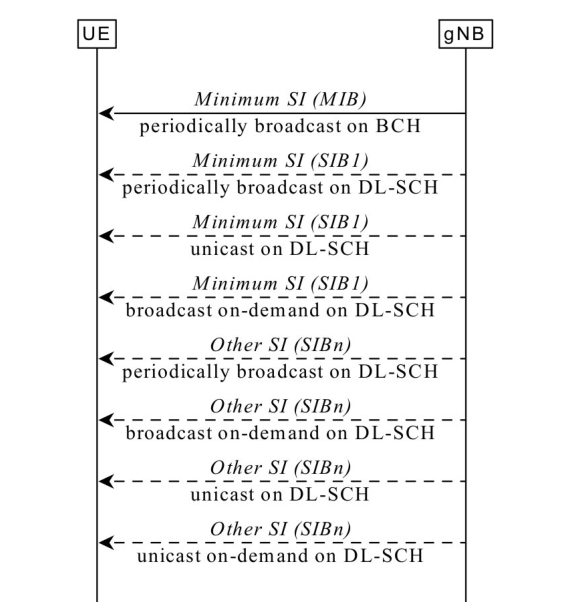
- MIB contains cell barred status information and essential physical layer information of the cell required to receive further system information, e.g. CORESET#0 configuration. MIB is periodically broadcast on BCH.
- SIB1 defines the scheduling of other system information blocks and contains information required for initial access. SIB1 is also referred to as Remaining Minimum SI (RMSI) and can either be periodically broadcast on DL-SCH, sent in a dedicated manner on DL-SCH to UEs in RRC_CONNECTED, or broadcast on-demand upon OD-SIB1 request from UEs in RRC_IDLE, RRC_INACTIVE or RRC_CONNECTED state when T311 is running if a UE and cell support OD-SIB1 as described in 15.4.2.9.
- Other SI encompasses all SIBs not broadcast in the Minimum SI. Those SIBs can either be periodically broadcast on DL-SCH, broadcast on-demand on DL-SCH (i.e. upon request from UEs in RRC_IDLE, RRC_INACTIVE, or RRC_CONNECTED), or sent in a dedicated manner on DL-SCH to UEs in RRC_CONNECTED (i.e., upon request, if configured by the network, from UEs in RRC_CONNECTED or when the UE has an active BWP with no common search space configured or when the UE configured with inter cell beam management is receiving DL-SCH from a TRP with PCI different from serving cell's PCI). For on-demand SIB requests made in RRC_CONNECTED, the UE may also request the start or stop of posSIB deliveries in a dedicated manner on DL-SCH, if configured by the network. Other SI consists of:
- SIB2 contains cell re-selection information, mainly related to the serving cell;
- SIB3 contains information about the serving frequency and intra-frequency neighbouring cells relevant for cell re-selection (including cell re-selection parameters common for a frequency as well as cell specific re-selection parameters);
- SIB4 contains information about other NR frequencies and inter-frequency neighbouring cells relevant for cell re-selection (including cell re-selection parameters common for a frequency as well as cell specific re-selection parameters), which can also be used for NR idle/inactive measurements;
- SIB5 contains information about E-UTRA frequencies and E-UTRA neighbouring cells relevant for cell re-selection (including cell re-selection parameters common for a frequency as well as cell specific re-selection parameters);
- SIB6 contains an ETWS primary notification;
- SIB7 contains an ETWS secondary notification;
- SIB8 contains a CMAS warning notification;
- SIB9 contains information related to GPS time and Coordinated Universal Time (UTC);
- SIB10 contains the Human-Readable Network Names (HRNN) of the NPNs listed in SIB1;
- SIB11 contains information related to idle/inactive measurements;
- SIB15 contains information related to disaster roaming;
- SIB16 contains slice-based cell reselection information;
- SIB17 and SIB17bis contain information related to TRS configuration for UEs in RRC_IDLE/RRC_INACTIVE;
- SIBpos contains positioning assistance data as defined in TS 37.355 [43] and TS 38.331 [12];
- SIB18 contains information related to the Group IDs for Network selection (GINs) associated with SNPNs listed in SIB1.
- SIB19 in TN contains NTN-specific parameters for NTN neighbour cells as defined in TS 38.331 [12].
- SIB26 contains OD-SIB1 request configurations of serving and neighbour cells which support OD-SIB1 as defined in TS 38.331 [12].
For sidelink, Other SI also includes:
- SIB12 contains information related to NR sidelink communication, ranging and sidelink positioning;
- SIB13 contains information related to SystemInformationBlockType21 for V2X sidelink communication as specified in TS 36.331 clause 5.2.2.28 [29];
- SIB14 contains information related to SystemInformationBlockType26 for V2X sidelink communication as specified in TS 36.331 clause 5.2.2.33 [29];
- SIB23 contains information related to ranging and sidelink positioning.
For non-terrestrial network, Other SI also includes:
- SIB19 contains NTN-specific parameters for serving cell and optionally NTN-specific parameters for neighbour cells as defined in TS 38.331 [12].
- SIB25 contains TN coverage information as defined in TS 38.331 [12].
- SIB28 contains assistance information for cell selection to IoT NTN neighbour cells as defined in TS 38.331 [12].
For MBS broadcast, Other SI also includes:
- SIB20 contains MCCH configuration;
- SIB21 contains information related to service continuity for MBS broadcast reception;
- SIB27 contains the information of the ISA(s) of MBS broadcast service(s) in an NTN cell.
For MBS multicast reception in RRC_INACTIVE state, Other SI also includes:
For ATG network, Other SI also includes:
Figure 7.3.1-1 below summarises System Information provisioning.
For a cell/frequency that is considered for camping by the UE, the UE is not required to acquire the contents of the minimum SI of that cell/frequency from another cell/frequency layer. This does not preclude the case that the UE applies stored SI from previously visited cell(s).
If the UE cannot determine the full contents of the minimum SI of a cell by receiving from that cell, the UE shall consider that cell as barred.
In case of BA, the UE only acquires SI on the active BWP.
If the UE is configured with inter cell beam management:
- the UE is not required to acquire the SI from the serving cell while it is receiving DL-SCH from a TRP with PCI different from serving cell's PCI.