3GPP 38.300 v19.3.0 — the document's own text
6.11.3 Routing, BAP Header Rewriting and BH-RLC-channel Mapping on BAP sublayer
Taught in 2. The six working groups and the line between them (TSG RAN — the group that specifies the radio, overview).
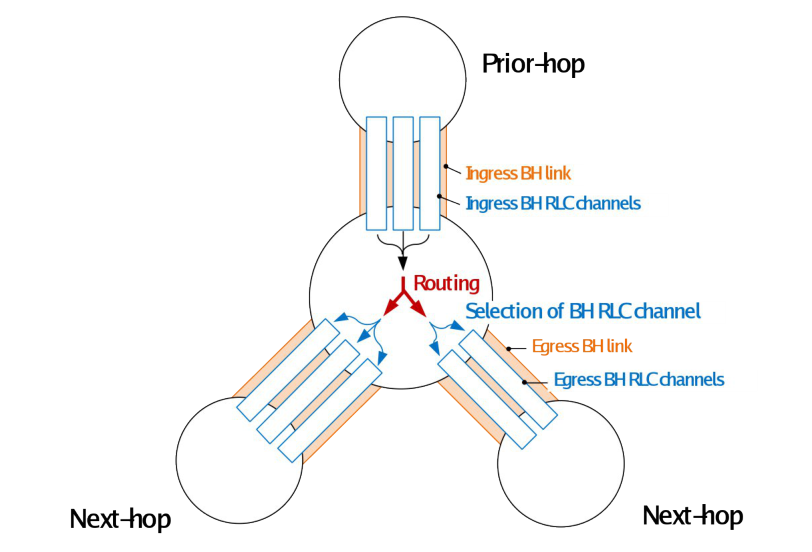
Routing on BAP sublayer uses the BAP routing ID, which is configured by the IAB-donor-CU. The BAP routing ID consists of BAP address and BAP path ID. The BAP address is used for the following purposes:
1. Determination if a packet has reached the destination node, i.e. IAB-node or IAB-donor-DU, on BAP sublayer. This is the case if the BAP address in the packet's BAP header matches the BAP address configured via RRC on the IAB-node, or via F1AP on the IAB-donor-DU. For a dual-connected boundary IAB-node that is configured with two BAP addresses, the BAP address in the packet's BAP header is matched with the BAP address configured by the CU of the IAB topology, where the packet has been received.
2. Determination of the next-hop node for packets that have not reached their destination. This applies to packets arriving from a prior hop on BAP sublayer or that have been received from IP layer.
For packets arriving from a prior hop or from upper layers, the determination of the next-hop node is based on a routing configuration provided by the IAB-donor-CU via F1AP signalling or a default configuration provided by the IAB-donor-CU via RRC signalling. This F1AP configuration contains the mapping between the BAP routing ID carried in the packet's BAP header and the next-hop node's BAP address.
Table 6.11.3-1: Routing configuration
| BAP routing ID | Next-hop BAP address |
|---|---|
| Derived from BAP packet's BAP header | Egress BH link to forward packet |
The IAB-node resolves the next-hop BAP address to a physical backhaul link. For this purpose, the IAB-donor-CU provides the IAB-node/IAB-donor-DU with its child-node's BAP address via F1AP, and it provides the IAB-node with its parent-node's BAP address via RRC. For a boundary IAB-node, the routing configuration also indicates the IAB topology it applies to. The BH link to the next-hop node and the next-hop BAP address belong to the IAB topology of the CU that provided the RRC configuration of the BH link to that next-hop node.
The IAB-node can receive multiple routing configurations with the same destination BAP address but different BAP path IDs. These routing configurations may resolve to the same or different egress BH links.
In case the BH link resolved from the routing entry is considered unavailable for this packet, the IAB-node may perform local rerouting as defined in TS 38.340 [31], i.e., select another BH link by considering only the packet's BAP address or, in some cases, by header rewriting. In this manner, the packet can be delivered via an alternative path as defined in TS 38.340 [31].
A BH link may be considered unavailable in case the BH link has RLF. A parent link may be considered unavailable after a BH RLF detection indication has been received on this parent link and before a subsequent BH RLF recovery indication has been received on the same parent link. For DL traffic, a BH link may be considered unavailable for BAP PDUs carrying a certain BAP routing ID due to congestion derived from flow-control feedback information related to this BAP routing ID, as defined in TS 38.340 [31].
For a boundary IAB-node, the routing configuration may carry information on the IAB topology the configuration applies to.
The IAB-node may rewrite the BAP routing ID in the packet's BAP header under the following circumstances:
- A packet is routed between two IAB topologies via a boundary IAB-node as defined in TS 38.401[31]. In this case, the BAP routing ID carried by the received BAP PDU is allocated by the IAB-donor-CU of the ingress IAB topology, while the BAP routing ID carried by the BAP PDU after header rewriting is allocated by the IAB-donor-CU of the egress IAB topology.
- An upstream packet is locally re-routed to a different IAB-donor-DU than indicated by the BAP address in the BAP header of the received packet. The rewritten BAP header carries the BAP address of the alternative IAB-donor-DU and the BAP path ID for a path to this alternative IAB-donor-DU. BAP header rewriting for upstream inter-IAB-donor-DU local rerouting is only applied if neither routing nor local re-routing without header rewriting resolve to an available egress BH link.
For packets that are routed between two IAB topologies via a boundary node, the BAP header rewriting configuration is provided via F1AP, and it includes the ingress BAP routing ID, the egress BAP routing ID, and it indicates the egress IAB topology:
Table 6.11.3-2a: BAP header rewriting configuration
| Ingress BAP routing ID | Egress BAP routing ID | Egress topology indicator |
|---|---|---|
| BAP routing ID carried in the BAP header of the received BAP PDU | BAP routing ID carried in the BAP header of the transmitted BAP PDU | Indicates the egress IAB topology. |
For upstream packets that are locally re-routed to a different IAB-donor-DU, the BAP header is rewritten with a BAP routing ID contained in the routing entry that was selected for re-routing.
Details of BAP header rewriting are defined in TS 38.340 [31].
When routing a packet from an ingress to an egress BH link, the IAB-node derives the egress BH RLC channel on the egress BH link through an F1AP-configured mapping from the BH RLC channel used on the ingress BH link. The BH RLC channel IDs used for ingress and egress BH RLC channels are generated by the IAB-donor-CU. Since the BH RLC channel ID only has link-local scope, the mapping configurations also include the BAP addresses of prior and next hop:
Table 6.11.3-2: BH RLC channel mapping configuration
| Next-hop BAP address | Prior-hop BAP address | Ingress RLC channel ID | Egress RLC channel ID |
|---|---|---|---|
| Derived from routing configuration | Derived from packet's ingress BH link | Derived from packet's ingress BH RLC channel | BH RLC channel on egress BH link to forward packet |
For a boundary IAB-node, the BH RLC channel mapping configuration may also include indicators for the IAB topology of the ingress and of the egress BH link.
The IAB-node resolves the BH RLC channel IDs from logical channel IDs based on the configuration by the IAB-donor-CU. The IAB-MT obtains the BH RLC channel ID in the RRC configuration of the corresponding logical channel. The IAB-DU obtains the BH RLC channel ID in the F1AP configuration of the BH RLC channel.