3GPP 38.300 v19.3.0 — the document's own text
16.8.2.3 Network timing synchronization status monitoring towards UE
The gNB may receive clock quality reporting control information for a UE from the AMF, see TS 23.501 [3]. The clock quality reporting control information contains the clock quality detail level (i.e., "metrics" or "acceptable/not acceptable indication") and clock quality acceptance criteria for the UE (if the clock quality detail level equals "acceptable/not acceptable indication"). Based on the clock quality reporting control information, the gNB determines what clock quality information provide to the UE:
- If the clock quality detail level equals "clock quality metrics", the gNB provides clock quality attribute values supported by the gNB to the UE.
- If the clock quality detail level equals "acceptable/not acceptable indication", the gNB indicates "acceptable" to the UE if the gNB's timing synchronization status matches the acceptance criteria received from the AMF; otherwise, the gNB indicates "not acceptable" to the UE.
To provide clock quality information to the UEs:
- For UEs in the RRC CONNECTED state, the gNB uses unicast RRC signalling. The RRC signalling includes Event ID and clock quality information.
- For UEs that are not in the RRC_CONNECTED state, the UE first needs to establish or resume the RRC connection to receive the clock quality information from the gNB via unicast RRC signalling. The gNB broadcasts Event ID in SIB9 to notify its timing synchronization status. Event ID or Global gNB ID change serves as a notification for the UEs reading the SIB information that the RAN timing synchronization status information has changed.
The following figure describes the signalling procedure of gNB reporting clock quality information to a UE:
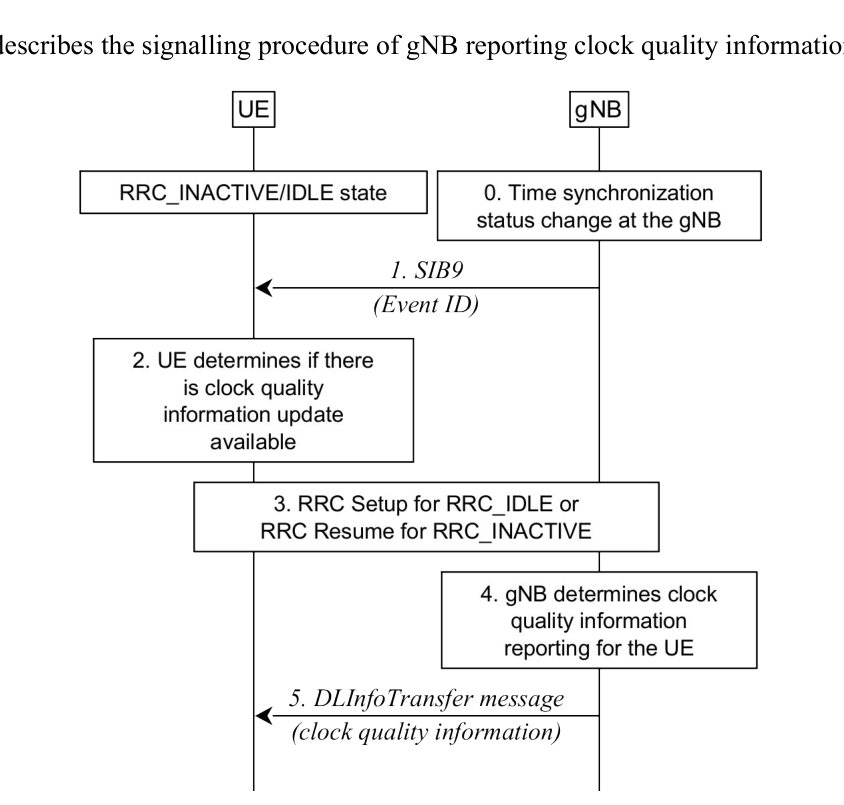
0. The gNB is pre-configured with a threshold for each RAN TSS attribute it supports as described in in TS 23.501 [3]. When there is a primary source event as defined in TS 38.401 [4], the gNB may detect a change on its timing synchronization state (e.g., degradation, failure, recovery).
1. The gNB notifies a change on its timing synchronization operation using Event ID in SIB9. The Event ID scope is local to gNB.
2. The UE in RRC_INACTIVE or RRC_IDLE determines if there is clock quality information update available at the gNB based on SIB9 information. For a UE in RRC_CONNECTED state, steps 2-3 can be skipped.
3. If there is a RAN timing synchronization status update available, the UE's RRC layer indicates this to the NAS layer which may request the RRC layer to initiate RRC Setup or RRC Resume procedure.
4. The gNB determines clock quality information reporting to the UE (e.g., metrics or "acceptable/not acceptable").
5. The gNB sends the clock quality information to the UE via unicast RRC signalling.