3GPP 38.300 v19.3.0 — the document's own text
16.23.5.3 A-IoT Access Procedure
Both A-IoT CBRA procedure and A-IoT CFA procedure are supported for A-IoT access. The A-IoT device initiates either A-IoT CBRA or A-IoT CFA based on an explicit indication in the A-IoT paging message, if the device is paged.
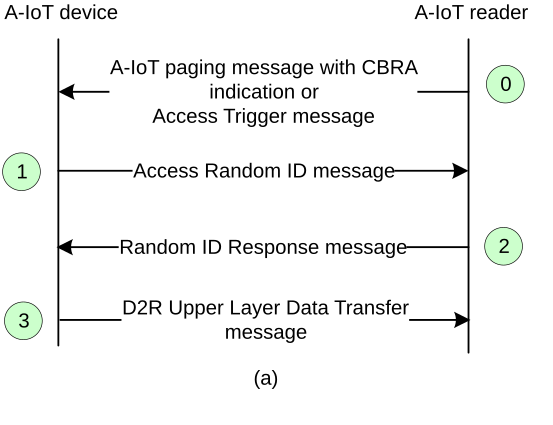
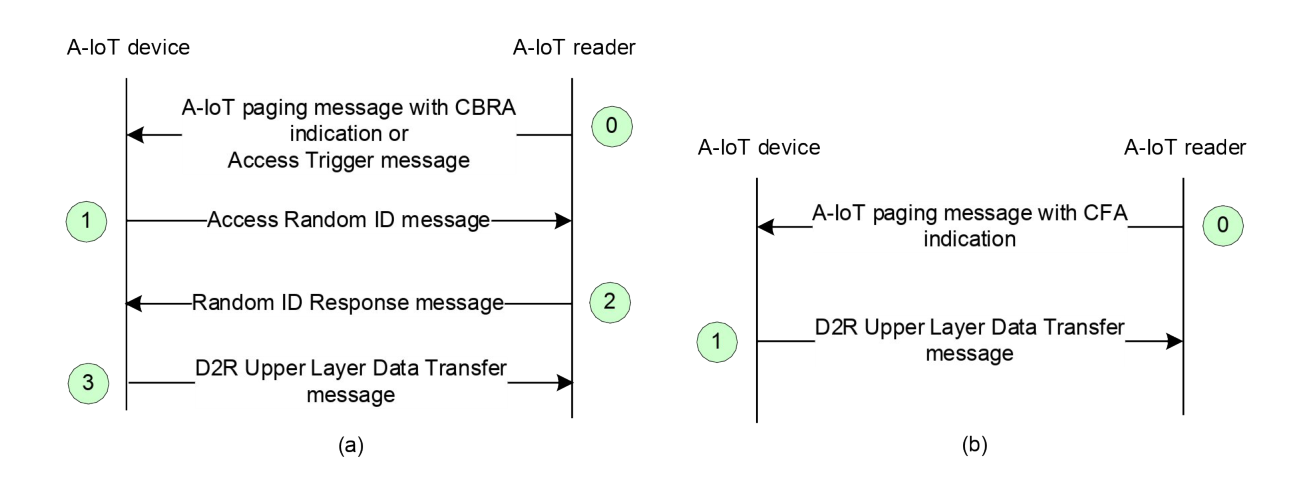
For CBRA, the A-IoT device randomly selects one access occasion among access occasions configured in A-IoT paging message. The A-IoT device may then monitor the Access Trigger message(s) to determine the start of the selected access occasion and transmits the A-IoT MSG1 (i.e. the Access Random ID message) on this access occasion as described in TS 38.391 [66]. The start of the first set of A-IoT MSG1 resources is indicated by A-IoT Paging message directly instead of the Access Trigger message. After A-IoT MSG1 transmission, the device monitors A-IoT MSG2 (i.e. the Random ID Response message) from the A-IoT reader for contention resolution until it has received the configured number of Access Trigger messages or subsequent A-IoT Paging message or R2D Upper Layer Data Transfer message addressed to the device or NACK Feedback message containing the device’s AS ID (i.e., the device does not process the A-IoT MSG2 received after that). Upon successful reception of A-IoT MSG2 which contains the matched frequency index (if present) as used and same random ID as transmitted in A-IoT MSG1, the A-IoT device considers the contention resolution as successful, as shown in Figure 16.23.5.3-1(a). Otherwise, the A-IoT device considers the contention resolution as failed. If contention resolution is successful, the A-IoT device transmits the D2R Upper Layer Data Transfer message in the resource provided in A-IoT MSG2. If the A-IoT device considers the contention resolution as failed, the A-IoT device shall perform re-access if an A-IoT Paging message with the same transaction ID is received.
For CFA, the A-IoT device shall use the dedicated resource provided in A-IoT paging message to send the D2R Upper Layer Data Transfer message as shown in Figure 16.23.5.3-1(b). The A-IoT device does not need to monitor the Access Trigger message.
NOTE: For CBRA, the A-IoT reader is expected to transmit enough Access Trigger message(s) to provide a number of access occasions not less than that configured in the A-IoT Paging message, unless the A-IoT reader is about to transmit subsequent A-IoT Paging message with either the same transaction ID or a different transaction ID.