3GPP 38.300 v19.3.0 — the document's own text
16.14.2.1 Scheduling and Timing
DL and UL are frame aligned at the uplink time synchronization reference point (RP) with an offset given by NTA,offset (see clause 4.2 of TS 38.213 [38]).
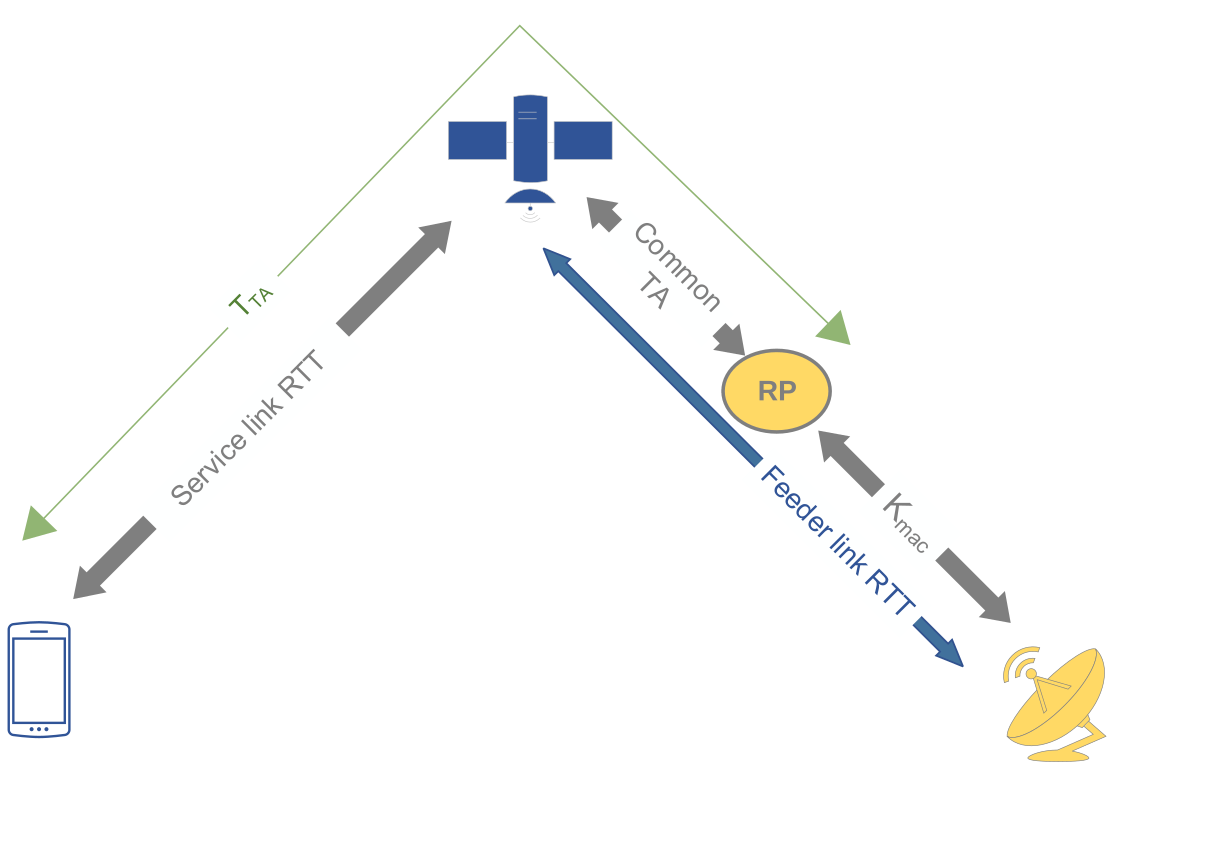
To accommodate the propagation delay in NTNs, several timing relationships are enhanced by a Common Timing Advance (Common TA) and two offsets Koffset and Kmac:
- Common TA is a configured timing offset that is equal to the RTT between the RP and the NTN payload.
- Koffset is a configured scheduling offset that needs to be larger or equal to the sum of the service link RTT and the Common TA.
- Kmac is a configured offset (see TS 38.331 [12]) that is approximately equal to the RTT between the RP and the gNB.
The scheduling offset Koffset is used to allow the UE sufficient processing time between a downlink reception and an uplink transmission, see TS 38.213 [38].
The offset Kmac is used to delay the application of a downlink configuration indicated by a MAC CE command on PDSCH, see TS 38.213 [38], and in estimation of UE-gNB RTT, see TS 38.321 [6]. It may be provided by the network when downlink and uplink frame timing are not aligned at gNB. The Kmac is also used in the random access procedure, to determine the start time of RAR window/MsgB window after a Msg1/MsgA transmission (see TS 38.213 [38]).
The Service link RTT, Feeder link RTT, RP, Common TA, Kmac and TTA (see clause 16.14.2.2) are illustrated in Figure 16.14.2.1-1.
The network may configure the HARQ operation as follows:
- For downlink, HARQ feedback can be enabled or disabled per HARQ process (as specified in clause 5.3.2.2 and clause 5.7 of TS 38.321 [6]). Disabling HARQ feedback allows scheduling a HARQ process before one HARQ RTT has elapsed since last scheduled.
- For uplink, HARQ mode (i.e. HARQ mode A or HARQ mode B) can be configured per HARQ process (as specified in clause 5.4.3.1 and clause 5.7 of TS 38.321 [6]). HARQ mode B allows scheduling a HARQ process before one HARQ RTT has elapsed since last scheduled.
NOTE: For the HARQ processes configured with HARQ feedback enabled/disabled, it is up to network implementation to ensure a proper configuration of HARQ feedback (e.g., either all enabled or all disabled) for HARQ processes used by an SPS configuration. For the HARQ processes configured with HARQ mode, it is up to network implementation to ensure a proper configuration of HARQ mode (e.g., either all HARQ mode A or all HARQ mode B) for HARQ processes used by a CG configuration.