3GPP 38.300 v19.3.0 — the document's own text
16.14.1 Overview
Figures 16.14.1-1 and 16.14.1-2 below illustrate examples of a Non-Terrestrial Network (NTN) providing non-terrestrial NR access to the UE by means of an NTN payload and an NTN Gateway, depicting a service link between the NTN payload and a UE, and a feeder link between the NTN Gateway and the NTN payload. In Figure 16.14.1-1, the payload is transparent; in Figure 16.14.1-2 the payload is regenerative and hosts a gNB.
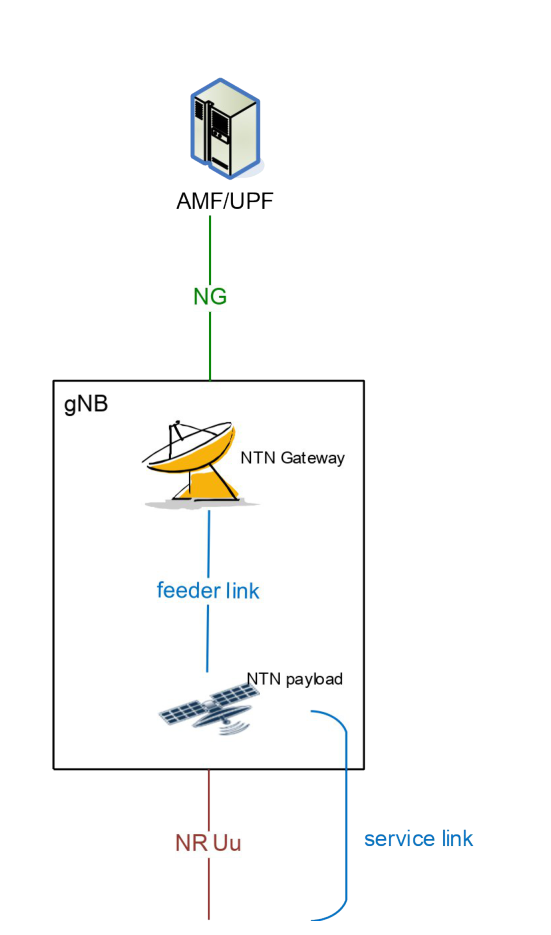
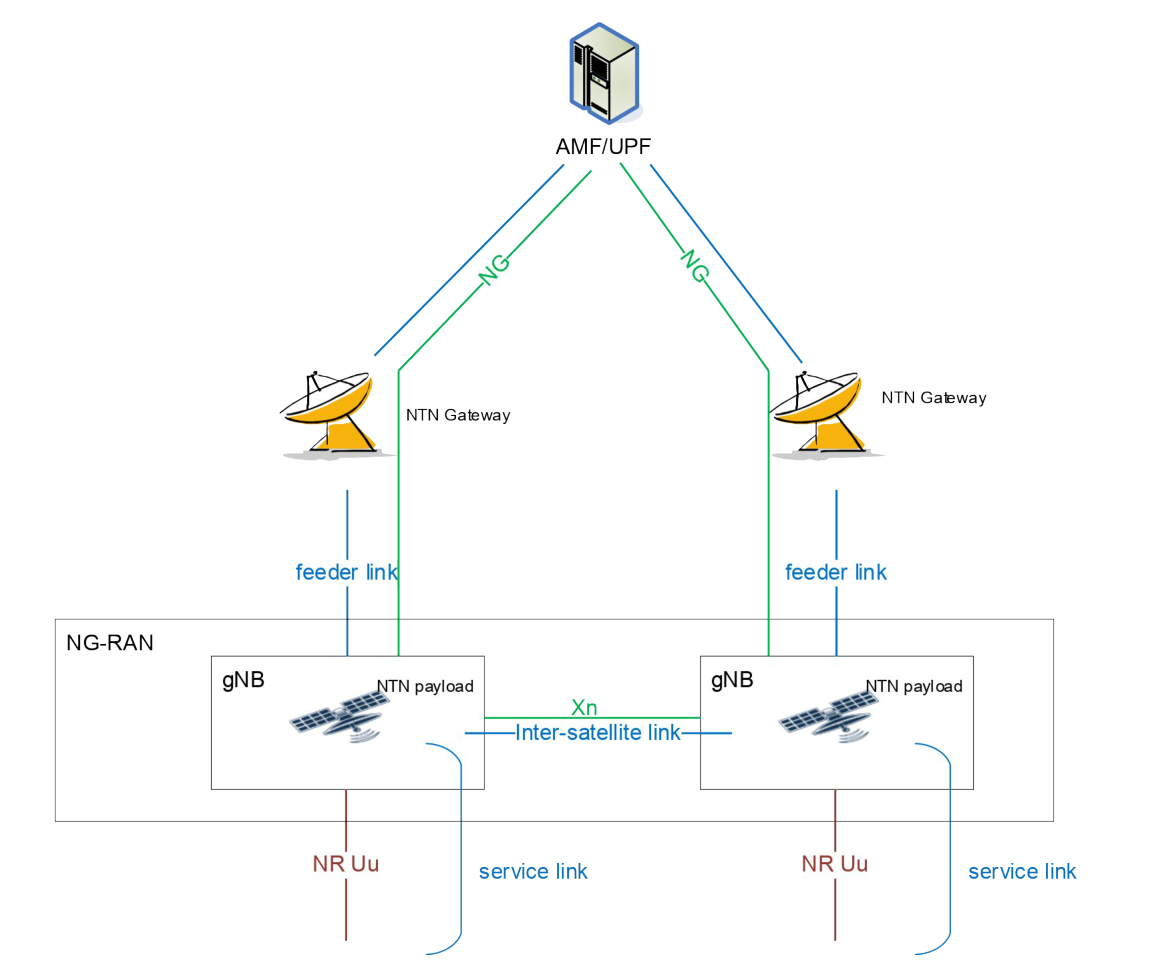
NOTE 1: Figure 16.14.1-1 and 16.14.1-2 illustrate an NTN; RAN4 aspects are out of scope.
The transparent NTN payload transparently forwards the radio protocol received from the UE (via the service link) to the NTN Gateway (via the feeder link) and vice-versa. The regenerative NTN payload terminates the Uu (via the service link), NG and Xn interfaces. The following connectivity is supported by the NTN payload:
- An NTN gateway may serve multiple NTN payloads;
- An NTN payload may be served by multiple NTN gateways.
NOTE 2: In this release, the transparent NTN-payload may change the carrier frequency, before re-transmitting it on the service link, and vice versa (respectively on the feeder link).
The following connectivity is supported by the NTN regenerative payload:
- A regenerative NTN payload may terminate one or more inter-satellite links toward other regenerative payloads.
For NTN, the following applies in addition to Network Identities as described in clause 8.2:
- A Tracking Area corresponds to a fixed geographical area. Any respective mapping is configured in the RAN;
- A Mapped Cell ID as specified in clause 16.14.5.
NTN can be deployed to provide coverage with earth-moving cell, quasi-earth-fixed cell and earth-fixed cell which are supported respectively by the following three types of service link:
- Earth-fixed: provisioned by beam(s) continuously covering the same geographical areas all the time (e.g., the case of GSO satellites);
- Quasi-Earth-fixed: provisioned by beam(s) covering one geographic area for a limited period and a different geographic area during another period (e.g., the case of NGSO satellites generating steerable beams);
- Earth-moving: provisioned by beam(s) whose coverage area slides over the Earth surface (e.g., the case of NGSO satellites generating fixed or non-steerable beams).
With NGSO satellites, the gNB can provide either quasi-Earth-fixed service link or Earth-moving service link, while gNB operating with GSO satellite can provide Earth fixed service link or quasi-Earth-fixed service link.
In this release, the UE supporting NTN is GNSS-capable.
In NTN, the distance refers to Euclidean distance.
In this release, NTN is only applicable to FDD system.