3GPP 38.300 v19.3.0 — the document's own text
16.1.3 Packet Duplication
When duplication is configured for a radio bearer by RRC, at least one secondary RLC entity is added to the radio bearer to handle the duplicated PDCP PDUs as depicted on Figure 16.1.3-1, where the logical channel corresponding to the primary RLC entity is referred to as the primary logical channel, and the logical channel corresponding to the secondary RLC entity(ies), the secondary logical channel(s). All RLC entities have the same RLC mode. Duplication at PDCP therefore consists in submitting the same PDCP PDUs multiple times: once to each activated RLC entity for the radio bearer. With multiple independent transmission paths, packet duplication therefore increases reliability and reduces latency and is especially beneficial for URLLC services. Packet duplication can be configured for a MP split bearer with SL indirect path or N3C indirect path (see clause 16.21). In this case, PDCP entity is associated with one or more RLC entities and, either one SRAP entity or the N3C, as defined in TS 38.323 [8].
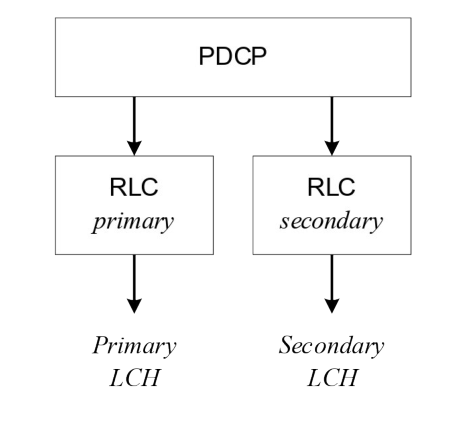
NOTE: PDCP control PDUs are not duplicated and always submitted to the primary RLC entity.
When configuring duplication for a DRB, RRC also sets the state of PDCP duplication (either activated or deactivated) at the time of (re-)configuration. After the configuration, the PDCP duplication state can then be dynamically controlled by means of a MAC control element and in DC, the UE applies the MAC CE commands regardless of their origin (MCG or SCG). When duplication is configured for an SRB the state is always active and cannot be dynamically controlled. When configuring duplication for a DRB with more than one secondary RLC entity, RRC also sets the state of each of them (i.e. either activated or deactivated). Subsequently, a MAC CE can be used to dynamically control whether each of the configured secondary RLC entities for a DRB should be activated or deactivated, i.e. which of the RLC entities shall be used for duplicate transmission. Primary RLC entity cannot be deactivated. When duplication is deactivated for a DRB, all secondary RLC entities associated to this DRB are deactivated. When a secondary RLC entity is deactivated, it is not re-established, the HARQ buffers are not flushed, and the transmitting PDCP entity should indicate to the secondary RLC entity to discard all duplicated PDCP PDUs.
When activating duplication for a DRB, NG-RAN should ensure that at least one serving cell is activated for each logical channel associated with an activated RLC entity of the DRB; and when the deactivation of SCells leaves no serving cells activated for a logical channel of the DRB, NG-RAN should ensure that duplication is also deactivated for the RLC entity associated with the logical channel.
When duplication is activated, the original PDCP PDU and the corresponding duplicate(s) shall not be transmitted on the same carrier. The logical channels of a radio bearer configured with duplication can either belong to the same MAC entity (referred to as CA duplication) or to different ones (referred to as DC duplication). CA duplication can also be configured in either or both of the MAC entities together with DC duplication when duplication over more than two RLC entities is configured for the radio bearer. In CA duplication, logical channel mapping restrictions are used in a MAC entity to ensure that the different logical channels of a radio bearer in the MAC entity are not sent on the same carrier. When CA duplication is configured for an SRB, one of the logical channels associated to the SRB is mapped to SpCell.
When CA duplication is deactivated for a DRB in a MAC entity (i.e. none or only one of RLC entities of the DRB in the MAC entity remains activated), the logical channel mapping restrictions of the logical channels of the DRB are lifted for as long as CA duplication remains deactivated for the DRB in the MAC entity.
When an RLC entity acknowledges the transmission of a PDCP PDU, the PDCP entity shall indicate to the other RLC entity(ies) to discard it. In addition, in case of CA duplication, when an RLC entity restricted to only SCell(s) reaches the maximum number of retransmissions for a PDCP PDU, the UE informs the gNB but does not trigger RLF.