3GPP 38.300 v19.3.0 — the document's own text
15.3.3.5 Inter-system Automatic Neighbour Cell Relation Function
For Inter-system ANR, each cell contains an Inter Frequency Search list. This list contains all frequencies that shall be searched. Figure 15.3.3.5-1 depicts an example where the NG-RAN node serving cell A has an ANR function.
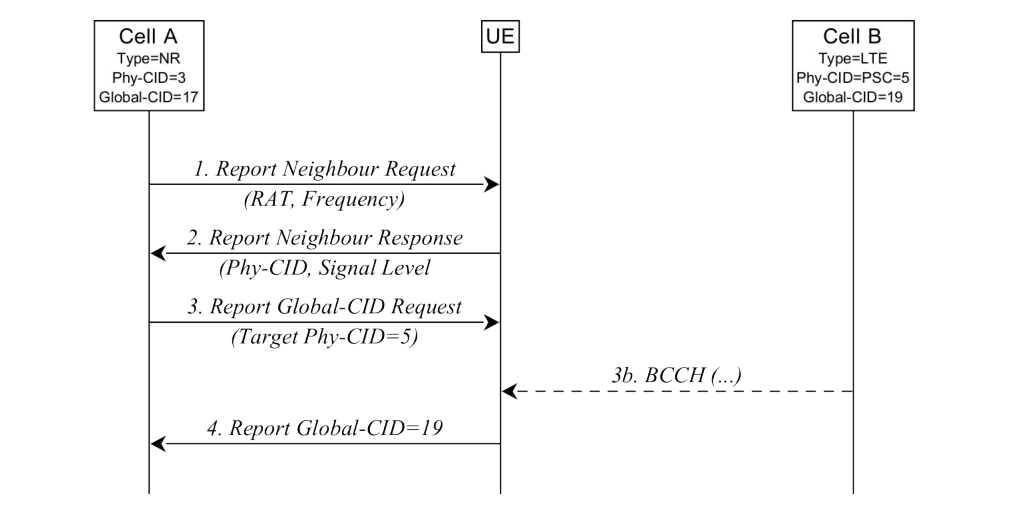
In RRC_CONNECTED, the NG-RAN node instructs a UE to perform measurements and detect E-UTRA cells connected to EPC.:
1 The NG-RAN node instructs a UE to look for neighbour cells in the target system. To do so the NG-RAN node may need to schedule appropriate idle periods to allow the UE to scan all cells in the target system.
2 The UE reports the PCI and carrier frequency of the detected cells in the target system.
NOTE: The NG-RAN node may use different policies for instructing the UE to do measurements, and when to report them to the NG-RAN node.
When the NG-RAN node receives the UE reports containing PCIs of cell(s), the following sequence may be used:
3 The NG-RAN node instructs the UE, using the newly discovered PCI as parameter, to read the ECGI, the TAC and all available PLMN ID(s) of the newly detected cell in case of E-UTRA detected cells. The UE ignores transmissions from the serving cell while finding the requested information transmitted in the broadcast channel of the detected inter-system/inter-frequency neighbour cell. To do so, the NG-RAN node may need to schedule appropriate idle periods to allow the UE to read the requested information from the broadcast channel of the detected inter-system neighbour cell.
4 After the UE has read the requested information in the new cell, it reports the detected ECGI, TAC, and available PLMN ID(s) to the serving cell NG-RAN node.
5 The NG-RAN node updates its inter-system NCRT.