3GPP 23.369 v20.0.0 — the document's own text
6.2.2.1 General Inventory Procedure
Taught in 3. How a tag is actually read, from the request to the answer (Ambient IoT — a tag with no battery, quick start).
Figure 6.2.2.1-1 describes the inventory procedure.
The procedure focuses on the messages and parameters used for the communication between AIOTF and NG-RAN regardless of the path to access NG-RAN, see clause 4.2.2.1. The handling of the different communication paths is described in clause 6.2.4 for RAN Reader, and clause 6.2.10 for UE Reader.
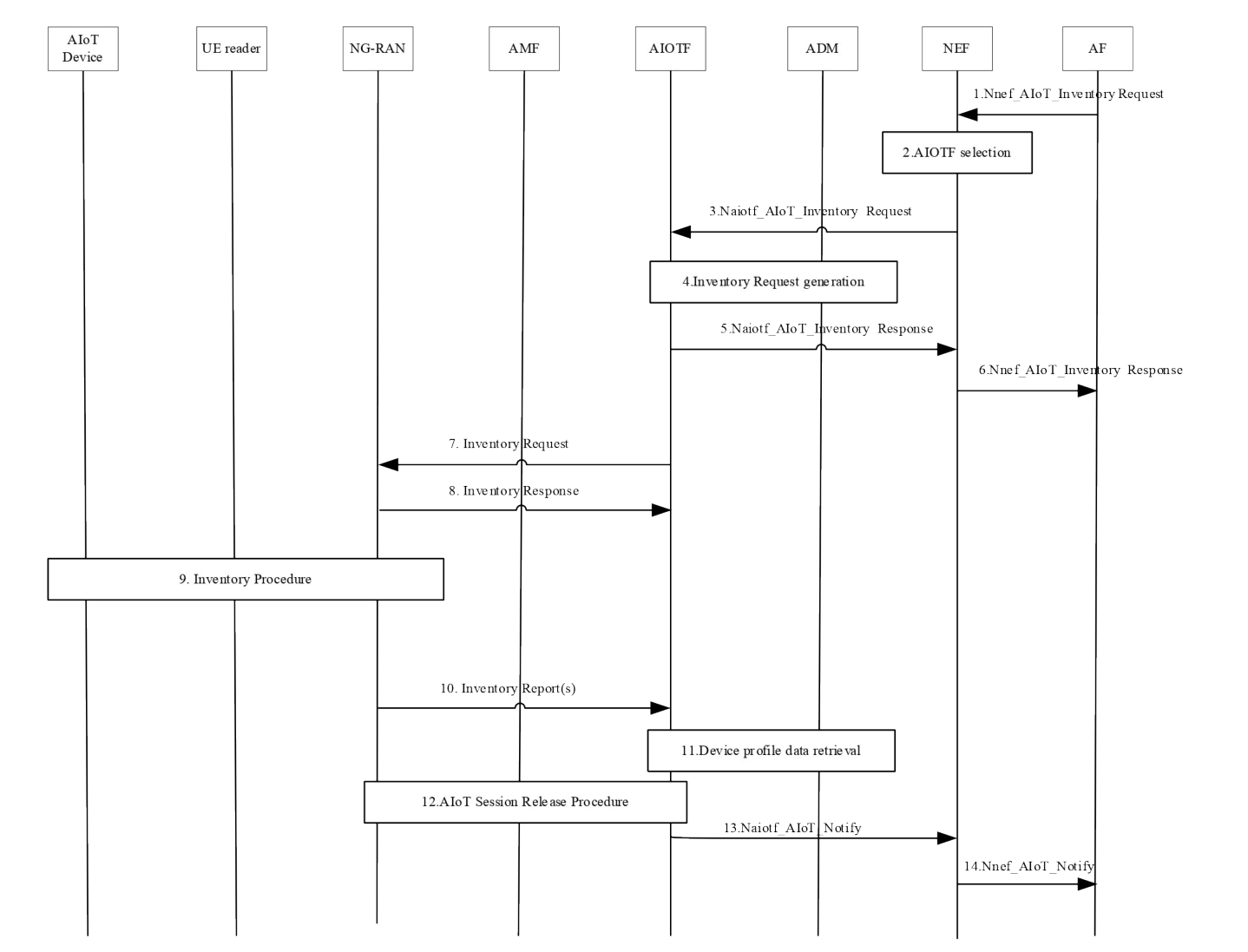
1. The AF invokes Nnef_AIoT_Inventory Request (AF ID, [External Target Area information], [External Identifier (i.e. GPSI)], [information about the target AIoT Device(s)], [Approximate number of AIoT Devices], [time interval], [location information requested]) to the NEF.
Information about the target AIoT Device(s) may include Filtering Information, as described in clause 5.8, or include complete AIoT Device Identifier(s). If Information about the target AIoT Device(s) is not included, the Inventory Request is for all AIoT Devices.
The Approximate number of AIoT Devices, if provided, is used to determine the number of AIoT Devices expected to respond to this inventory AIoT service operation request, which is sent by AIOTF to the NG-RAN in the assistance information for NG-RAN in step 7 for proper radio resource allocation.
The time interval, if provided, is described in clause 5.9.
The location information requested parameter indicates whether the AF expects the network to provide AIoT Device location information.
2. The NEF may further authorize the AF request as specified in clause 5.6.
The NEF determines the Target Area information from the External Target Area information, and selects one or multiple AIOTF(s) to handle the request as specified in clause 5.3.1. If External Identifier is provided, the NEF queries the UDM to get the SUPI, serving AMF of the UE Reader and selects the AIOTF as specified in clause 5.3.1. If no AIOTF can be selected, the NEF rejects the Nnef_AIoT_Inventory request with an appropriate cause code and step 6 is performed before ending the procedure.
3. The NEF invokes the Naiotf_AIoT_Inventory Request (AF ID, [Target Area information], [SUPI], [serving AMF information], [information about the target AIoT Device(s)], [Approximate number of AIoT Devices], [time interval], [location information requested]) towards each of the selected AIOTF(s).
4. The AIOTF receives the Naiotf_AIoT_Inventory request and checks the parameters included in the request. The AIOTF may perform authorization as specified in clause 5.6. If the AIoT service operation request cannot be processed, the AIOTF rejects the AIoT service operation request with an appropriate cause code, and step 7 onwards is skipped.
The AIOTF generates a Correlation ID corresponding to this AIoT service operation request and the Correlation ID is used for the AIOTF to correlate the service operation responses received from NG-RAN to the AIOTF request. The AIOTF creates the AIoT Session for the AF service operation request, which is identified by the Correlation ID.
The AIOTF obtains security parameters from the ADM, as described in TS 33.369 [9].
If the information about the target AIoT Device(s) received in step 1 is AIoT Device Permanent Identifier(s), and privacy protection is used, the AIOTF retrieves the AIoT Device Temporary Identifier and temporary identifier related information for each target AIoT Device from the ADM as described in TS 33.369 [9].
The AIoT Identification Information to be provided to NG-RAN contains either Filtering Information as defined in clause 5.8, an AIoT Device Permanent Identifier as defined in clause 5.7.2 or an AIoT Device Temporary Identifier as defined in clause 5.7.4.
NOTE 1: The structure of AIoT Identification Information is defined in TS 23.003 [6].
If no AIoT Identification Information is provided to NG-RAN, then the NG-RAN inventories all AIoT Devices.
NOTE 2: The concerns of paging all or paging a large group of AIoT Devices are described in TS 33.369 [9].
The AIoT Identification Information and security parameters are provided to NG-RAN in step 7.
The AIOTF performs RAN Reader Selection (see clause 5.3.3), or UE Reader Selection (see clause 5.3.3a), or both, based on the local configuration and deployment. If no NG-RAN, RAN Reader(s) or UE Reader(s) can be selected, the AIOTF or NG-RAN rejects the AIoT service operation request with an appropriate cause code.
Editor's note: The procedure to cover the rejection by NG-RAN regarding the UE Reader selection is FFS.
The AIOTF determines assistance information as described in clause 5.4, taking into account the parameters provided in the AIoT service operation request.
The AIOTF may perform AMF selection as described in clause 5.3.4.
5. AIOTF sends a Naiotf_AIoT_Inventory Response to the NEF containing the accept or reject result for the AIoT service operation request based on step 4.
6. NEF sends a Nnef_AIoT_Inventory Response to the AF, containing the accept or reject result for the AIoT service operation request, as specified in clause 8.3.
7. The AIOTF sends the Inventory Request message including AIoT Identification Information and security parameters determined in step 4 to be included in the paging message, Correlation ID, Requested Service Area Information and assistance information to the selected NG-RAN node(s) as specified in TS 38.413 [10].
8. The NG-RAN sends an Inventory Response to the AIOTF with the Correlation ID indicating that the Inventory Request is received successfully and it will perform the AIoT service operation as specified in TS 38.413 [10]. If the Inventory Request is not rejected, then an AIoT Session is created in the NG-RAN. After this step, the AIoT Session between the NG-RAN and AIOTF, identified by Correlation ID, is established.
9. Upon reception of the Inventory Request message from the AIOTF, the RAN Reader(s) or UE Reader(s) execute the inventory operation as specified in TS 38.300 [5] and TS 38.391 [11]. The RAN Reader(s) or UE Reader(s) broadcast the paging message that includes the AIoT Identification Information and the security parameters.
If the received AIoT Identification Information contains:
- Filtering Information, the AIoT Device determines whether it matches the AIoT Identification Information, as described in clause 5.8.
- AIoT Device Temporary Identifier, the AIoT Device determines whether it matches the AIoT Identification Information, as described TS 33.369 [9].
- AIoT Device Permanent Identifier, the AIoT Device determines whether it matches the AIoT Identification Information by comparing it with the stored AIoT Device Permanent Identifier.
If an AIoT Device matches the AIoT Identification Information in the paging message, the AIoT Device responds to the paging message and sends an AIoT NAS Inventory Report that includes its device specific authentication information as specified in TS 33.369 [9] and optionally the AIoT Device Permanent Identifier if privacy protection is not used.
Editor's note: For the case that AF providing UE reader(s), how to ensure the specific UE reader(s) are used in the inventory procedure is FFS.
10. NG-RAN sends one or more Inventory Report messages to the AIOTF including the Correlation ID, Reader ID and the AIoT NAS Inventory Report(s) from the AIoT Device(s) as specified in TS 38.413 [10]. The NG-RAN may aggregate multiple Inventory Report messages based on the assistance information before reporting the response to the AIOTF as described in clause 5.9. The AIOTF stores the mapping between the Reader ID and AIoT Device ID(s) as part of the AIoT Device context.
When the NG-RAN detects that no more AIoT Devices will respond to the inventory procedure, the NG-RAN informs the AIOTF by including the Inventory Complete Indication in the last Inventory Report message.
11. The AIOTF authenticates the AIoT Device and obtains the AIoT Device Permanent Identifier as specified in TS 33.369 [9]. The AIOTF may aggregate the results.
12. If the NG-RAN has sent an inventory complete indication in step 10, the AIOTF triggers the AIoT Session Release procedure defined in clause 6.2.5 to release the AIoT Session between the NG-RAN and the AIOTF.
13. The AIOTF reports the progress of the Naiotf_AIoT_Inventory request to the NEF by sending the Naiotf_AIoT_Notify message including a list of AIoT Device Permanent Identifier(s) and optionally location of each AIoT Device. The AIOTF may send multiple reports.
Based on operator policy, if the location information is requested by the AF and if the location of the RAN Reader is configured, the AIOTF uses the Reader ID reported from NG-RAN in step 10 to determine the AIoT Device location.
The AIOTF in the final Naiotf_AIoT_Notify message indicates it is the last report for this operation. The final Naiotf_AIoT_Notify message with the Last Report Indication is sent when all the involved NG-RAN nodes have completed the inventory procedure. When the last report is sent, the AIOTF ends the AIoT Session. If multiple AIOTFs are involved in the procedure, the NEF may receive Naiotf_AIoT_Notify messages from multiple AIOTFs.
14. When receiving the Naiotf_AIoT_Notify message from an AIOTF, the NEF informs the AF of the outcome of the Nnef_AIoT_Inventory request by sending the Nnef_AIoT_Notify message(s) including the AIoT Device Permanent Identifier(s) and optionally the location of each AIoT Device. The NEF in the final Nnef_AIoT_Notify message indicates that it is the last report for this operation.